
OIL Then and Now
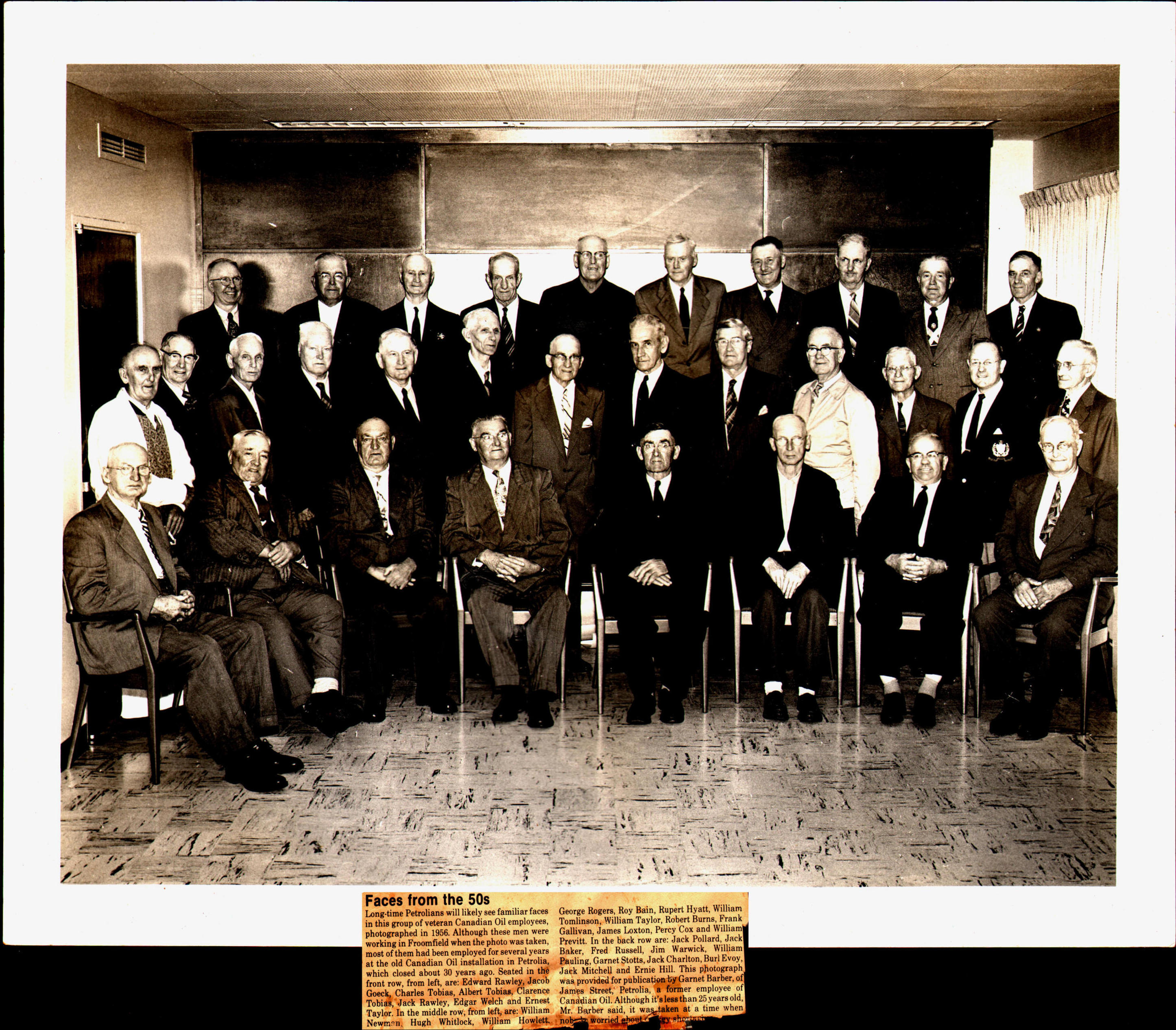
A group of Canadian Oil retirees.
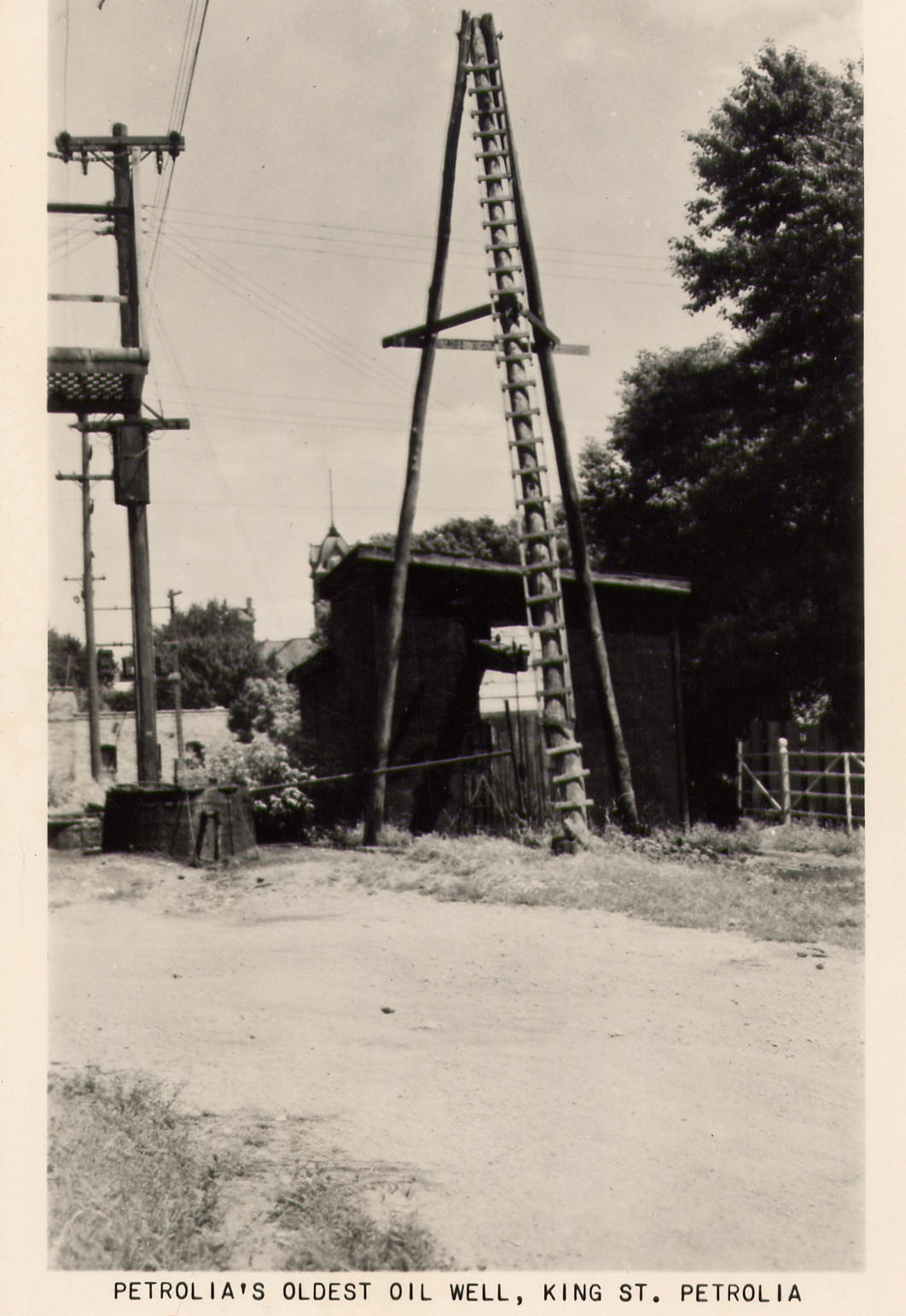
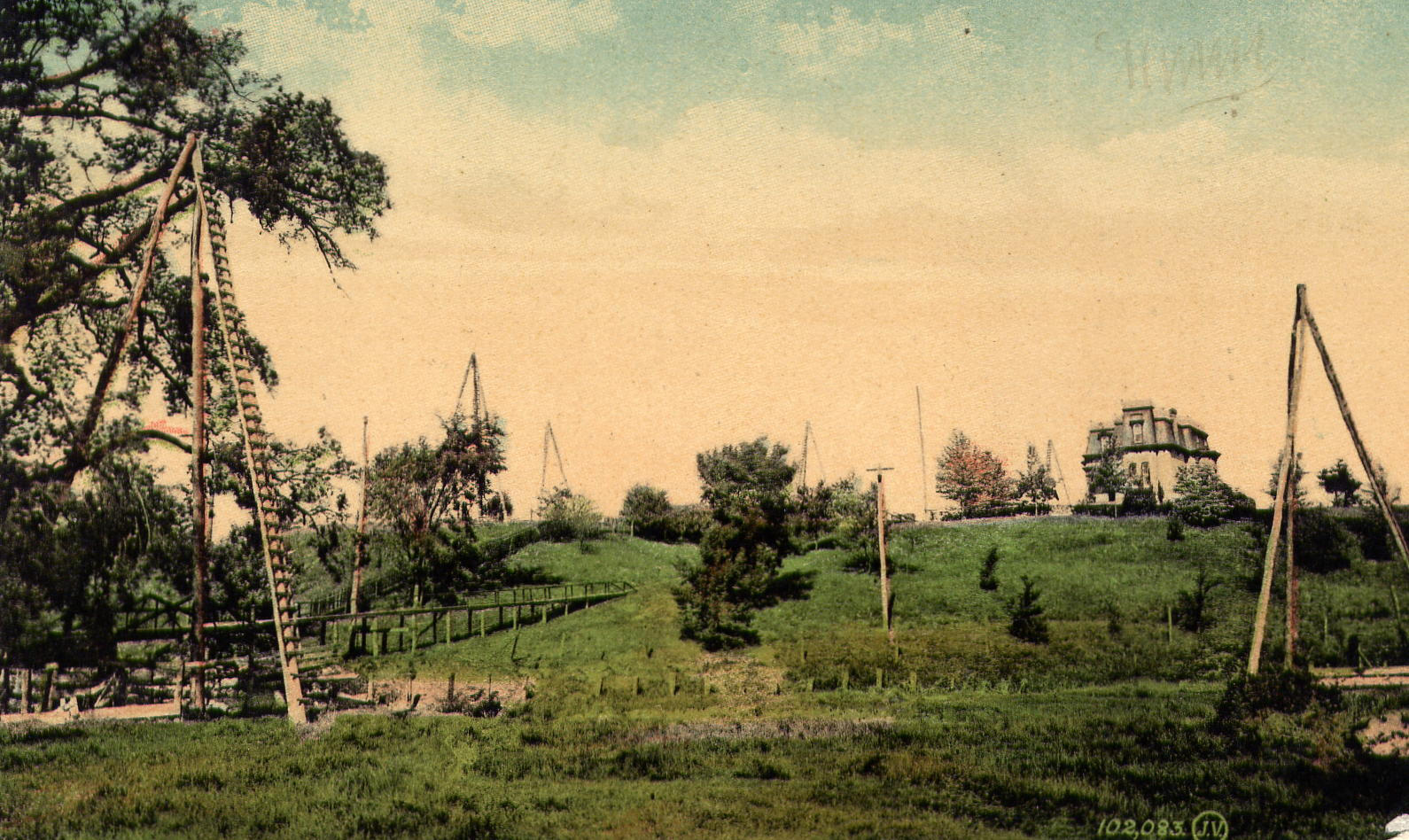
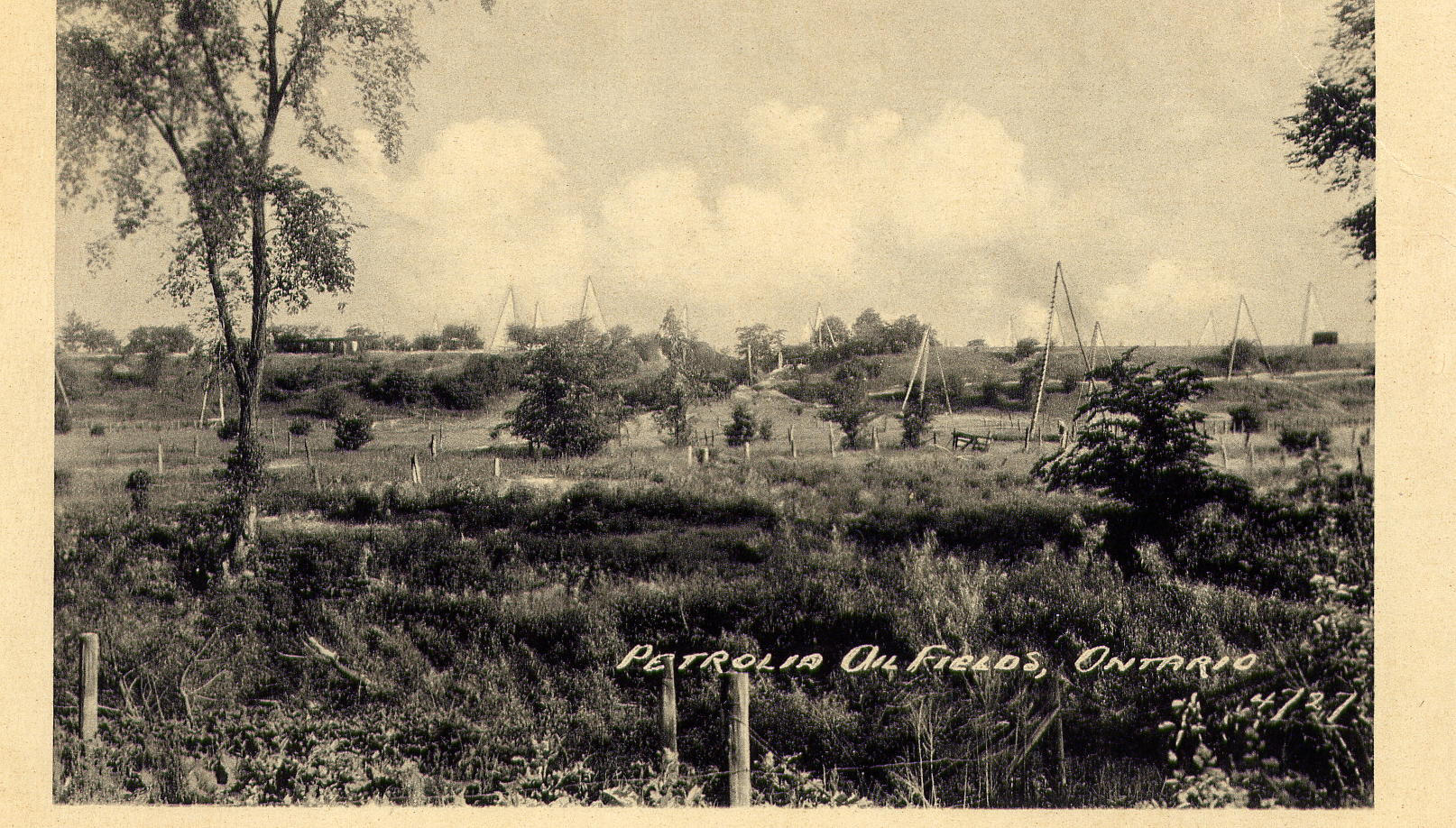
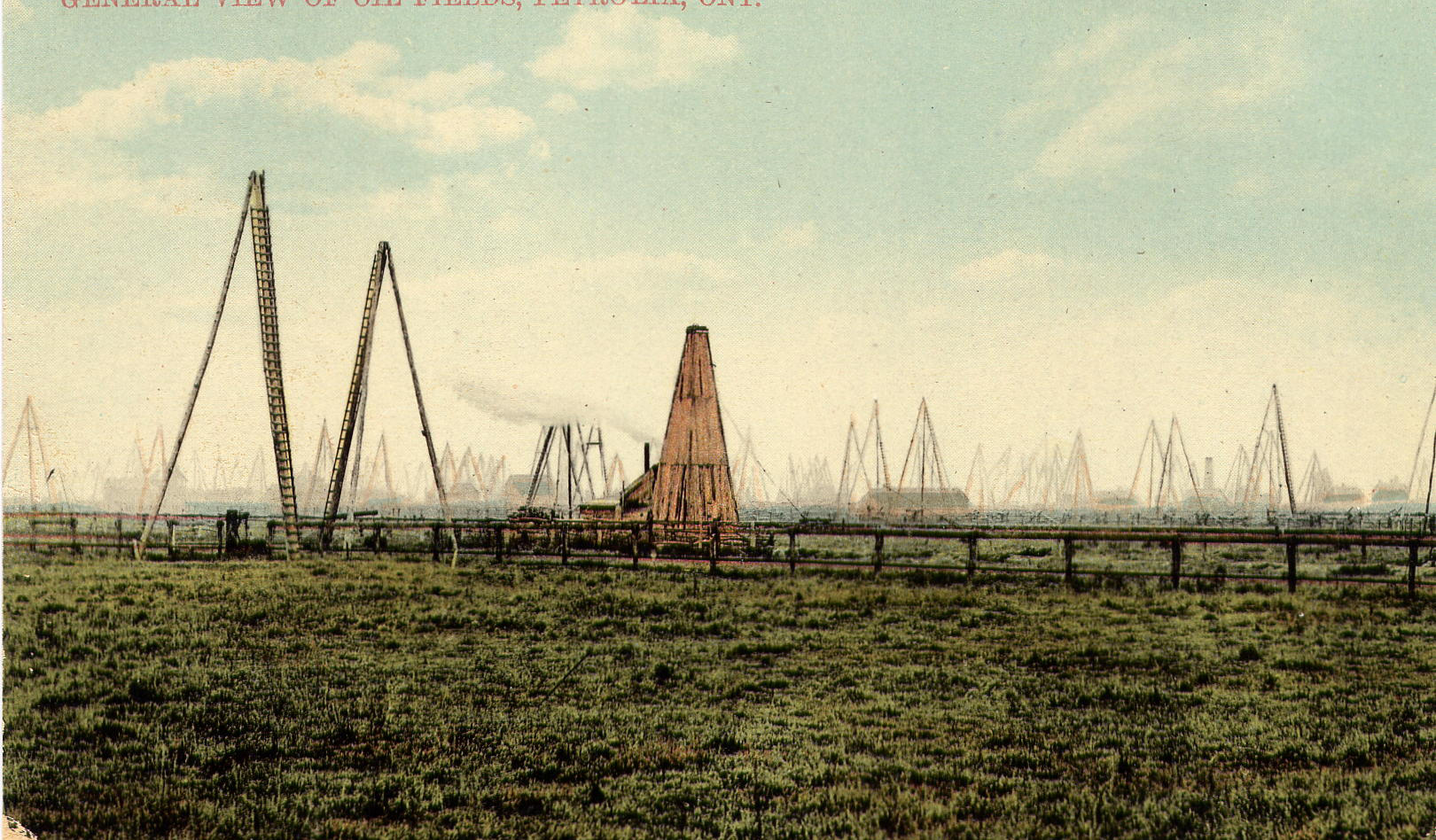
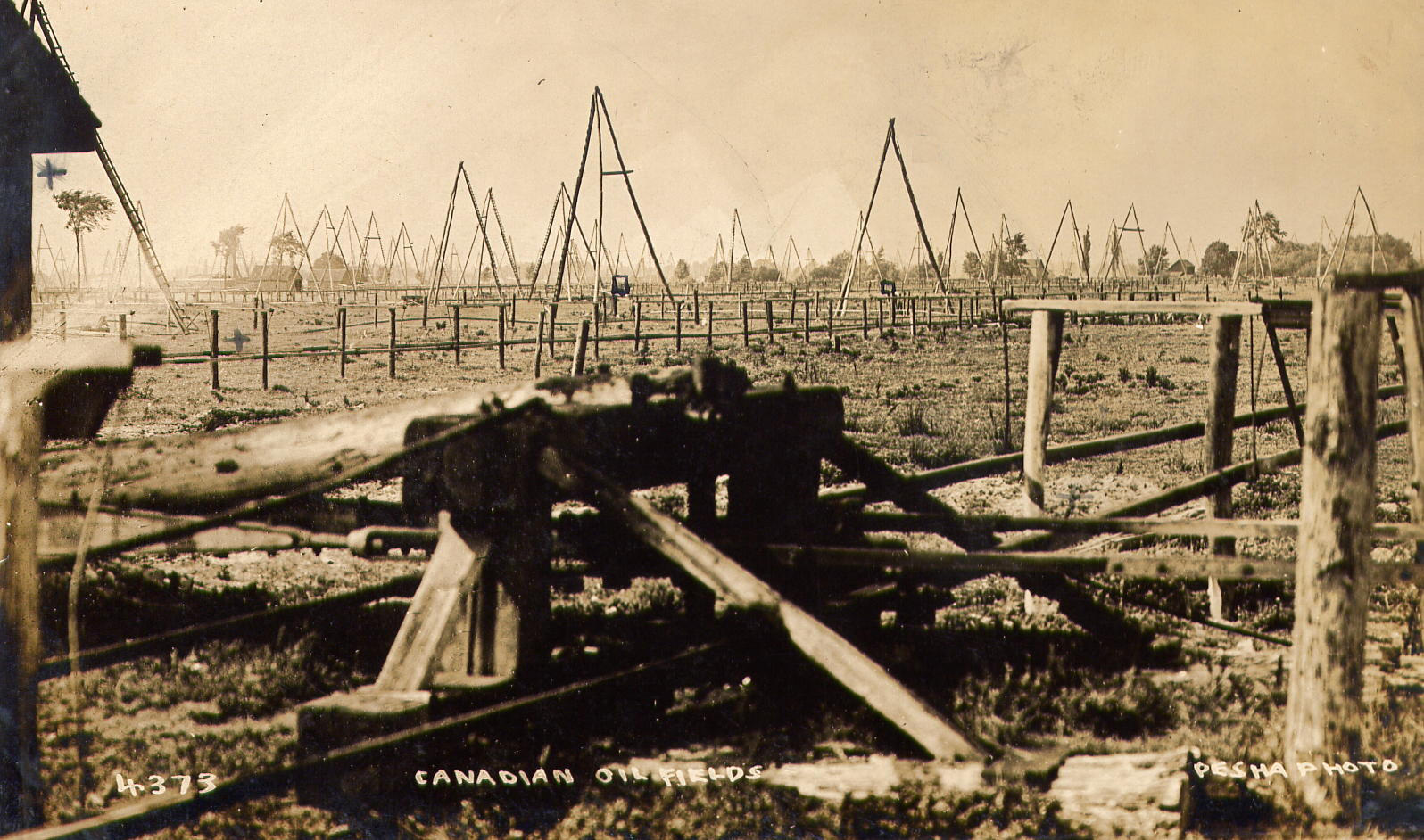
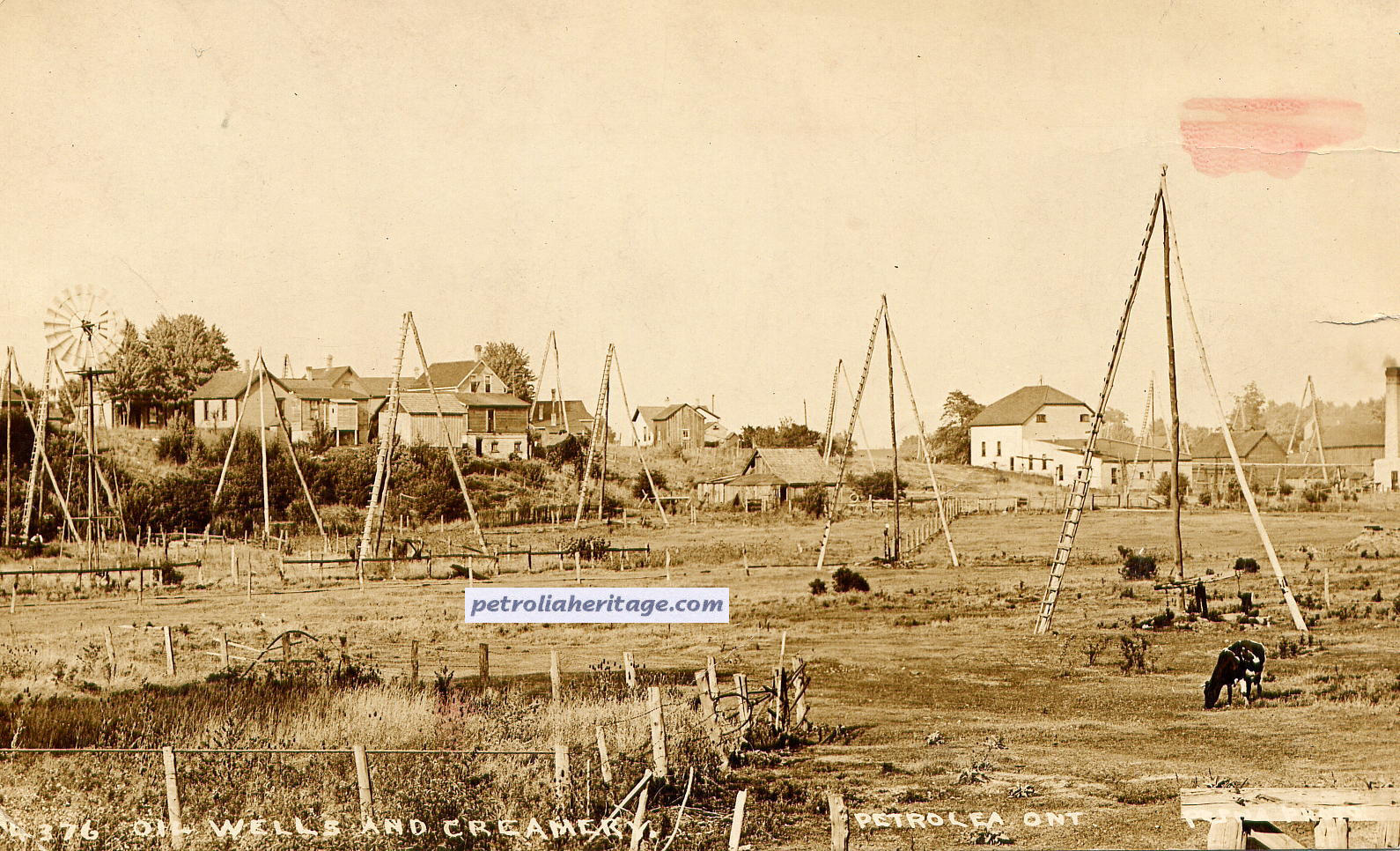
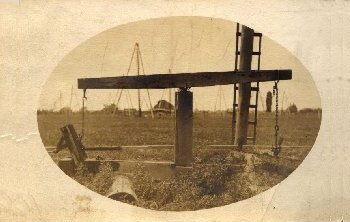 One of Petrolia's Old Pump Jacks,one of many in an oil field run from a central drive building via the Jerker Line system . |
 |
 Bradshaw collection |
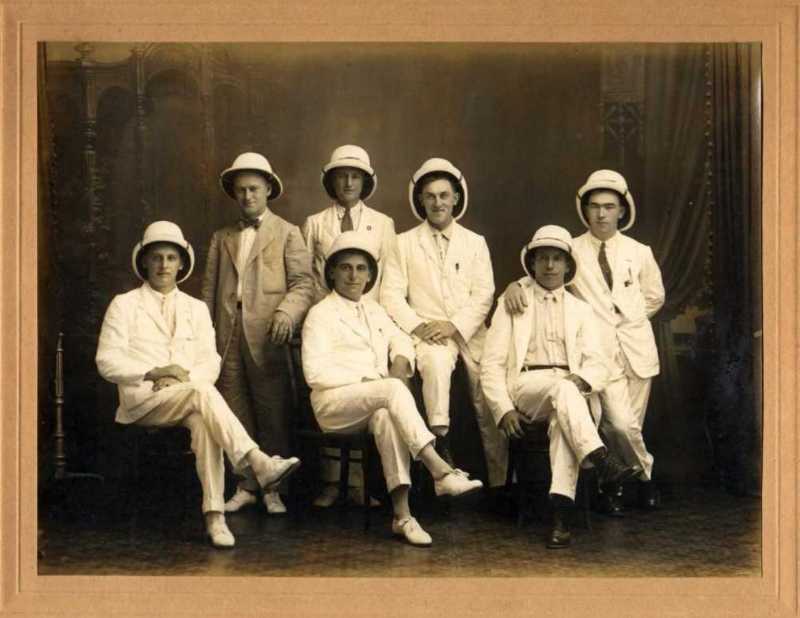
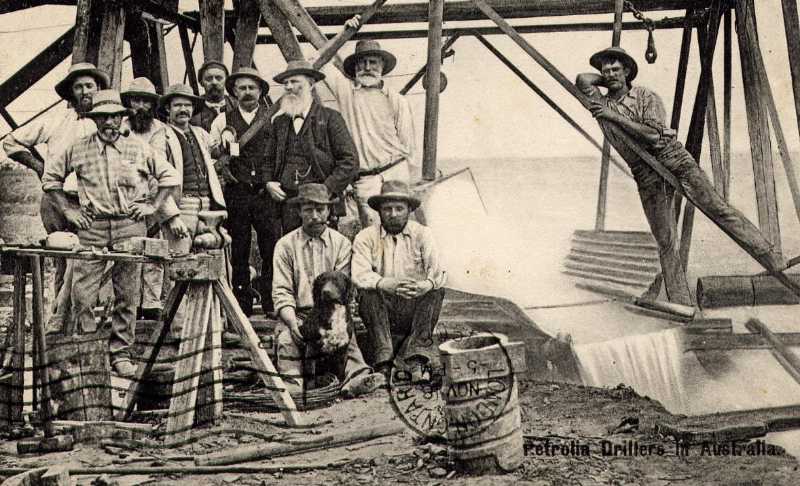
Some of the men on the left, that went out into the far reaches of the world armed with the technology that was formed in the Oil Springs and Petrolia Ontario Oil Fields.After the oil boom in this area was dried up, the oil Industry was just starting up in other parts of the world. These original Hard Oilers went out to acquire and build new fortunes in Arabia, Persia and Mesopotamia, Australia, Burma,Assam and Punjab India, Sarawak British Borneo, Italy, Egypt, Sumatra,Borneo,Taracken,New Caledonia,Sagelin Island {Siberia}, Madagascar,South Africa,West Africa,Algiers, Crete, Jerusalem, Spain, England, Ireland, Galatia, Romania, Russia, Germany, Poland, Bavaria, Alsace-Loraine, New Zealand, British New Guinea,Celebes Island, Ceram Island, Java, Sumatra, Venezuela, Columbia, Equador, Argentina,Peru, Brazil, West Indies, Tarakan, Barbados, Newfoundland, and all other oil rich parts of the world. This early shot on the right shows a group of hard working Petrolia lads plying their trade in Australia
* Editors Note...........In view of the conflict in Iraq, the question has been posed" Is Petrolia responsible for the conflict In Iraq?"It was drillers from Petrolia that discovered and developed the oil fields of Iraq. If the oil was not there would the USA be involved in the region?Some would say if it was not Hard Oilers that discovered the oil later on others would have. I am sure that the oil fields of the Petrolia region stand ready to fill in for any inadequacies in the world oil supplies.
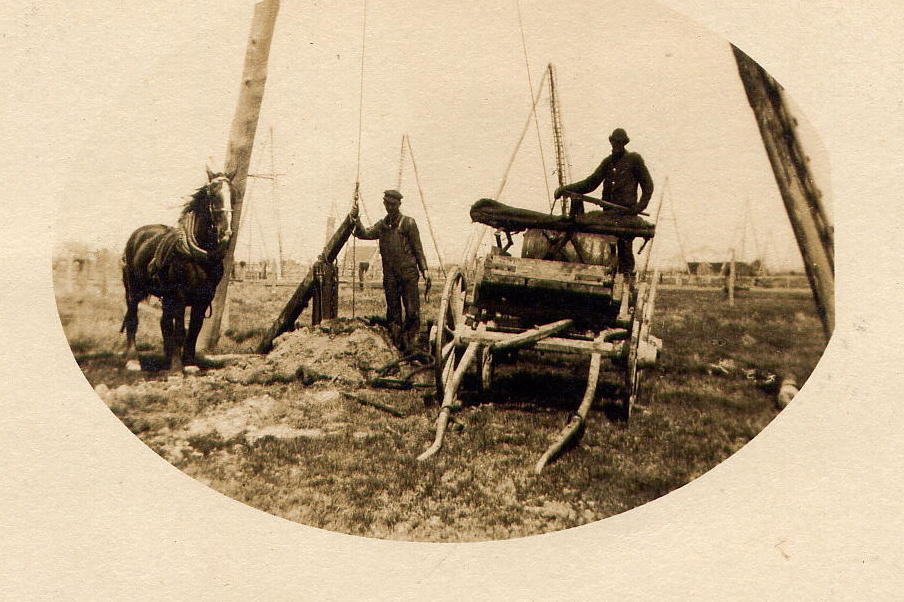
An early
shot of two oilmen with a spool wagon getting ready to" pull
rods". Each rod was about 15 or 20 feet long. Each was attached
vertically all the way down to
the bit. The rods were pulled by the horse pictured and each one
disconnected and layed out on
stands until the last rod with the bit was pulled out and the bit
was inspected and replaced
or
ok-ed. The whole system was replaced and oil
extraction was continued from hundreds of feet
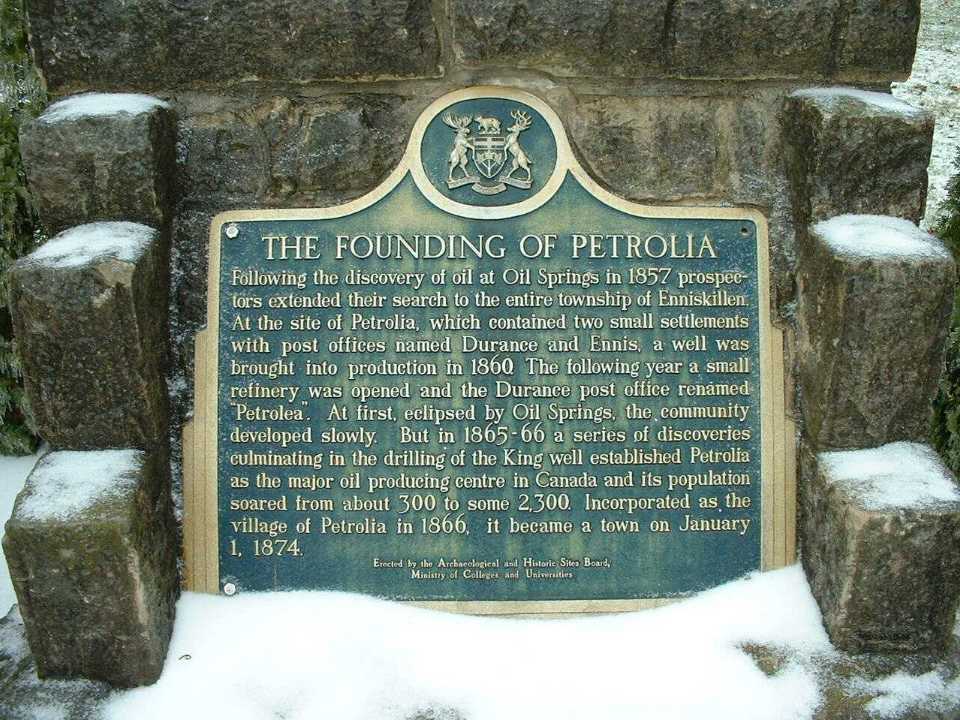
down. On the right is a plaque at Victoria
Park Oil Shrine.
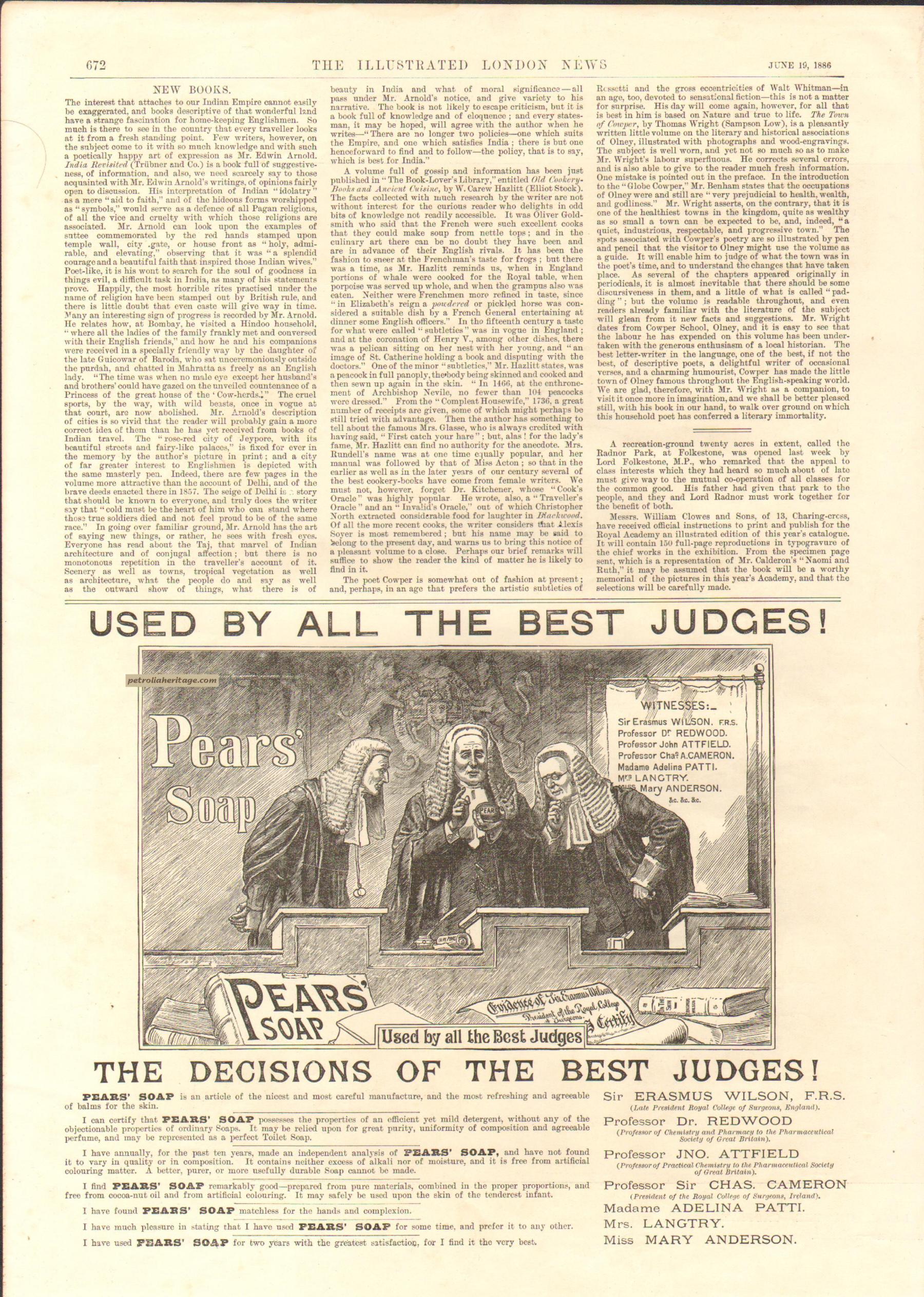
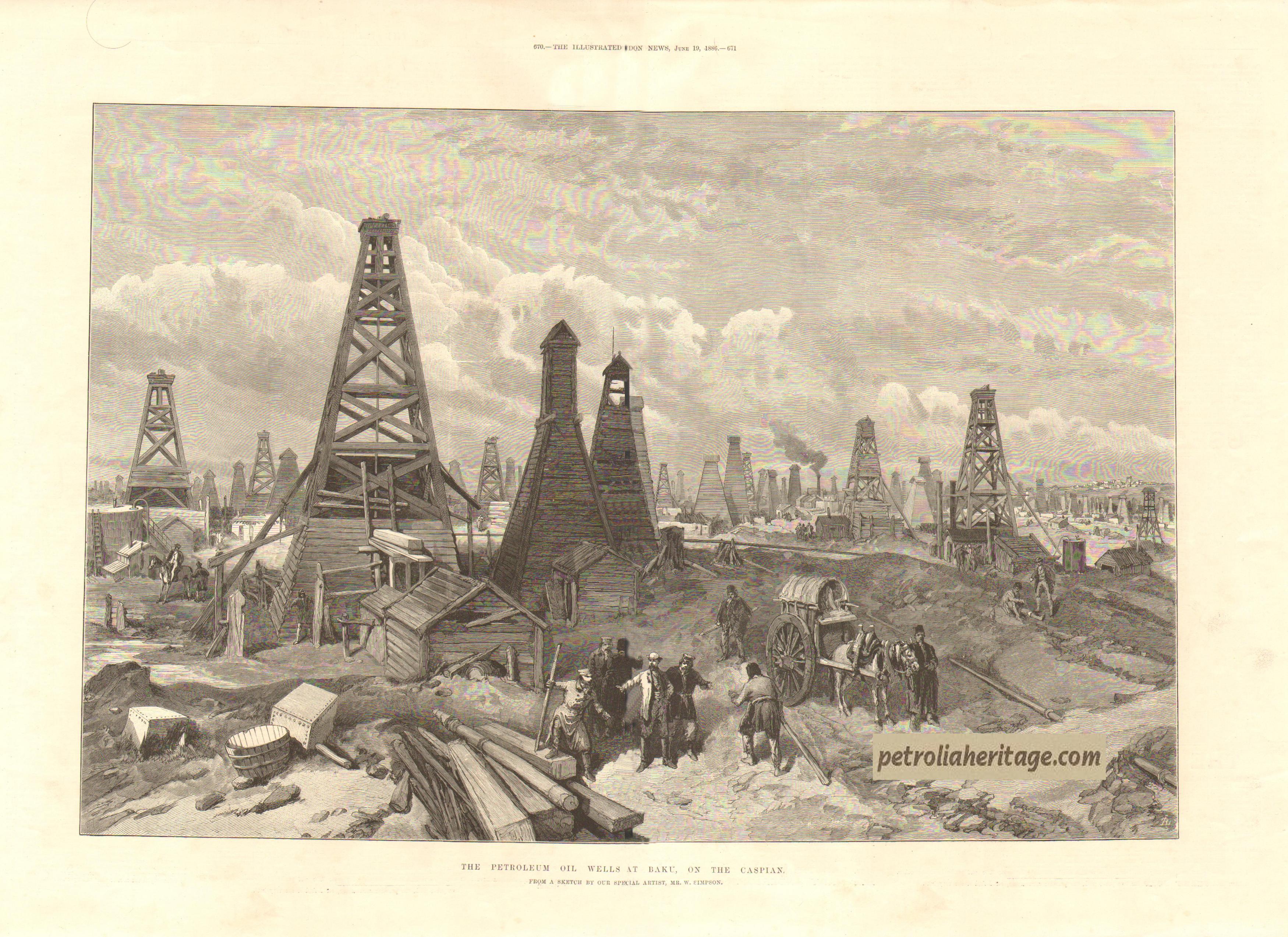 editors collection Just bought this picture from a UK Auction House. One of the many locations that drillers from Petrolia went was Baku on the Caspion Sea. This shows an active and developing Oil Field in Baku ca. 1886.Also as a added bonus I have included the two back pages of this picture. Thanx to David Hext for stitching this scan together as this picture is newspaper size |
 |
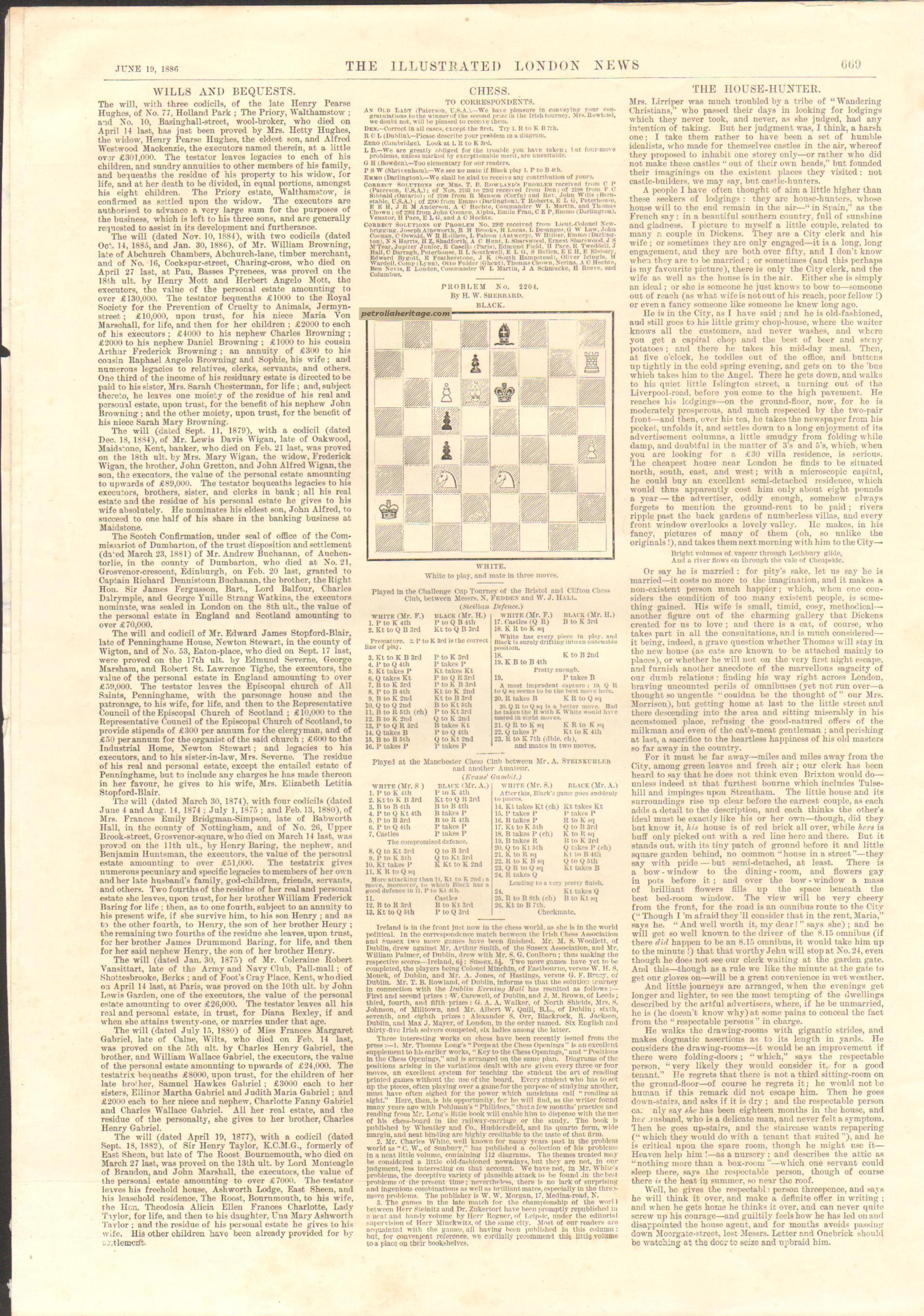 |
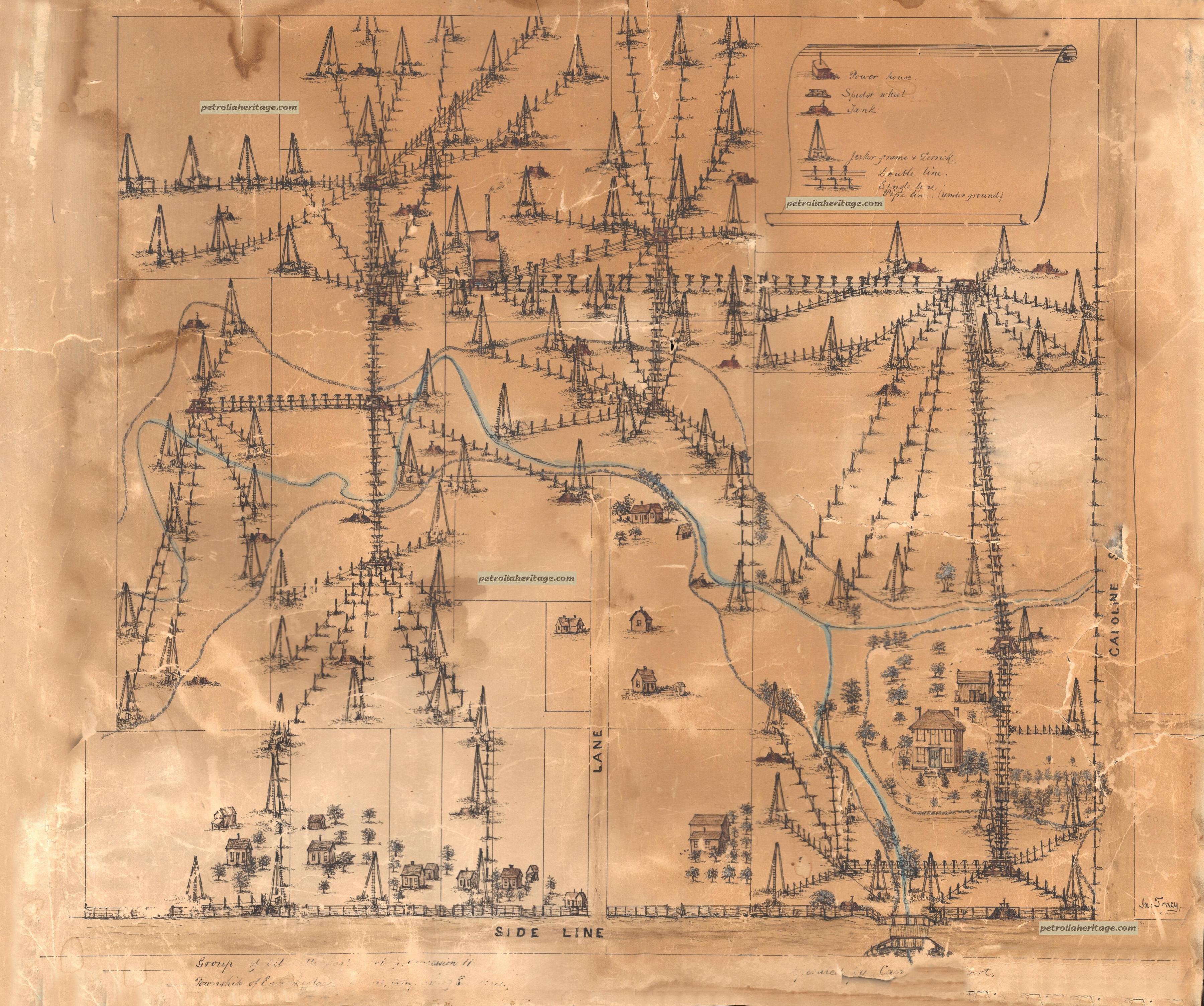 Interesting map showing the Oil Field details at the Marthaville road and Caroline street area. Probably ca.1860s to ca.1870s. Jerker lines and well details and buildings.This area is about one Kilometer west of Petrolia. |
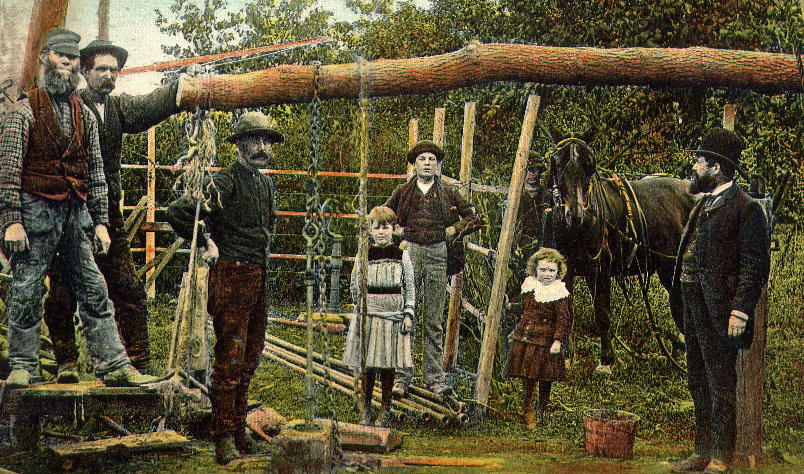 editor's collection J ames Love,John Adams,William Stokes,Heilena Kerr,William Allenby,George Browning,K.C. Kerr,John Kerr An oil baron with his children and workers proudly posing in front of one of his wells. This pic displays the Spring Pole method |
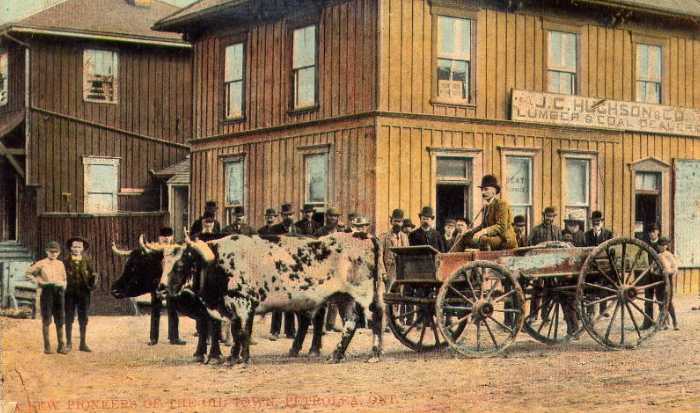 editor's collection A group of eager Petrolia pioneers with high hopes of striking it rich by extracting black gold from the hard clay of Petrolia |
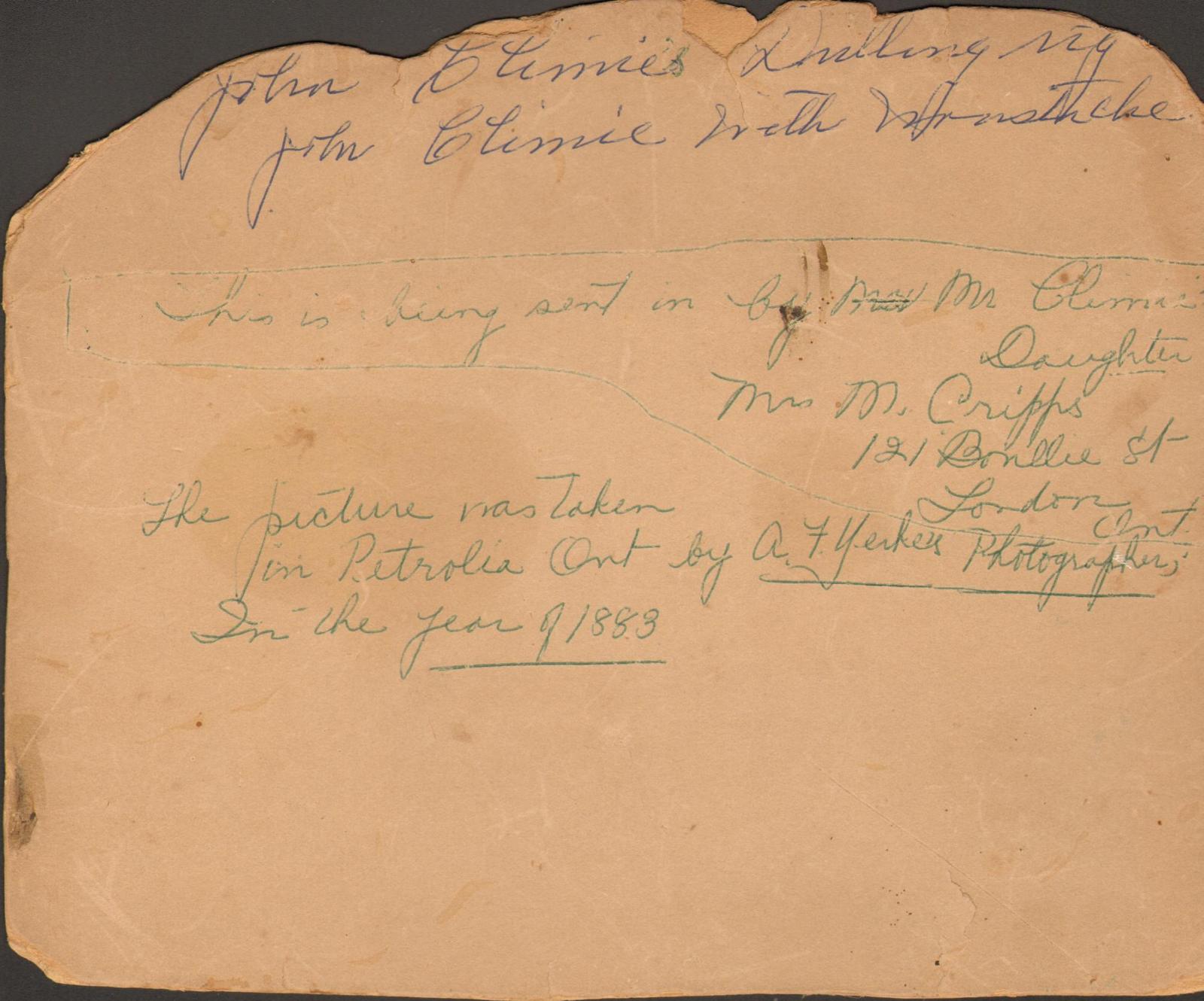
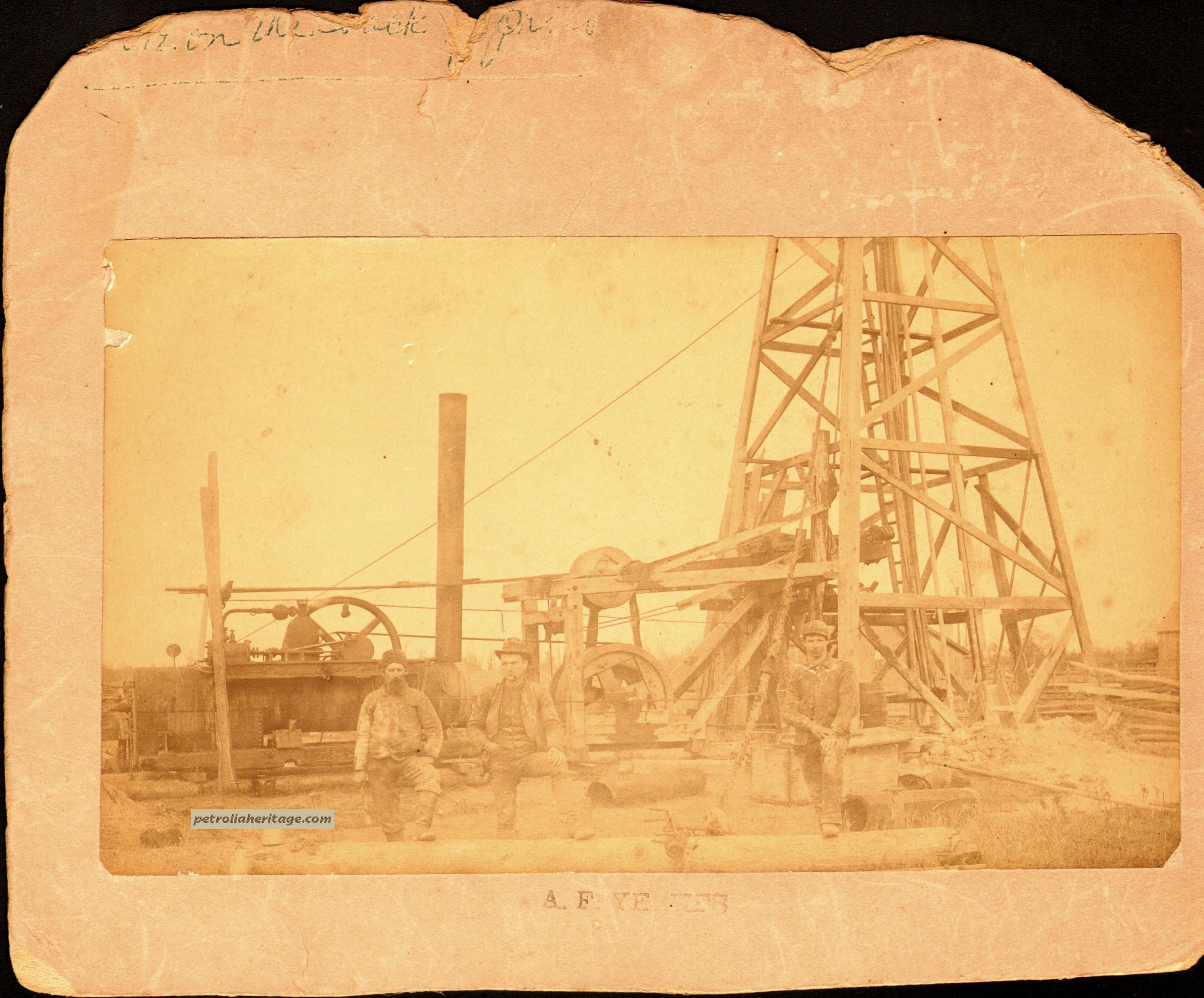 This is a photo that was garnered during one of the scanning days during Heritage week at Victortia Hall.The photo to the right is the reverse and reads, John Climies Drilling Rig, Picture taken in Petrolia Ontario by A.F. Yerkes Photographer in the year 1883.If I have made a mistake interpretting the hand writing please let me know. |
 |
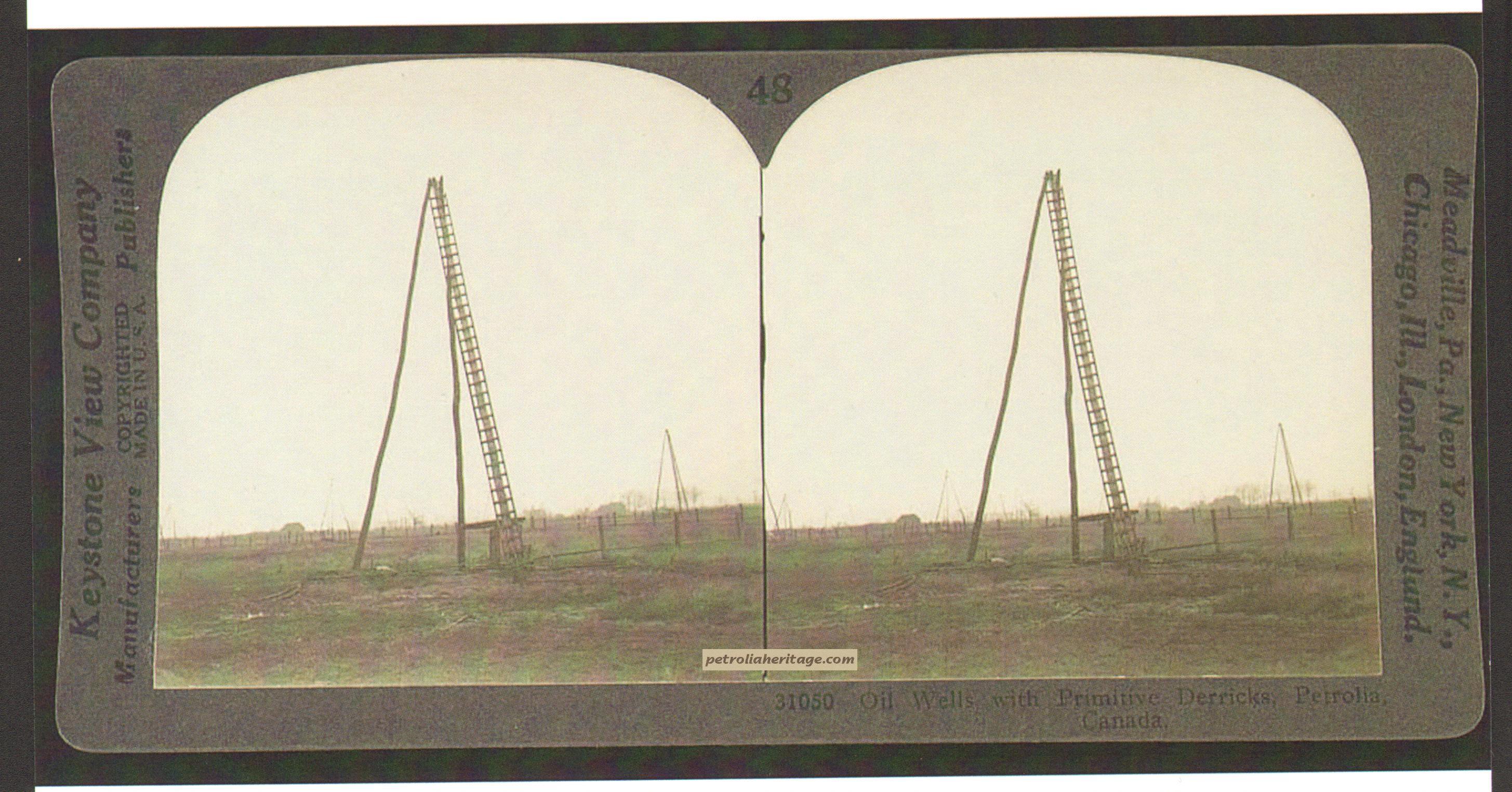
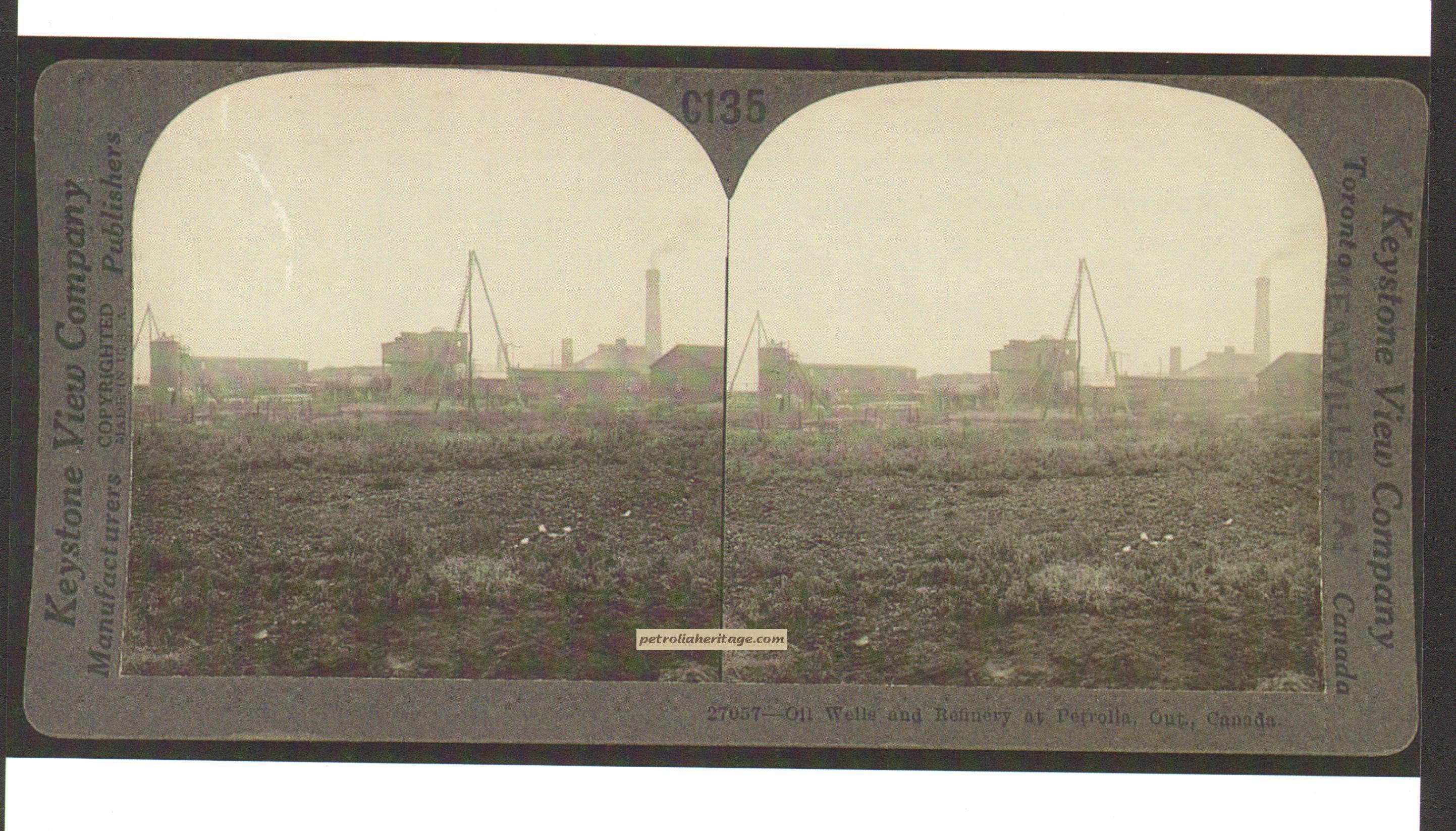 Just picked these Stereoview slides (June 10 2023) Note the Cities mentioned. Petrolia did get around then. These 2 slides are probably ca.1880s and part of a series of Petrolia slides. |
 |
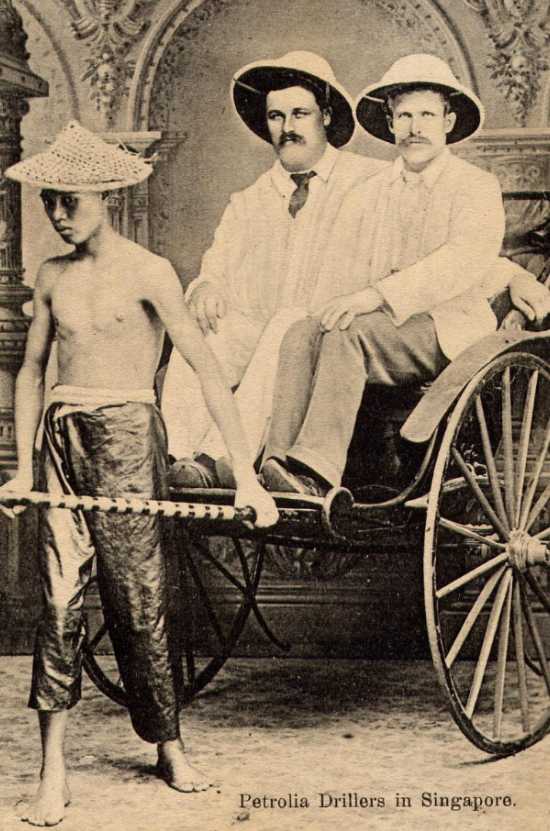
editor's collection In this interesting pic we see two foreign Oil Drillers in a rickshaw and I don't know if this puller is completely ok with these two large men.This scene is ca.1900 in Singapore. |
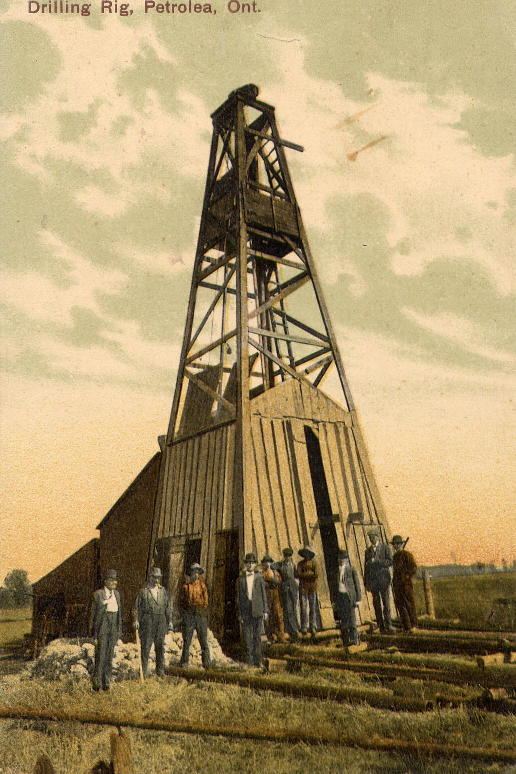 Bradshaw collection This is a pic showing a group of oil men with a drilling rig shack which was pulled by horse team to the spot and moved into position by rolling on the logs that are shown . The men could work out of the weather and cold and when the drilling was complete the rig was moved to the next spot where drilling was to start. A working pump jack was left continuing to extract the black gold from deep down in the earth. |
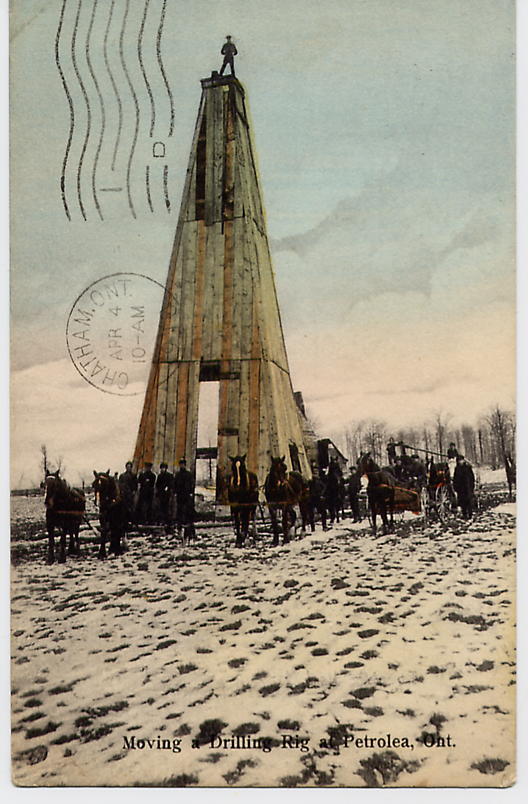 Bradshaw collection A team of horses pulls the rig shack to the next spot on skids. |
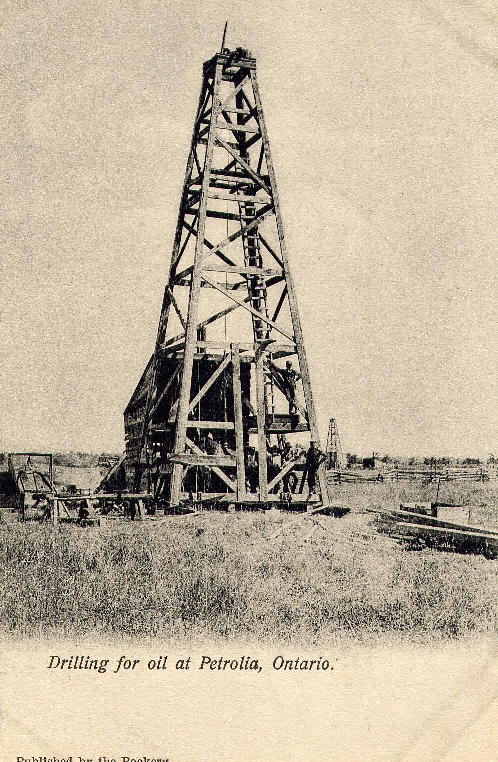 editor's collection |
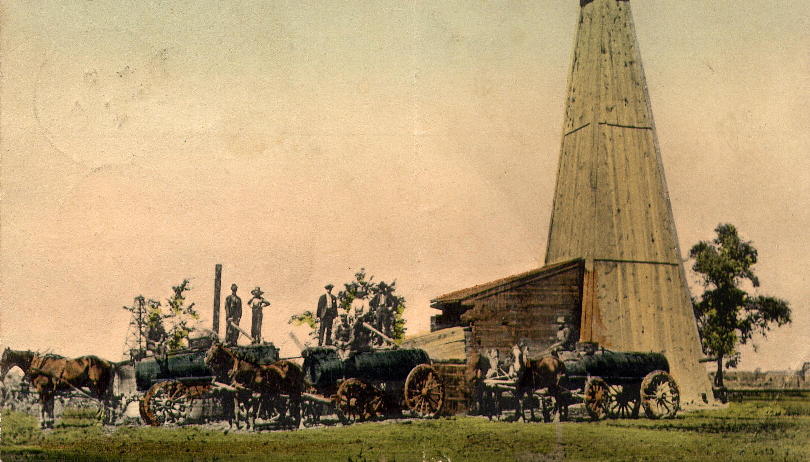 Bradshaw collection |
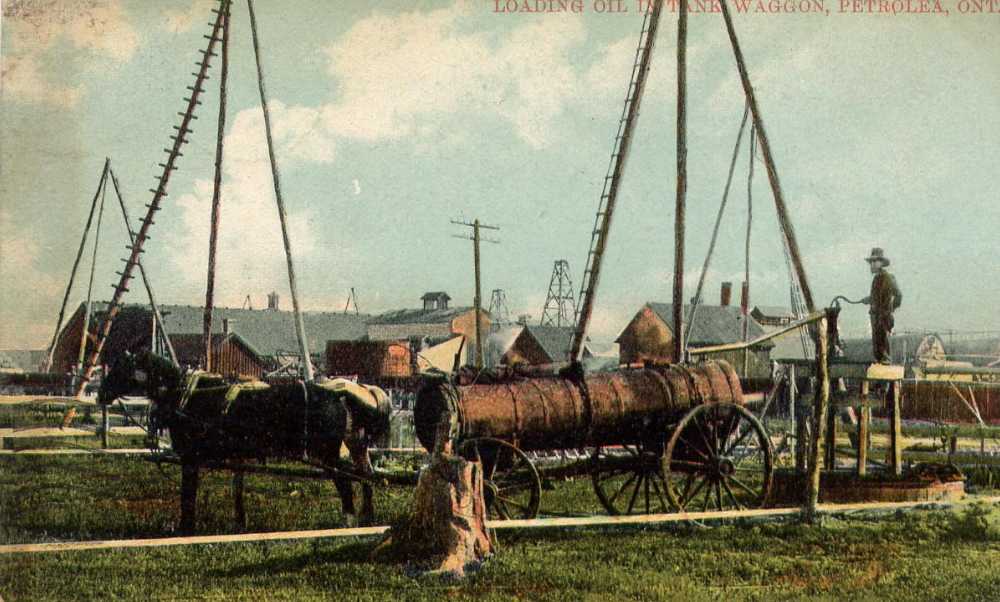 Bradshaw collection This is the bottom line. This man is pumping the black gold into a horse drawn tanker destined for refining. |
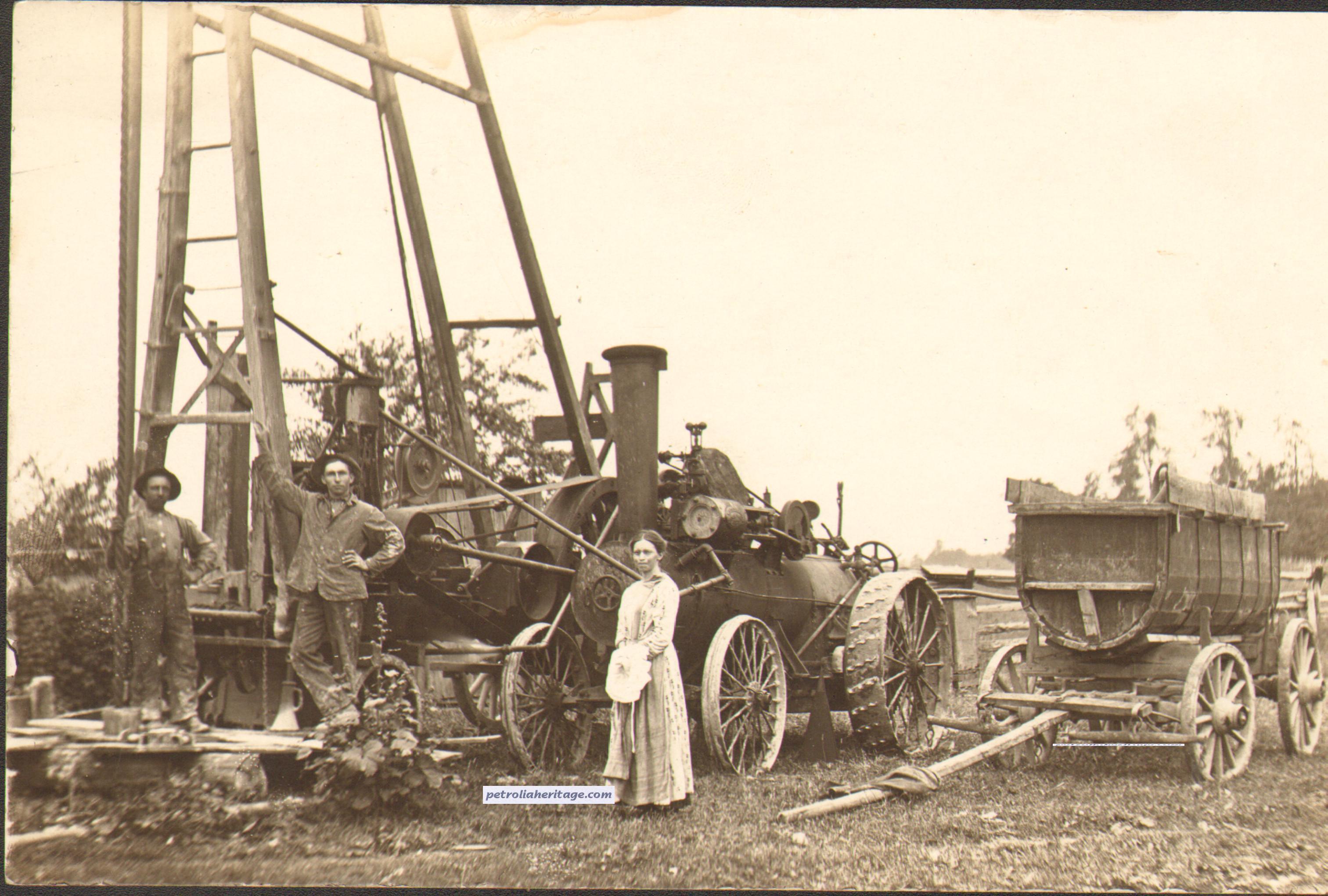 editor's collection I picked this card up recently and it shows a steam driven drilling rig probably ca.1910s. In with a group of Petrolia pics but not positively identified as Petrolia scene. Hopefully I can verify it as Petrolia soon. |
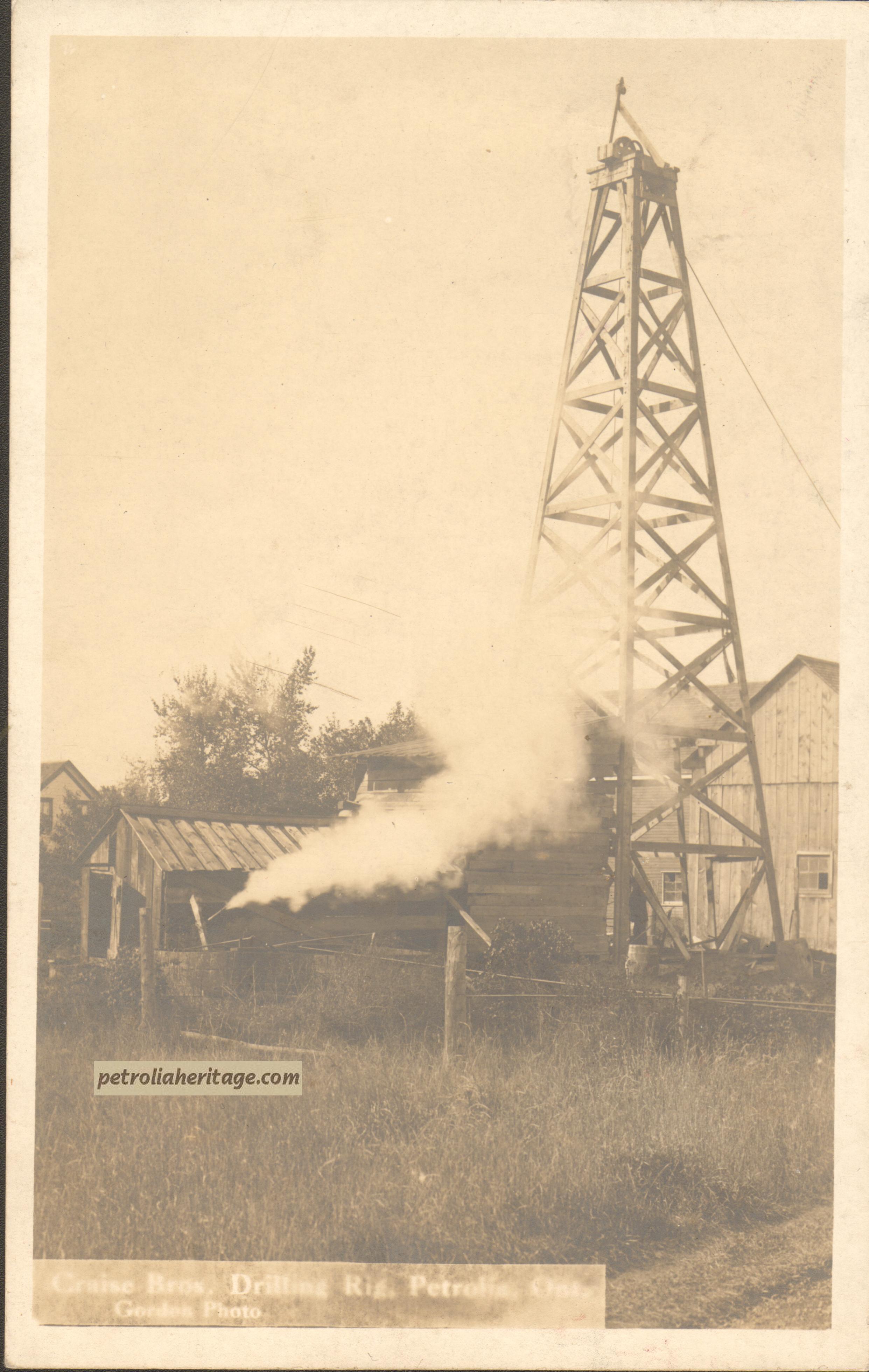 ca.1903 Quad Drilling rig. Caption says Craise Brothers Drilling Rig Petrolia Ont. Gordon Photo |
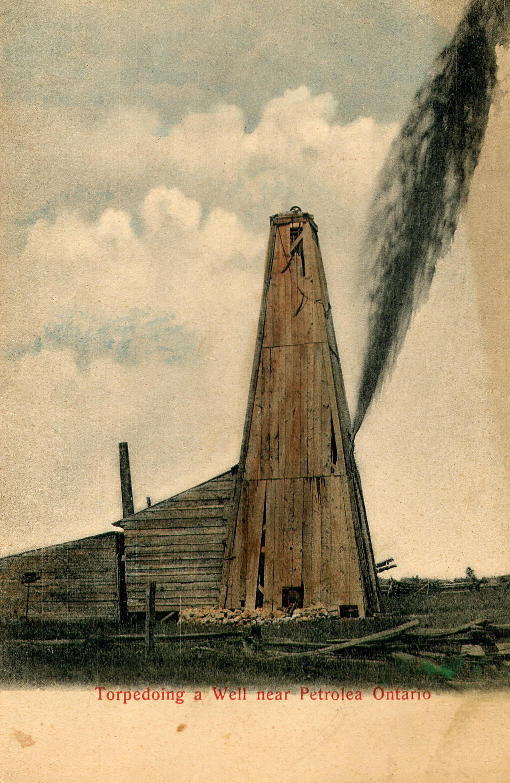
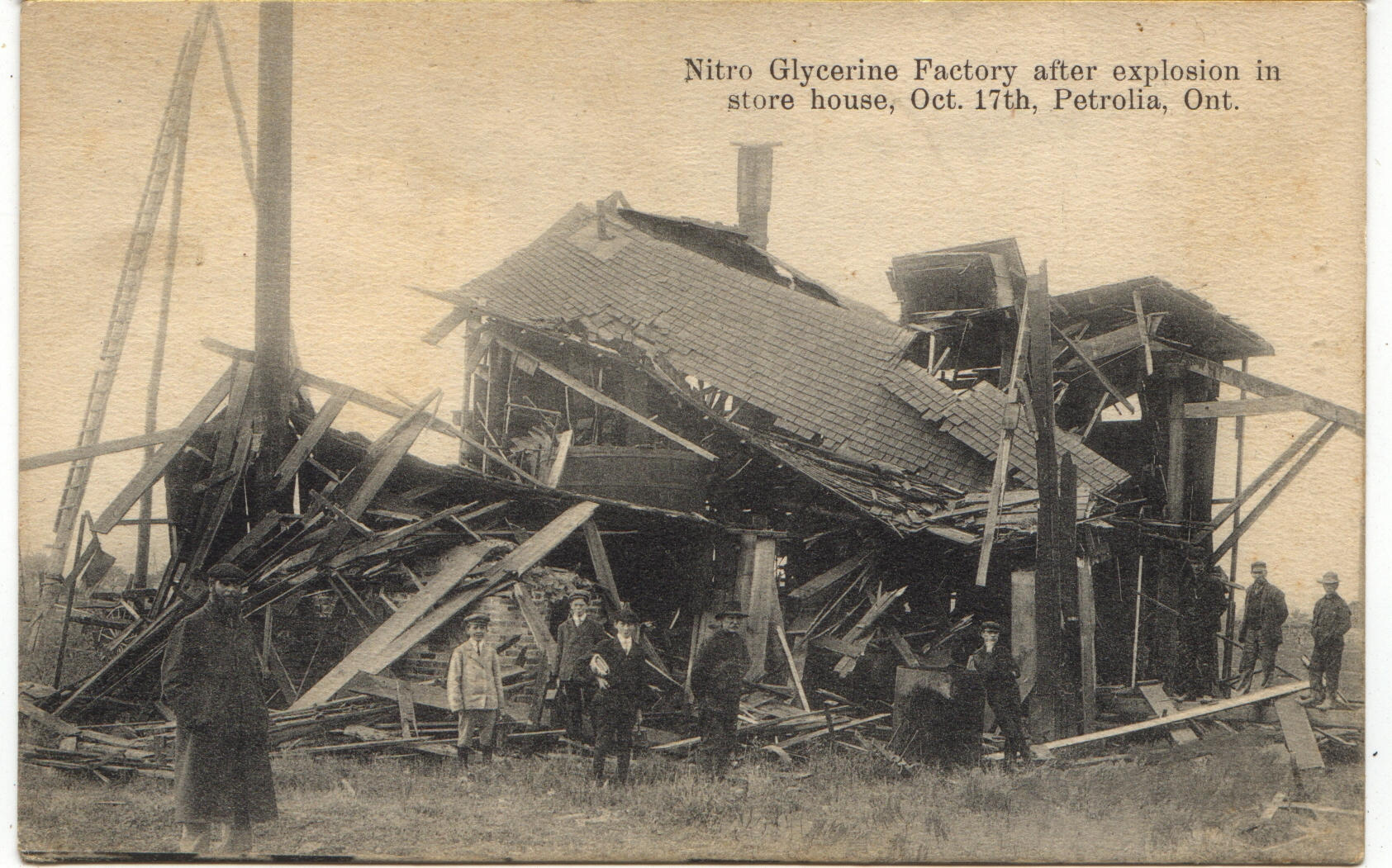 editor's collection left to right....Muxlow, George Whitaker, Mr Whitaker, 2 unknown boys, Tom Braybrook, Pete. Churchhill, Tom Deacon. Once the drilling was started Nitroglycerin was dropped in cylinders {torpedoes} down the hole to help entice the oil from the ground by creating a pooling area from where the oil could be pumped;. however, the nitro was very dangerous and many scenes like this occurred while handling this explosive chemical. |
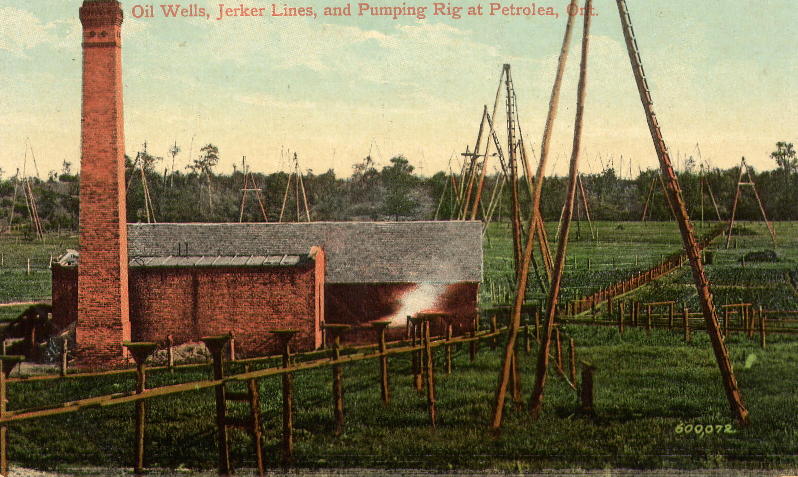 editor's collection This is a drive building that in the early days would have housed a steam engine and later an electric motor. The drive system for moving the jerker lines back and forth was driven from here and a real and operating example can be seen at Petrolia Discovery the Oil Museum of Petrolia. |
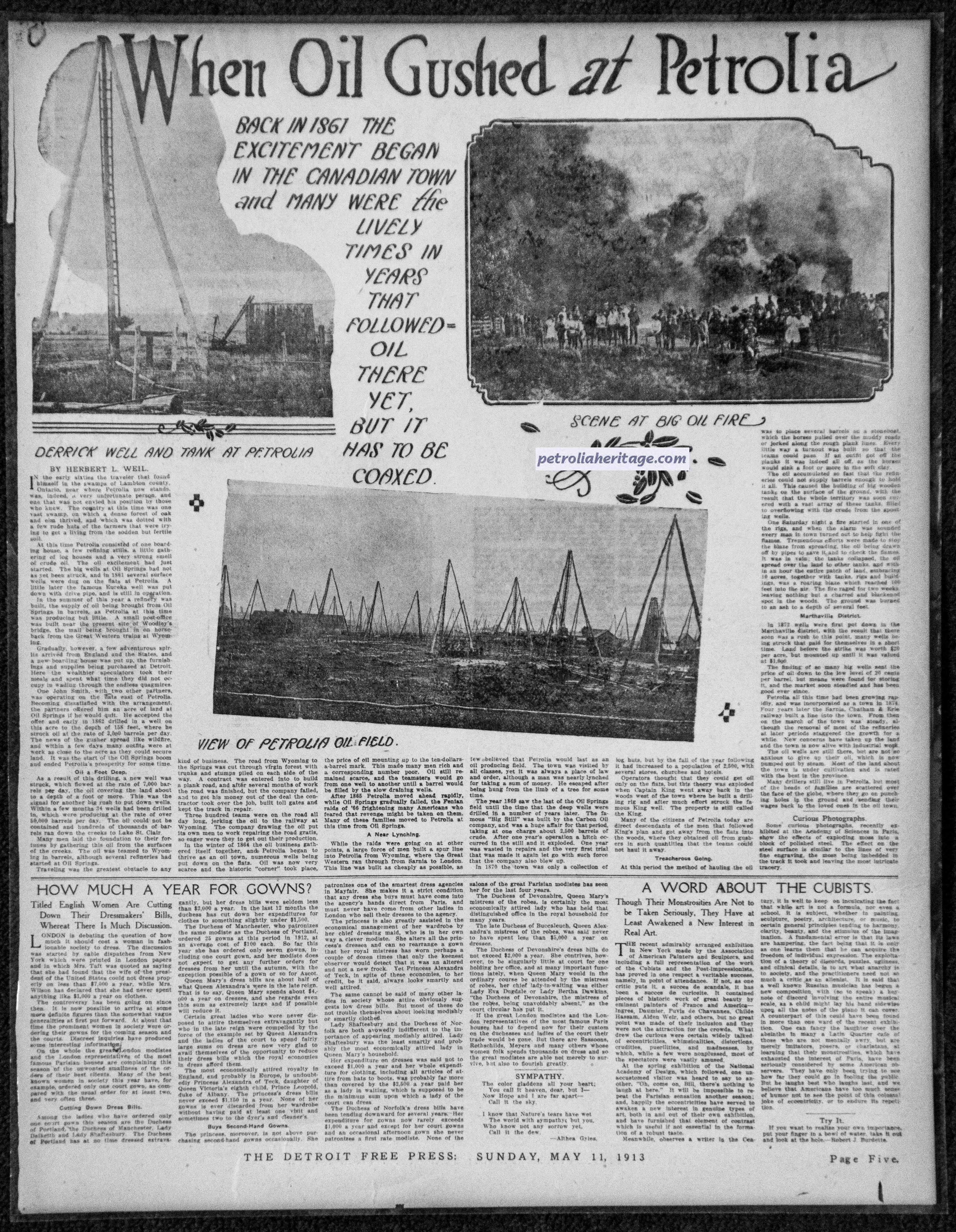 An interesting ca.1913 article about the area Oil history.It looks like a corespondent came here from Detroit for the Detroit News. |
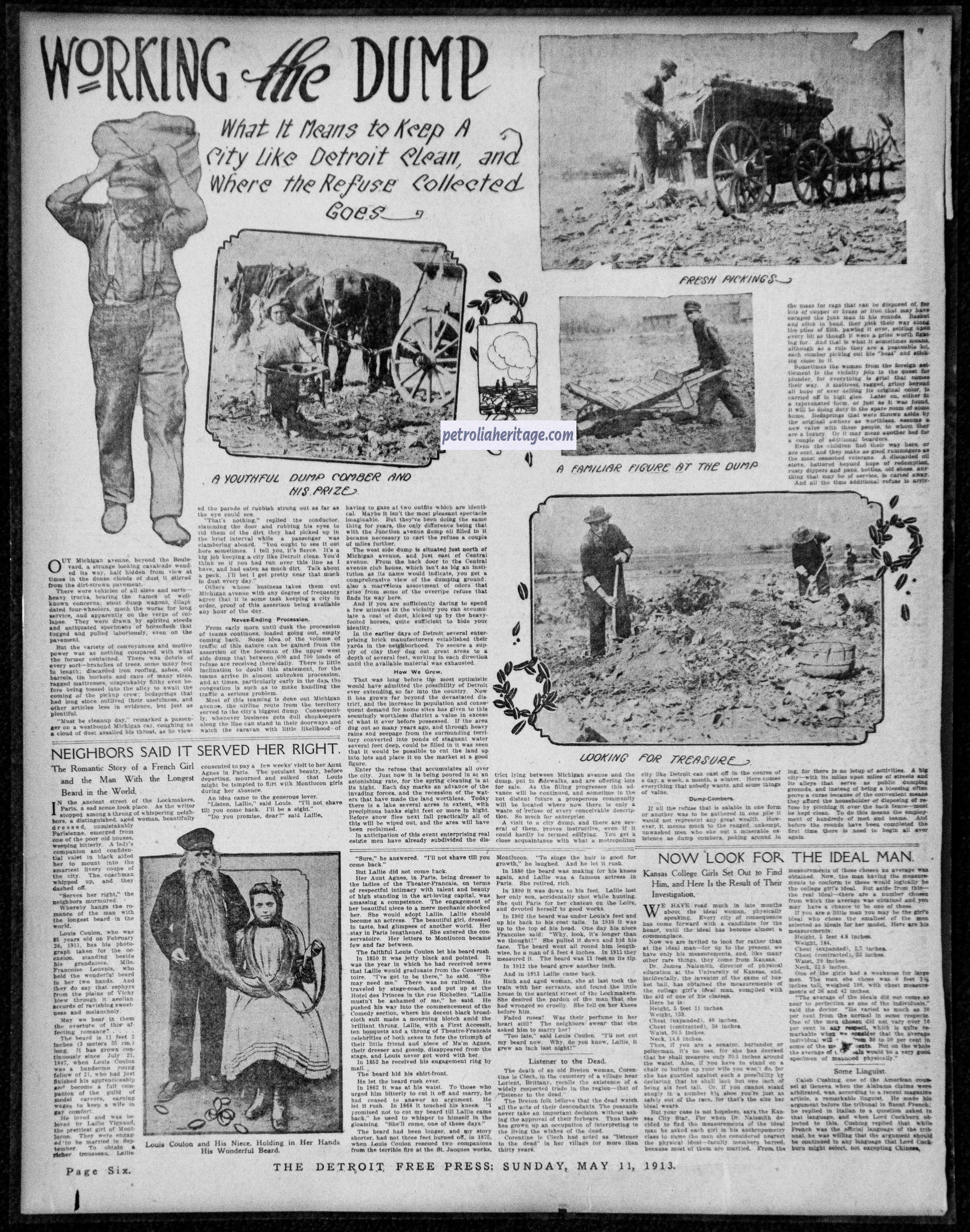 The other side of the newspaper page from the left image. Even though a Detroit article it is still quite interesting and is included for your amusement. |
 |
|
|
|
|
|
|
|
|
|
|
|
 |
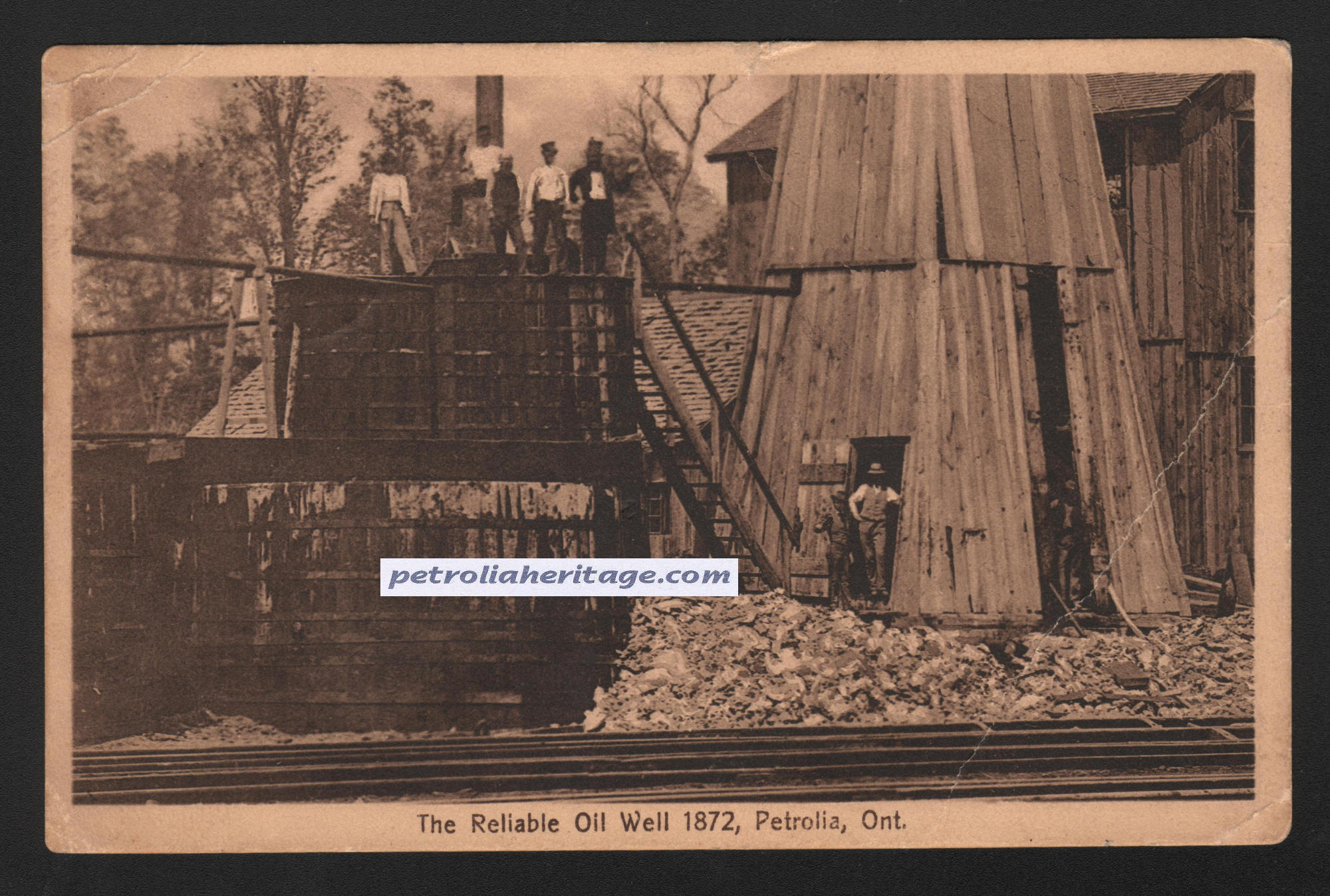 editor's collection The caption for this pic speaks for itself. Kerr had a well called "Old Reliable" but I am not sure if he was drilling that early. |
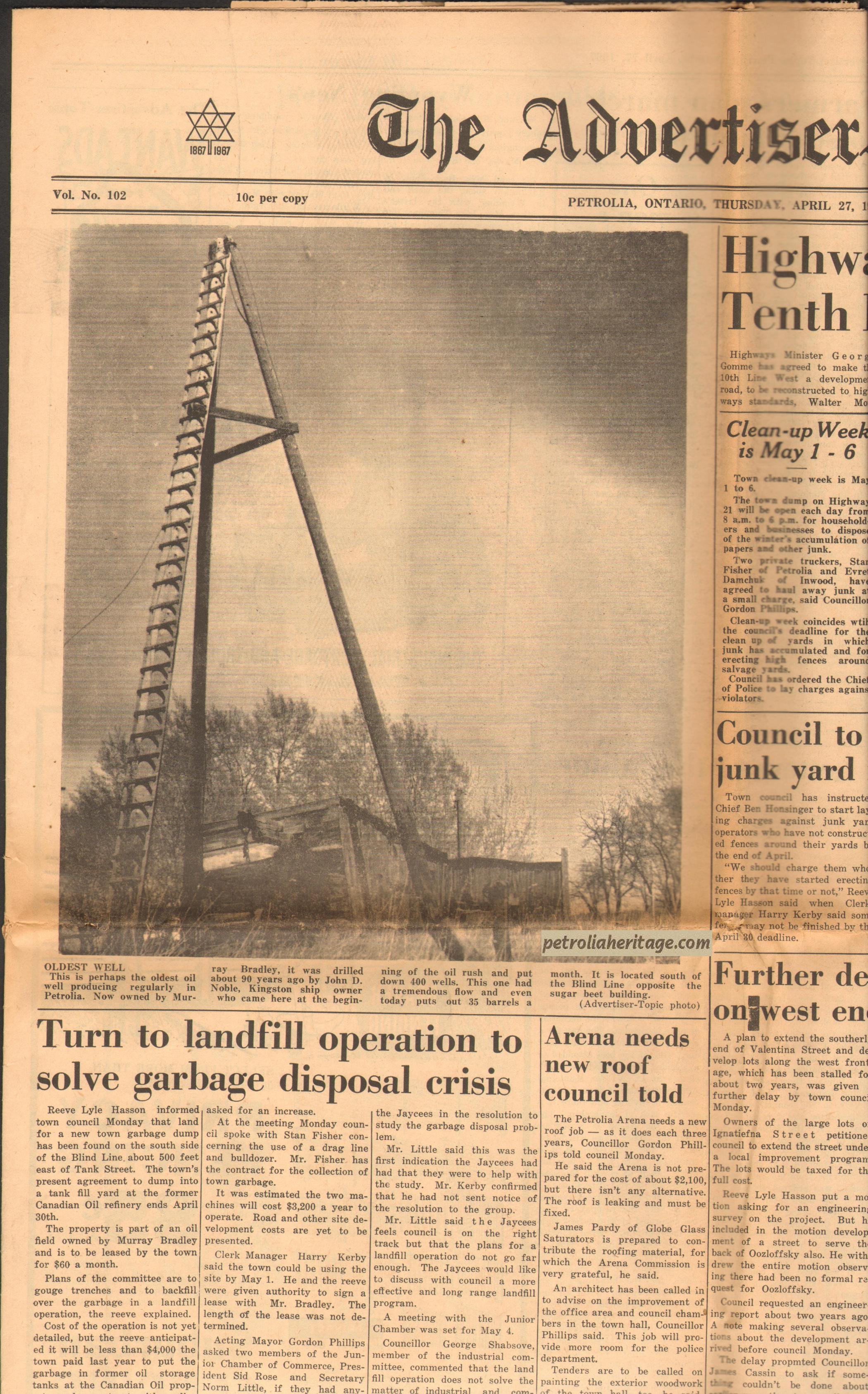 Great oil well item from ca.1967 |
|
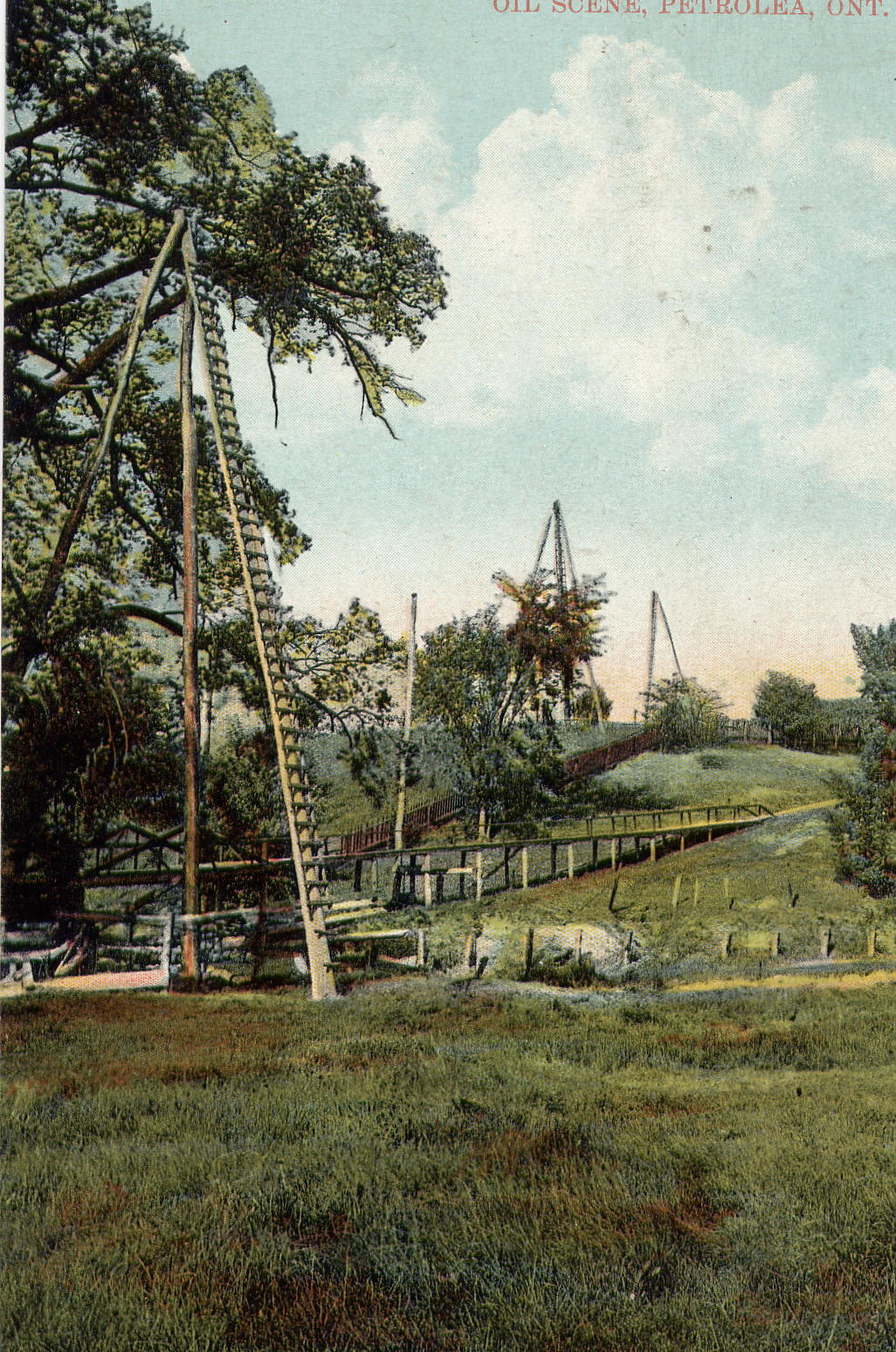
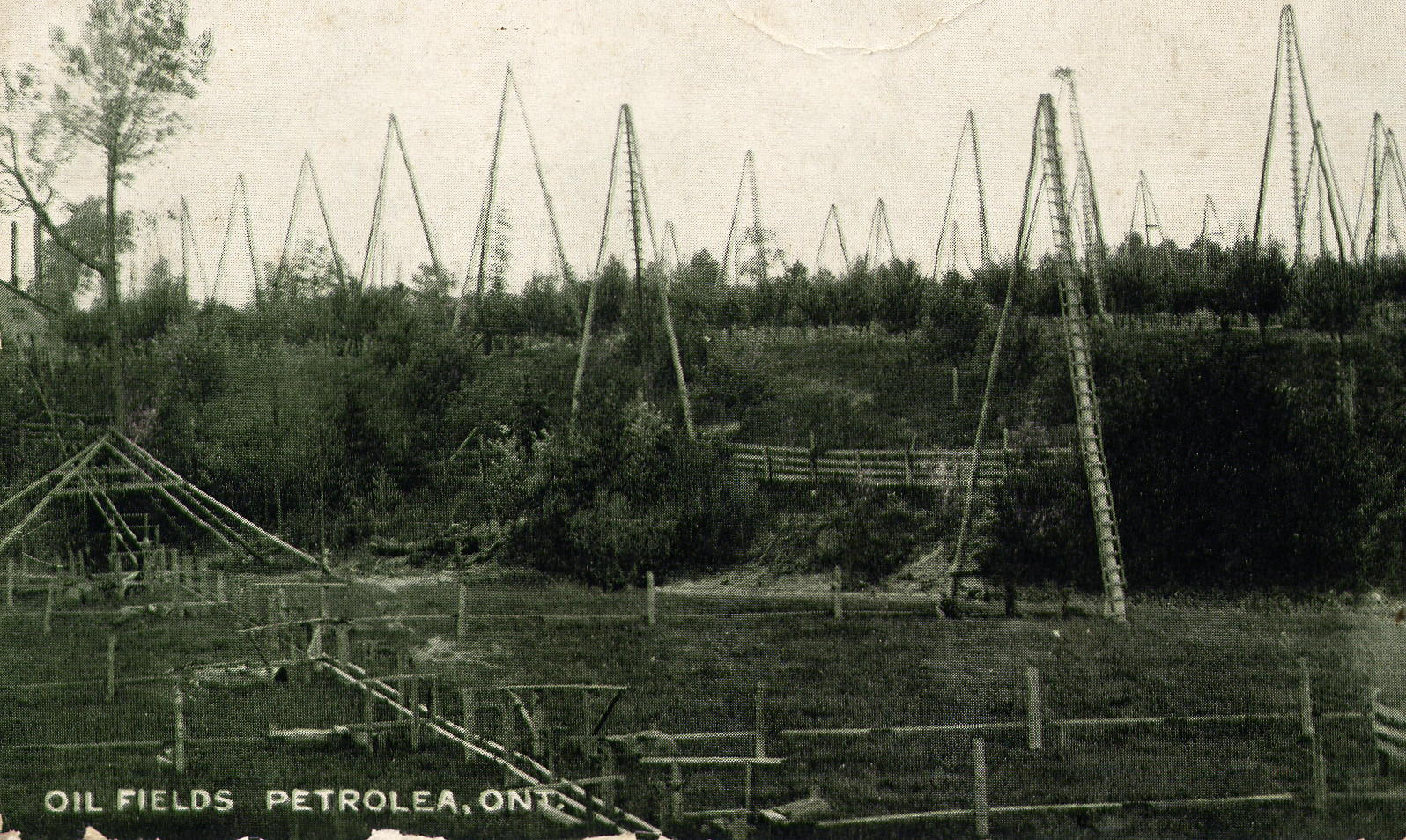
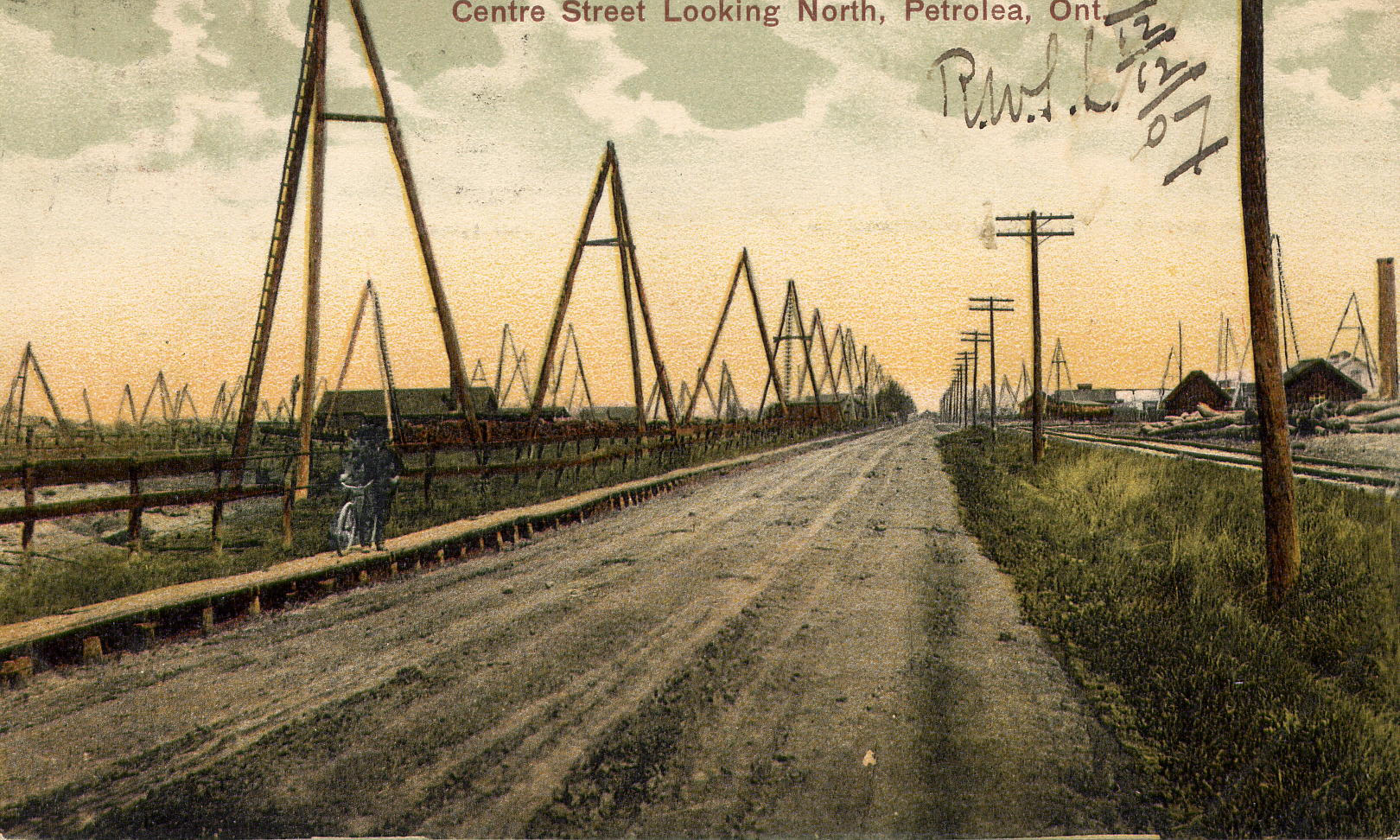
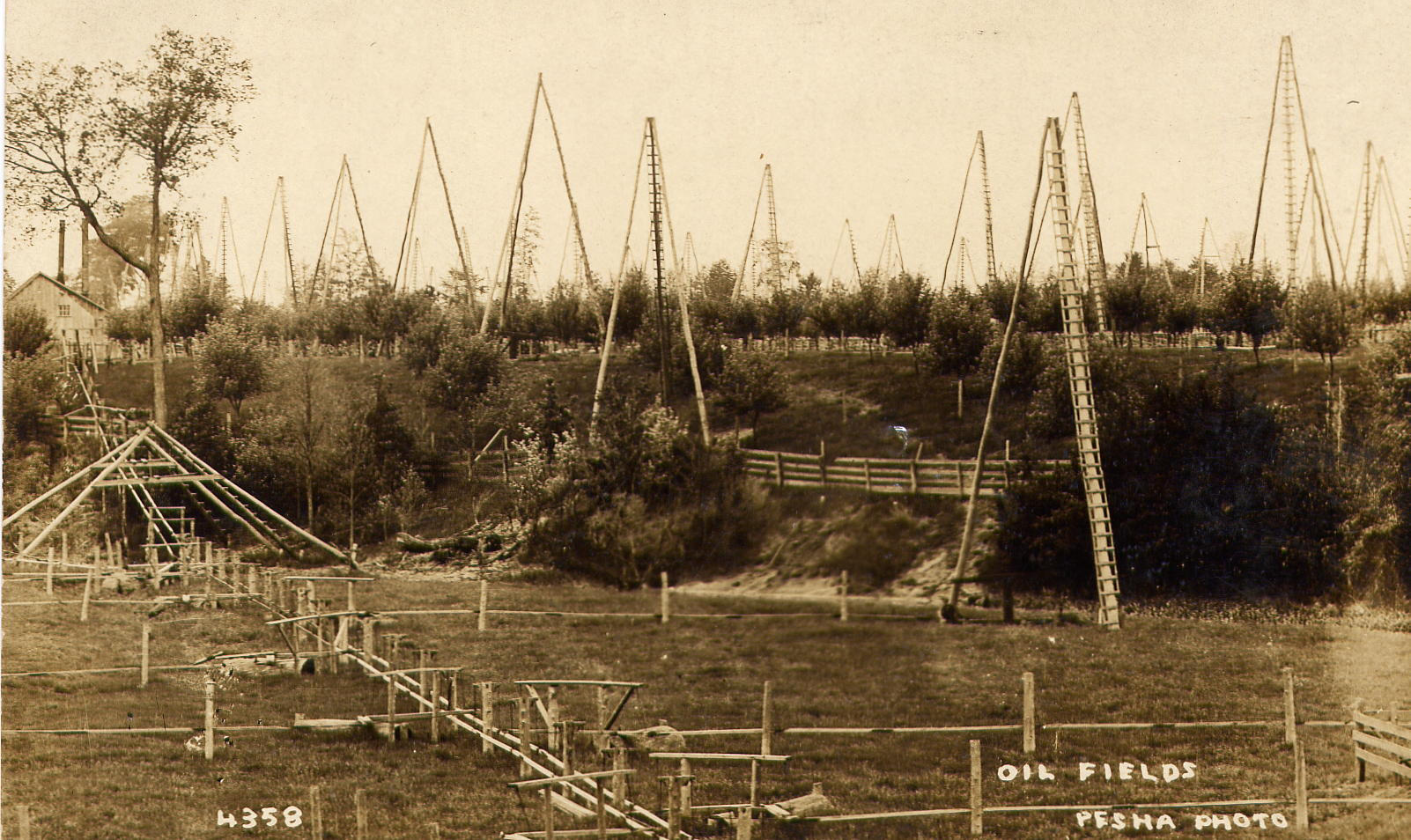
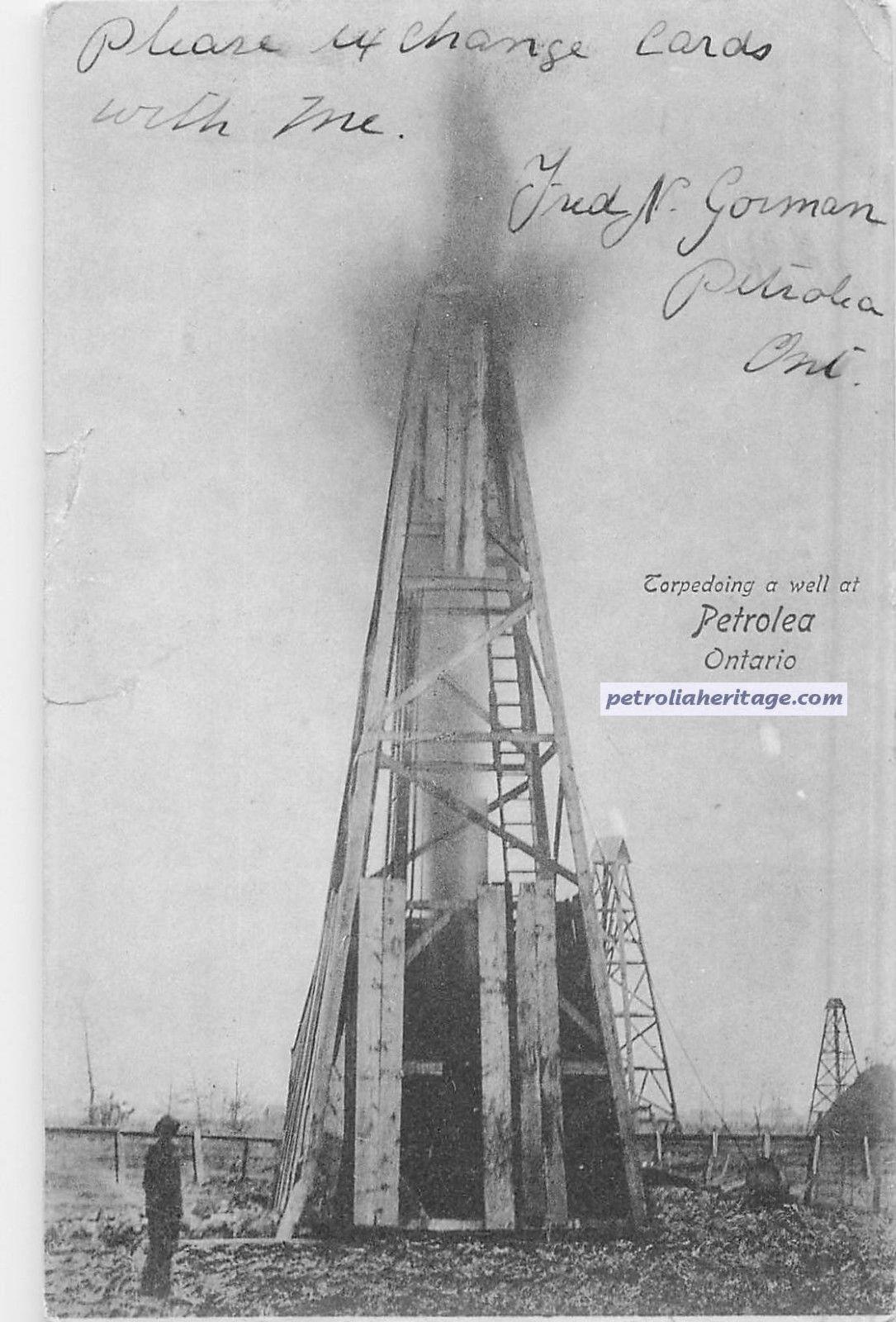 An interesting oil derrick starter rig. Not an unusual view but earlier than most. This card is post marked ca.1903. Note that it was sent by Fred N.Gorman who obviously was an early post card collector. |
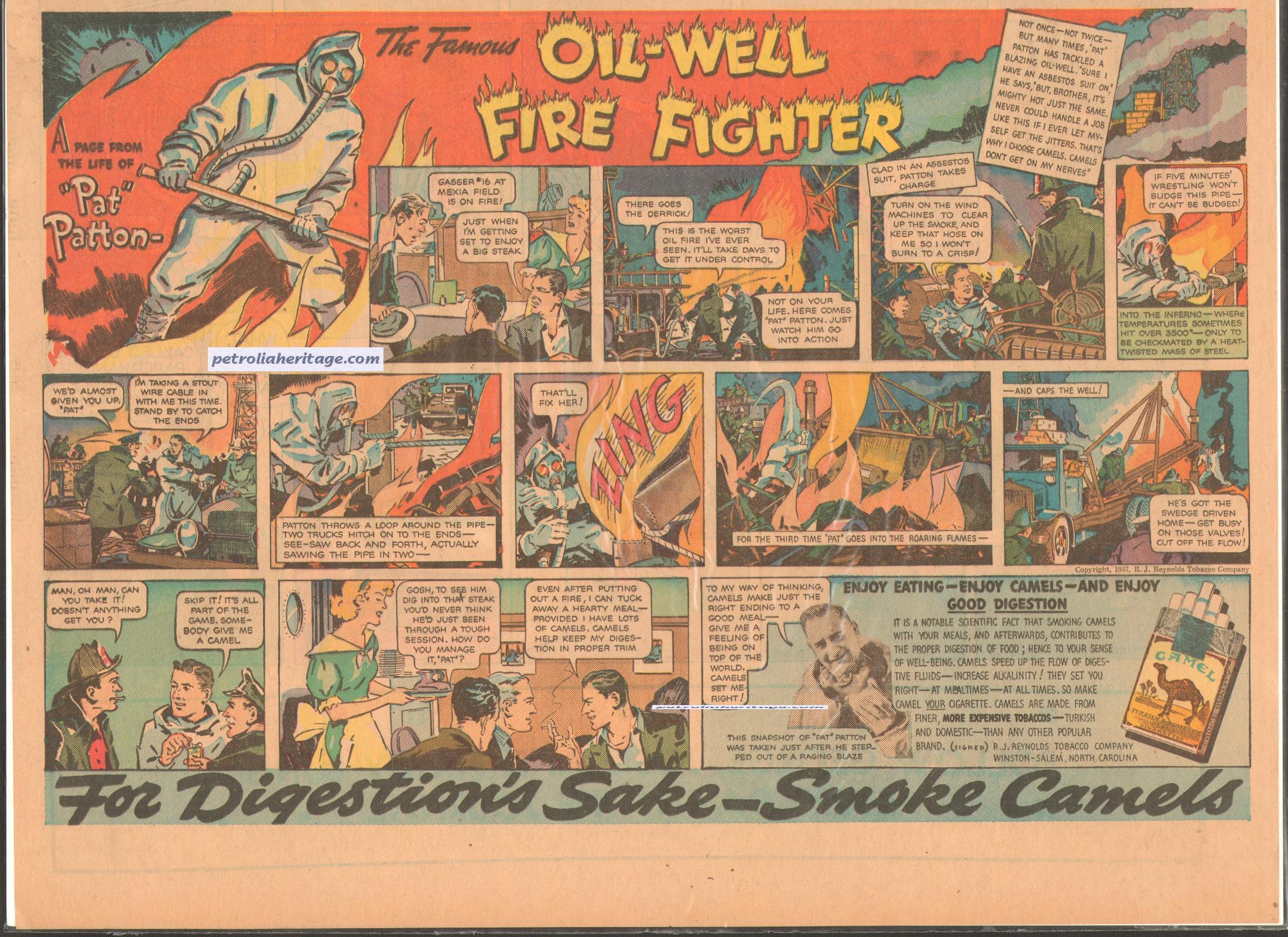 Interesting Cigarette ad Featuring Oil Well Fire expert Pat Patton. This ad is from about ca-1937. |
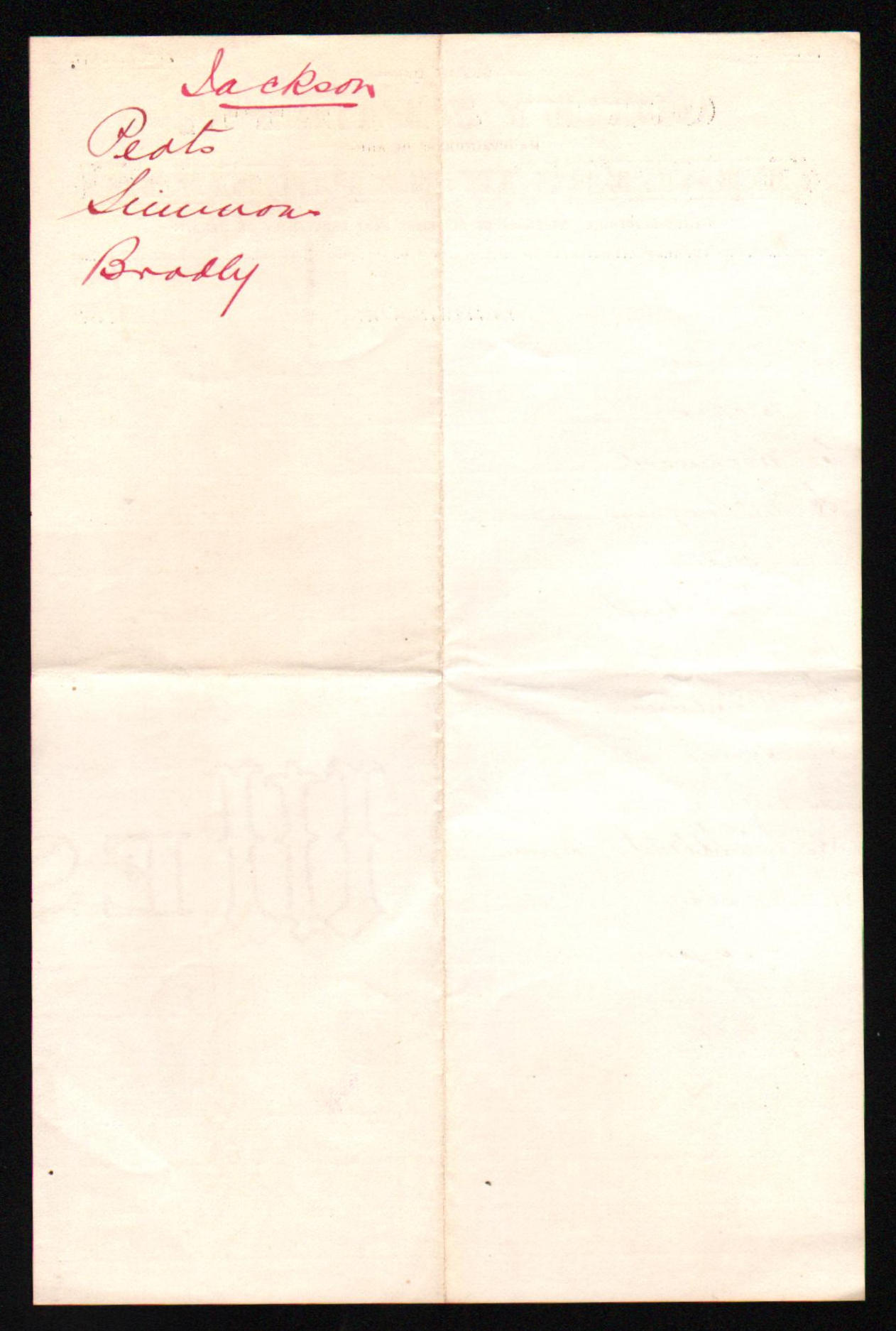
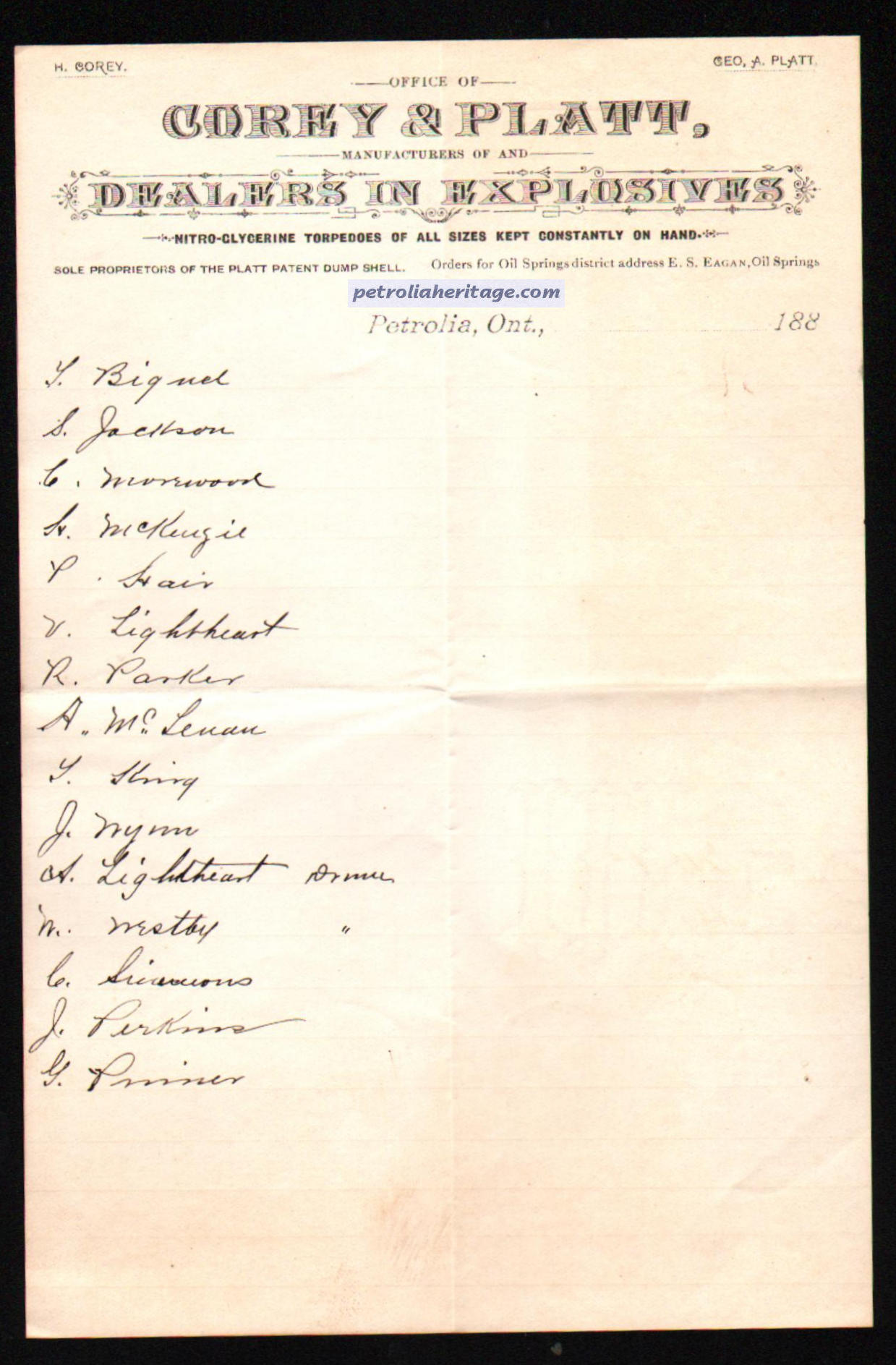 An interesting Letter Head for Corey & Platt. Obviously sellers of nitro glycerin for the oil industry. (ca.1880s,) The front side shown here has a list of some well know names in Petrolia and Oil Springs history. As well the right pic shows the reverse of this document with more area names from the period. Was the secretary making a list of current clients? |
 |
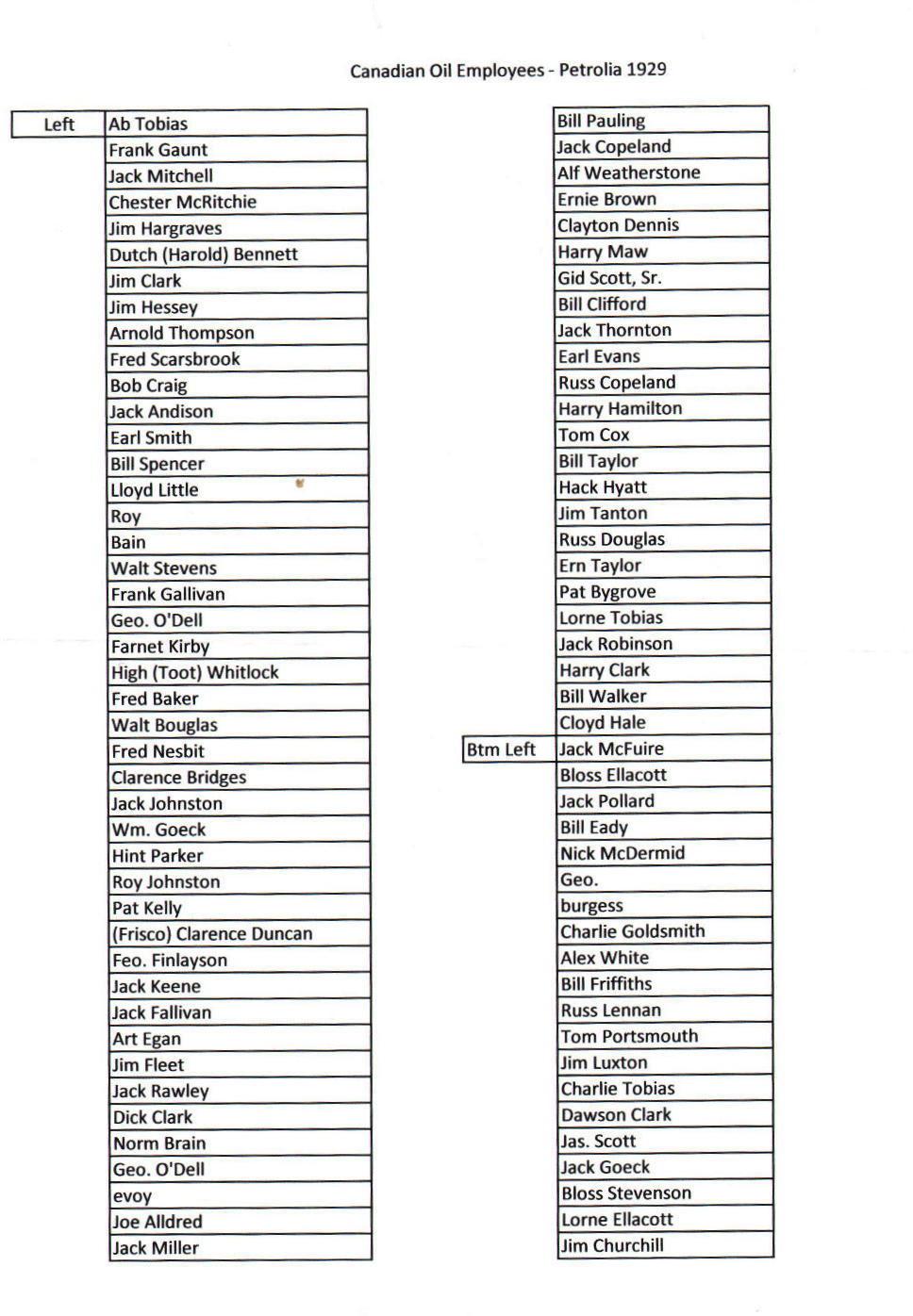
 Sutherland This is a very interesting 'panoramic' view of the ca. 1929 workers of Petrolia's Canadian Oil Refinery. The names are to the right.Some day soon I will type these out here so they are picked up by a search but for now they are right.Thanks to Norm Sutherland for bringing this pic to me. I had Clouse Photo, scan & stitch this huge photo. |
 |
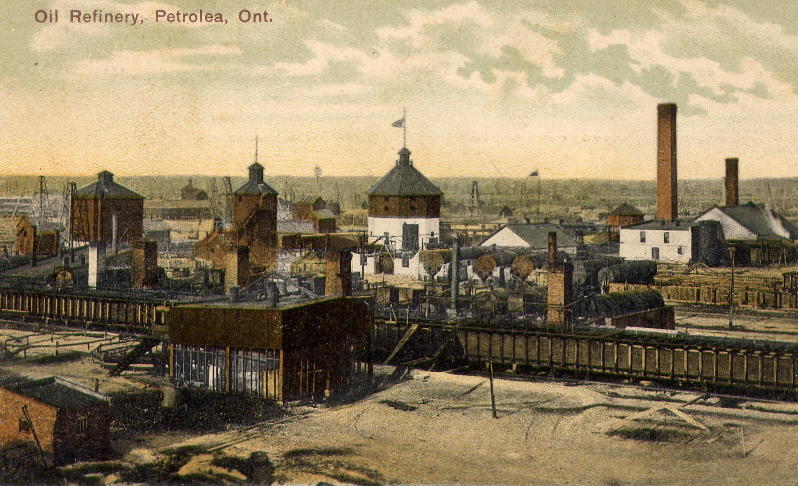 
editor's collection The Canadian Oil Refinery early 1900s This is a note that the Editor received recently: Thought it was time to update you on where we have got to in locating Imperial and the other old refineries in Petrolia. Not that we didn't believe you but, once we got into it, we found that history was rather full of conflicting evidence! Briefly we read the old Petrolia histories (and the latest one), looked up some of the original references, visited the library and Lambton Room, dug up some of the Imperial archives and most recently Charlie (with Imperial in Toronto) visited the Ontario archives and located the assessment rolls for the 1890's. So we've now convinced ourselves that the Imperial refinery was originally located on both sides of Center Street, south of the Blind Line. Originally it consisted of Englehart's Silver Star refinery built in 1879 just prior to Imperial Oil being formed in 1880 and, in 1881, they also took over the adjacent Home Oil refinery. Imperial moved its head office to Center Street from London in December 1884. It was not much more than a wooden shack (there's a picture in one of the earlier Phelps histories) and was probably located on the East side of Center about 2/3 rd of the way up between Petrolia St and the Blind Line. Between then and 1899, when Imperial moved to Sarnia, they took over most of the other refineries and, by the time they left town, they owned most of the property on both sides of Center Street up to the Blind Line (in those days Center St. continued on north up to the 12th line). The 1899 assessment roll still has Imperial owning all these properties as well as some on Tank and Petrolia Streets. After they left town (taking their equipment with them) there were no operating refineries left in Petrolia until, in 1901, the Canadian Oil refinery was built North of the Blind Line between Center and Tank where Canflow is now located. The admin building picture and most of the other refinery pictures are, in fact, Canadian Oil which didn't leave town until 1952 when they moved to what is now Shell in Corunna. They're the ones that left behind a number of their old buildings. One exception to the pictures of refineries being Canadian Oil is Oil27.jpg on your website (captioned The Canadian Oil Refinery early 1900s). Your caption probably reflects one of the earlier Phelps Petrolia histories that had it wrong. The latest book has a more likely date (ca 1898 see page 57). In fact this is the Imperial Oil refinery on Centre St. We can tell because of the cheese-box still (used for cutting paraffin distillates for wax/candle manufacture) in the foreground and the jumbo agitator in the background. These were both unique features of the Imperial refinery and here are pictures of them in the Imperial archives (there are copies at Discovery). There is also an old 1890's picture of Centre Street looking North from the top of the old water tower and you can see the jumbo agitator in the distance on the East Side of Center. One interesting note was that I ran across a map of the North end of Petrolia (including the location of Imperial) drawn from memory by a Charles Waylett (it's in the Lambton Room archives). It's very detailed and appeared to reflect the area around 1890 . I was able to locate Charles' grandson Doug in Calgary (another retired oilman) and got more background. Charles worked as an office boy/janitor at Imperial and moved to Winnipeg along with his future wife (Mary Aikin from Oil City) in 1898 (I guess he was out of a job at Imperial). He returned briefly to Petrolia in 1904 where he worked as a blacksmith and where Chester Charles (Doug's father) was born. Then to Fernie BC and finally Winnipeg where he died in 1960. Charles' father and mother (Samuel and Sarah) came to Petrolia from England in 1870, moved to Winnipeg in 1910 and both died there although they are buried in Hillsdale cemetery. One last request (if you've got this far!). You have a page for Corson Oil. I assume Corson was closely related to Corey Oil. The Corey building is now at Petrolia Discovery having been moved from Tank Street in 1994. Do you know where on Tank Street it was? I'm guessing it was opposite the planned Community Center site. Reason we were interested is that Imperial still owns some land there (they know it as 351 Tank Street) and Imperial finished up owning the Corey building as a result of the merger with Texaco Canada. And would that Corson Oil head office building picture corsonoilb.jpg be the Corey building when it was still on Tank Street? Tony White
editor's note the above note is an example of what top notch research reaps. If you are doing a school project or your thesis etc.,this is what you have to do..................... |
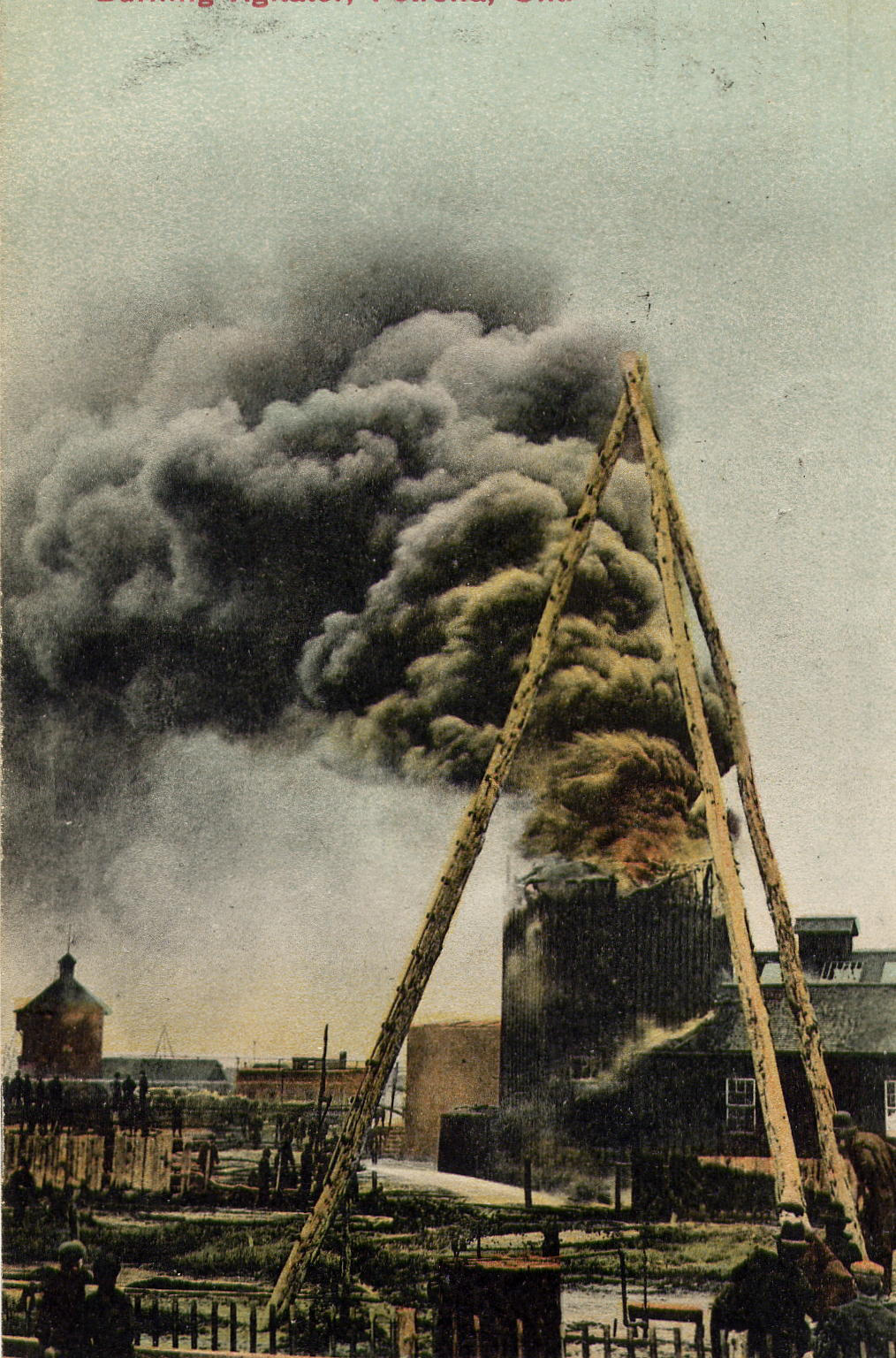
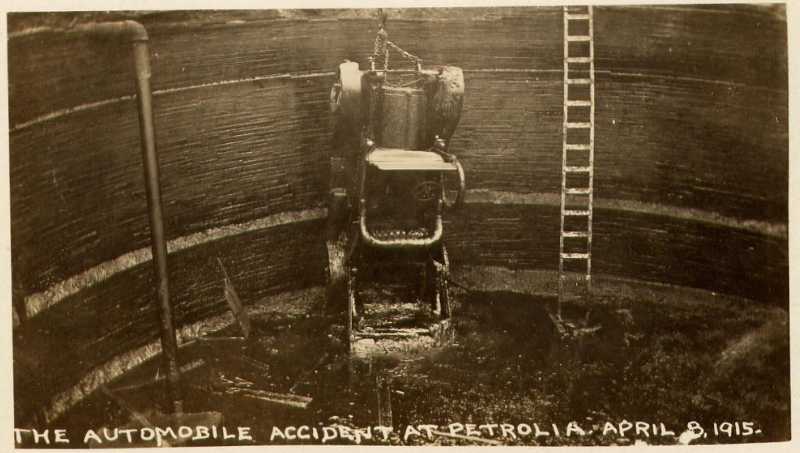 editor's collection This was the unfortunate scene that occurred when this vehicle was accidentally backed into this oil tank in ca.1915 at the Canadian Oil Refinery. The two women and two men were extracted from the tank and did not do too well. Here the car is being hauled out 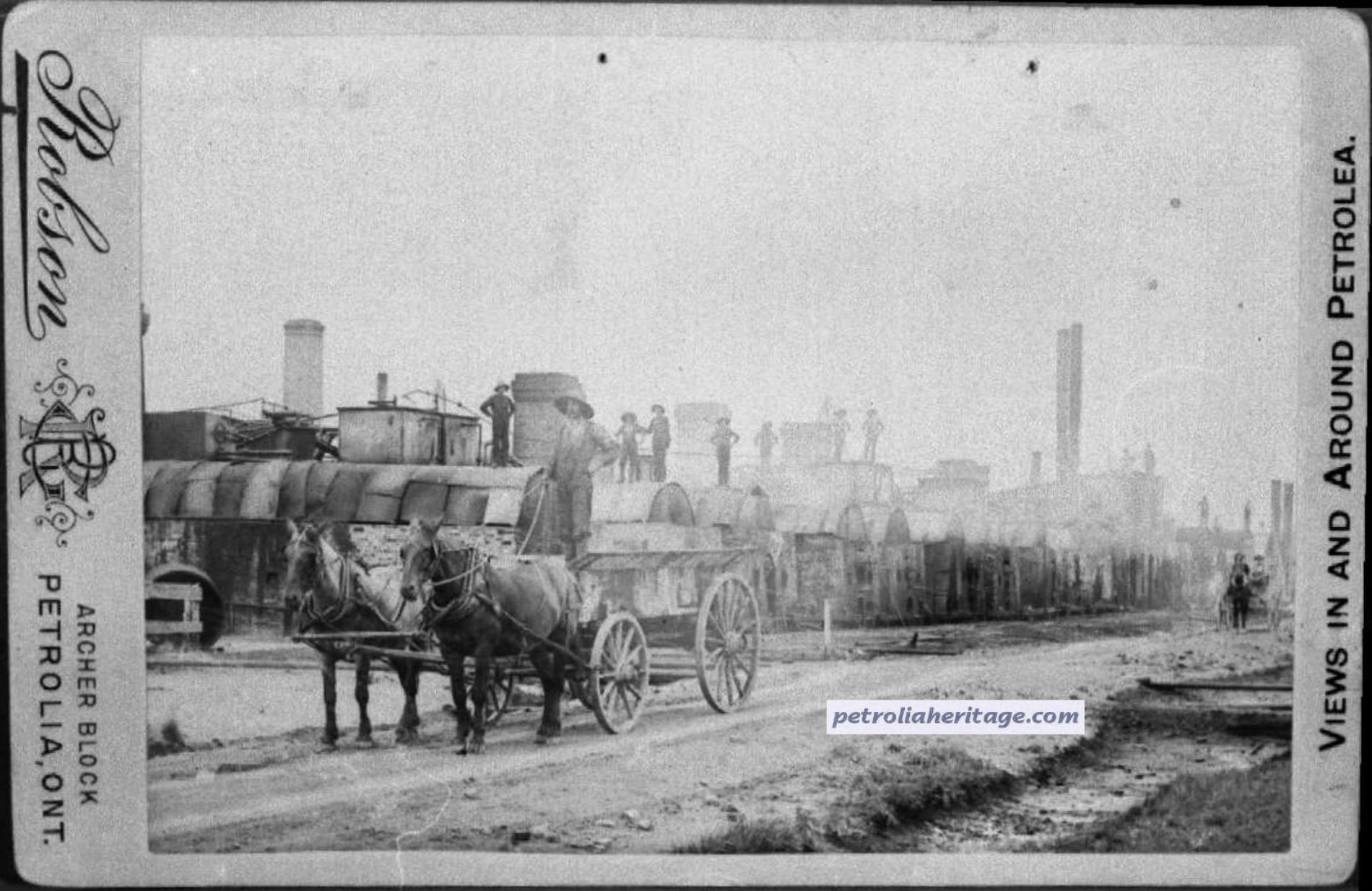 An interesting view of a refinery in action ca.1870s From the Topic negatives |
 |
|
All of these pics and more are from my own collection and from our contributors. If you would like to become a contributor, I just need a few minutes to scan what you have.
Email Martin martyd@ebtech.net