A LIBERAL BACK-BENCHER IN THE
MACDONALD REGIME: THE
POLITICAL CAREER OF JOHN HENRY
FAIRBANK 0F PETROLIA.
By Edward Phelps*
- 1 -
Introduction
John Henry Fairbank, Member of
Parliament for the riding of East
Lambton between 1882 and 1887,
entered politics in the midst of a pros-
perous business career.
A staunch Liberal, he had never previously
held elective office apart
from that of village Reeve, nor did he take
an active part in politics
after he retired from parliament. As an
Opposition back-bencher,
during the years when the Conservative Party
under the leadership of Sir
John A. Macdonald enjoyed a strong majority,
Fairbank exerted little or no
influence on government policy, nor made
any lasting mark in the
political annals of the country. His surviving
papers, however, afford an
interesting view of the activities of a
typical Ontario M.P. during
this period. 1
A descendent of a long line of
New England colonists and soldiers,
J.H. Fairbank was born at
Rouses Point, New York, on 21 July 1831. With
no resources but his capacity
for hard work, he left his home in 1853 at
the age of 22 to make a living
in Ontario, then called Canada West.
Settling at Niagara Falls, he
boarded at the home of Hermanus Crysler,
and worked as a
surveyor. On 8 September 1855 he married Edna Crysler,
his landlord's daughter, and
settled down to a quiet life of farming,
with occasional surveying work
and a fire insurance agency as sidelines.
In March 1861 Fairbank
accepted an assignment to survey some bush
land in the recently opened
Lambton County oil field, 150 miles to the
west. This opportunity
proved to be the key to Fairbank's future career,
for it introduced him at first
hand to the booming oil industry and a way
of life very different from
the placid existence to which he had been
accustomed. Leaving his
wife and two small sons on the farm at Niagara
Falls, he returned again to
Oil Springs after the survey was finished
to try his luck in oil.
He risked his own meagre savings and all the
money he could borrow in
drilling a well. After an agonizing period
of initial failure, his first
venture succeeded and after three years
of hard work during which he
acquired several more wells and a small
refinery, Fairbank was
launched on a successful career in the oil
business. From a
shoe-string operator, like hundreds around him, he
* Mr,
Edward Phelps, Secretary of the Lambton County Historical
Society
and a member of the Library staff at the
University of Western Ontario,
completed his degree of Master of Arts in
May 1965. The Subject of his
M.A. thesis is John Fairbank - A Canadian
Entrepreneur.
1-'The Fairbank Papers were generously donated to
the U.W.O. Library by
Mr. Charles 0. Fairbank, a grandson of
the subject of this article.
* The collection is described by the
writer in Western Ontario Historical
Notes, XVII, 2 (Sept. 1961), pp. 89-91.
2
rose rapidly to command the
confidence of the business community at Oil
Springs and secured for his
absent family whom he frequently visited, a
standard of living much higher
than they had known before. When in 1865
Oil Springs declined, nearly
becoming a ghost town, its oil wells having
given out, Fairbank became one
of the pioneers who opened up a rich new
and permanent oil field six
miles to the north at Petrolia. By 1866 he
had definitely cast in his lot
with the oil industry, He therefore sold
his old farm and moved his
family into a new home on the main street of
this thriving village which
had so recently sprung from the wilderness.
Over the next forty years
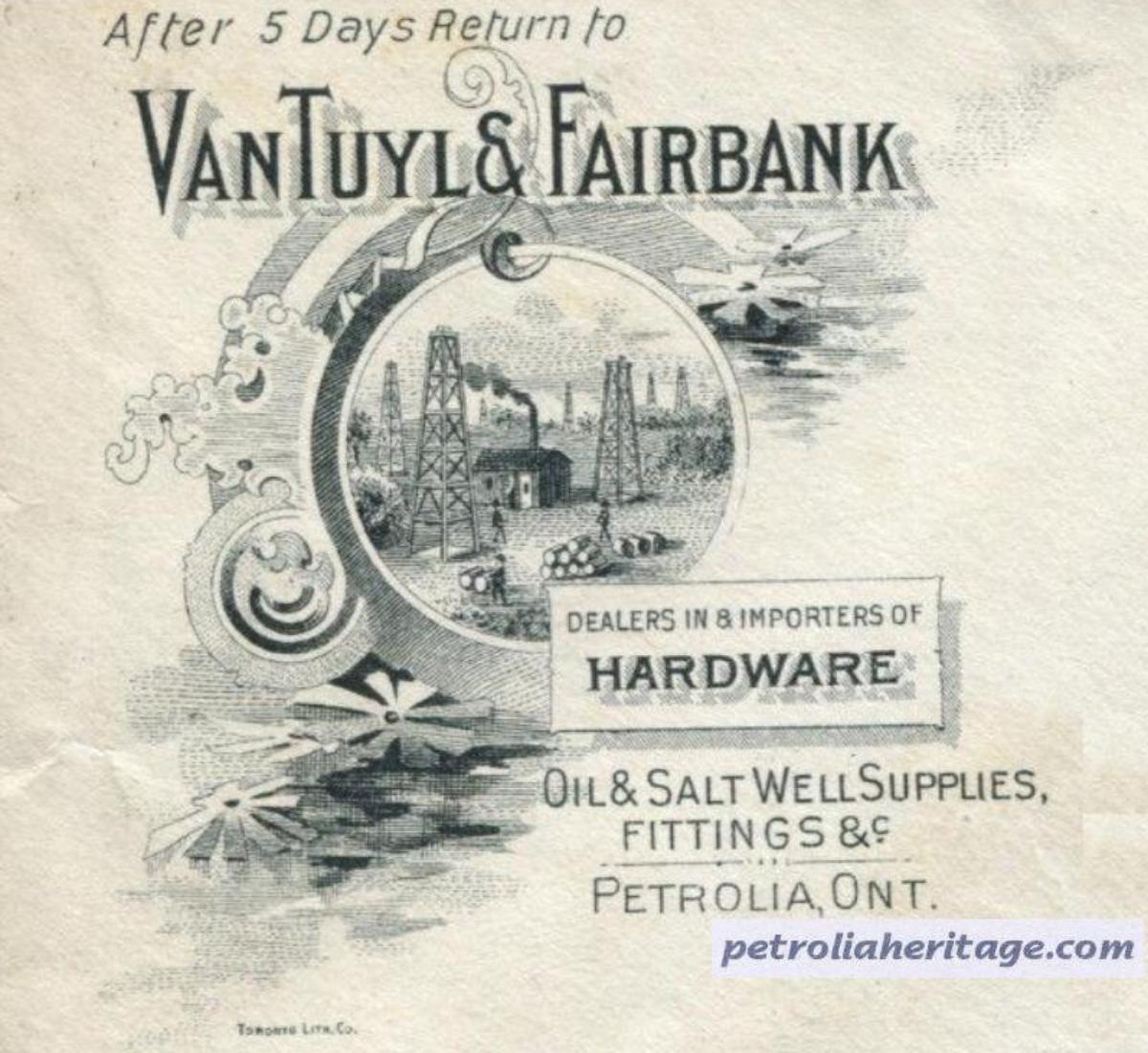
Fairbank built up a local business
empire by investing the
growing profits from oil in closely related
enterprises. In 1865 he
started a grocery, liquor and hardware store
which in 1874 evolved into a
hardware and oil well supply business.
This enterprise was undertaken
in partnership with Major Banjamin
VanTuyl. Now (1966) in
its one hundred and first year, VanTuyl &
Fairbank may be the oldest
business in Petrolia. In 1866 Fairbank took
a leading role in building a
railway line to join Petrolia with
Wyoming, five miles to the
north on the Great Western Railway. An
important link to the oil
fields, the little railroad was soon after-
wards purchased by the latter
company. Fairbank also took an active
interest in civic affairs
throughout his long career: to name
only
three of his community
services, he acted as Reeve of Petrolia during
the years 1868 to 1870, as
Fire Chief from 1874 to 1889, and as
Chairman of the Board of
Health for several years.
In the year 1869 Fairbank
greatly expanded his business operations
by establishing, in
partnership with Leonard B. Vaughn, one of Petrolia's
most useful institutions: a
bank. This firm operated for fifteen years
before it encountered
competition from branches of regular chartered
banks. Vaughn &
Fairbank thus played a leading role in the orderly
commercial development of the
crude oil industry in Western Ontario.
Despite the size and variety
of his other interests, Fairbank
remained first and foremost a
producer of crude oil. At the height
of his career he was the
largest single producer in Canada and for
this reason was the chief of
the acknowledged leaders of the industry.
He participated in several
combinations formed by the producers be-
tween 1862 and 1889 when they
were contending with the refiners for
domination of the Western
Ontario oil industry. 2
2
The first of these combinations appears to have been the
Canada Oil
Association, formed at Oil Springs in
1862. It is described in this
writer's article, "The Canada Oil
Association - an Early Business
Combination," in Western Ontario
Historical Notes, XIX, 2 (Sept.
1963), pp. 31-39. James Kerr, a
contemporary of Fairbank, assigned
the latter first place among the oil
producers in an article, "The
Oil Belt," in the Toronto Mail, 1
December 1888. (Reprinted as "An
early view of Petrolia. Ontario," in
Western Ontario Historical
Notes, XVII, 2 (Sept. 1962), pp. 57-91.)
Notes.XVII, 2 {Sept. 1962 }, pp. 57-91}
3
Sometimes this
involved setting up a refinery in competition with those
already established. Fairbank
was involved, by his own account, in no
less than seven refining
ventures over a period of thirty years. Apart
from his interests in banking,
oil and hardware, Fairbank also engaged
in manufacturing and farming.
While many of his
contemporaries found that their heavy business
responsibilities precluded
them from taking an active part in politics,
Fairbank was an
exception. At some time in his career, he evidently
took the Oath of Allegiance
which permitted him to become a naturalized
Canadian citizen, and later
took enough interest in party politics to
become a conscious adherent of
the Liberal Party. 3
As Fairbank left no papers
concerning his early involvement in
politics, one can only
speculate on the circumstances leading to his
choice of the Reform, rather
than the Tory party. The constituency of
Lambton had been traditionally
Liberal since its formation in 1854.
From 1861 to 1882 it was the
riding of Alexander Mackenzie, who was
Canada's Prime Minister for
the years 1873 to 1878. During Mackenzie's
tenure, however, a pocket of
Conservative opposition had emerged in
the heart of the riding.
Here, at Petrolia and Oil Springs, the
growing population of oilmen
traditionally voted Conservative because
the survival of their industry
depended upon the maintenance of
strong protective tariffs
against American imports. Doctrinaire
Reformers had been making
disturbing statements for years in favour
of free trade, which oilmen
feared would wipe out the oil trade of
Canada along with many other
home industries.
In the face of disapproval
from the majority of his business
colleagues, Fairbank's choice
of the Reform Party is rather surprising.
As a strong individualist, of
course, Fairbank was accustomed to making
up his mind independently on
political matters. At the start he quite
possibly contributed to the
campaign funds of both parties, as has been
the custom of many wealthy
individuals and corporations. As a prominent
Lambton businessman, however,
Fairbank soon came to know Alexander
Mackenzie, his representative
at the capital. It seems safe to assume
that personal regard for the
future Prime Minister, rather than political
expedience, dictated his
choice of the Reform Party. To a certain extent
the careers
3 The
terms "Liberal" and "Reformer" have been used
interchangeably
by the writer, following the usage of
recent Canadian historical
writing. Contemporary writers
and speakers generally used the
name "Reform" to distinguish that
party from the "Liberal-Conser-
vatives," more often simply called
the "Conservatives."
To become a Canadian (i.e. British)
citizen, an alien had
to prove three years' residence in
Canada, declare his intention
to remain, and take an oath of
allegiance. This procedure entitled
the naturalized citizen to all the
political rights enjoyed by a
British citizen,
(Canada. Revised Statutes,
1886, cap.113, sec.15)
4
of Fairbank and Mackenzie were
parallel: both men rose 'to the top from
humble beginnings, and both
were practical, direct, honest, and un-
sophisticated in their
approach to politics and business. Fairbank
could not of course, follow
the Reform leader without accepting the
Reform policies.
Mackenzie, however, was inclined to be realistic in
his views on free trade, and
favored the protection of industries
already established.
Both Fairbank and Mackenzie were convinced that
free trade, or unrestricted
reciprocity, was an unacceptable policy
for any Canadian party.
(Not until 1891 did the Liberal Party fight
an election mainly on this
issue. This action was bitterly denounced
by the two men, by then
retired from politics.) Since Fairbank flew
in the face of local opinion
when he cast in his lot with the Liberals
he must have been delighted
when, in 1876, the government of Alexander
Mackenzie confirmed the
protective oil tariff previously imposed by
the Conservatives.
Fairbank's importance in the
political hierarchy of his home
riding of Lambton was
established by 1872-3 when he was chosen on
two separate occasions to
nominate Alexander Mackenzie as the local
candidate for the House of
Commons. In a traditionally Reform riding
which had no dearth of
political stalwarts, this choice would come
as a distinct honor to any
man. The first nomination took place on
21 August 1872 in the general
election when Mackenzie was leader of
the opposition, the second
occurred fifteen months later. The Pacific
Scandal had just brought about
the downfall of the Macdonald govern-
ment on a want of confidence
motion, and Alexander Mackenzie was
named Prime Minister. He
immediately returned home to Sarnia for the
by-election rendered necessary
by his appointment to the government.
On 25 November 1873 Mackenzie
was duly nominated, and re-elected by
acclamation amidst great
rejoicing among the Reformers of Lambton
and the entire country.
Fairbank during the next ten
years was one of the prominent
supporters to whom Mackenzie,
first as Prime Minister and then again
(1878-1880) as
Leader of the Opposition, turned for advice on local
matters.
Fairbank probably never imagined in those years that he
would be called upon to
succeed Mackenzie when the latter ultimately
relinquished the Lambton
riding.
-ii-
J.H. Fairbank's election to
Parliament, 1882.
Between 1873 and 1882 Fairbank
devoted the major share of his
attention to his business
affairs, following closely the progress
of the Mackenzie
administration in Ottawa through the Toronto Globe
and other Reform papers.
When his ministry fell in the general
election of 1878 Mackenzie
easily retained the safe Lambton seat.
In 1881, his health failing,
the leader decided to contest the riding
of York East, close to his new
home in Toronto, instead of attempting
5
to represent Lambton and his
old neighbors whom he now saw but seldom. 4
Thus deprived of Mackenzie,
the Reformers of Lambton cast about
for the man in their midst
best equipped to carry the Liberal standard.
They considered Fairbank,
knowing of his popularity, his competence,
his loyalty, and his
fortune. Fairbank declined to stand for the riding,
maintaining that the state of
his health would not permit the necessary
canvassing and the physical
inconveniences of a campaign in what was
then a sizeable riding.5
He consented, however, to act as Chairman
of a Mackenzie Testimonial
Committee. During the year 1882 this group
collected $5,500 as a gift to
Alexander Mackenzie in appreciation of
his years of service to
Lambton County, which had seen the loss of his
health and most of his money. 6
While the Lambton reformers
debated the choice of a successor
to the illustrious Mackenzie,
events in Ottawa complicated their problem,
During the session of 1882 the
Conservative government of Sir John A.
Macdonald introduced a
redistribution bill with the purpose of giving
the country more adequate
representation by population, using the
figures compiled for the
census of 1881. The Prime Minister "decided
4. Dale C. Thomson, Alexander
Mackenzie; Clear Grit (Toronto, 1960), p.370.
5. The Watford Advocate-Adviser, 26 May
1882, carried a lengthy report
on the Reform Convention held at Watford
on 23 May.
J.H. Fairbank and his son
Major Charles Fairbank compiled two books
of clippings concerning their political
activities, which
the present owner, Mr. Charles 0.
Fairbank, of Petrolia, made avail-
able to the writer. Most of the
newspapers cited in connection with
the election of 1882 have been consulted
through these clippings.
The collection of clippings is of
outstanding value for two reasons.
No files have survived for some of the
papers clipped, while the
Fairbanks saved items hostile to their
cause, as well as those that
were sympathetic. Unfortunately, in
some cases neither the name
of the newspaper nor the date was
recorded.
6. A two-page circular, entitled
"To the Reformers of Lambton," and
dated 28 February 1882, probably compiled
by Fairbank (copy in
Fairbank Papers), was composed to bring
the matter before Mackenzie's
Lambton friends. Thomson, op.cit.,
p. 375 records the presentation.
The Toronto Globe said, "It is rare
indeed that any statesman, how-
ever eminent his rank or distinguised his
career, has received such
a signal mark of esteem and friendship as
was presented to the Hon.
Alexander Mackenzie, M.P., last evening
at his residence by a depu-
tation from his former constituency of
Lambton." (October 1882;
exact date unavailable at time of
writing.)
6
to take the opportunity, as he
put it, to 'hive the Grits'. Ignoring
municipal and county borders,
he rearranged the constituencies in a
brazen attempt to give his
candidates every possible advantage in the
election. Reform-minded
Lambton was divided." 7 Sarnia, the county
town, together with the
townships of Plympton, Sarnia, Moore, Sombra,
Dawn, and Euphemia were
reluctantly conceded to the Liberals as the
old stronghold of
Mackenzie. The town of Petrolia and the townships
of Enniskillen, Brooke,
Warwick, and Bosanquet, which together had
generally yielded a majority
for the Conservatives, were erected into
a new riding known as East
Lambton. Because of the past voting record
and known Conservative
leanings, of the oil district, this constituency
had obviously been "cut out as
a Tory preserve". 8 In the election of
1878 as part of the Lambton
riding the area had returned a Conservative
majority of eighty-six. 9
In 1882 the Lambton Reformers had to find
not one candidate, but two.
Although Fairbank, for reasons
of health, had declined to canvass
all Lambton as a candidate for
the House of Commons, he agreed to stand
for the much smaller new
riding of East Lambton, where he was more widely
known than in the rest of the
county. On 23 May 1882, he was unanimously
chosen as the Liberal
candidate at a large and enthusiastic convention
at Watford. 10 About
the same time, the West Lambton Reformers chose
Joseph F. Lister, a prominent
Sarnia Lawyer, to contest that seat, regarded
as a safe Liberal
constituency. 11
7.
Thomson, op.cit, p. 373. D.G. Creighton, John A.
Macdonald: the
Old Chieftain (Toronto, 1955), p. 335,
says, "The redistribution
was designed to secure a party
advantage. Liberal voters were to
be concentrated in as few ridings as
possible, thus increasing the
Conservatives' chances of success."
8 ."Mr. Fairbank's election for a
constituency that was especially cut
out for a Tory preserve was doubly
gratifying." (Unidentified
clipping, Fairbank scrapbooks).
9. In a letter thanking his supporters,
Fairbank said, "Starting
against an adverse majority of 86, you
have won by 165." (Petrolia
Advertiser, 30 June 1882).
10. Watford Advocate-Adviser, 26 May
1882; Toronto Globe, 24 May 1882.
11. Mr. Lister's return, though regarded
as certain, was very grati-
fying by reason of the large majorities
he received in all parts
of the riding, testifying to his personal
popularity as well as
proving that old Lambton is sound to the
core, politically."
(Unidentified clipping; Fairbank
scrapbooks).
7
Feeling sure of winning East
Lambton, the Conservatives had already
chosen on 18.May 1882
another Sarnia lawyer, John Alexander Mackenzie
(1837-1894), to carry their
standard against Fairbank . 12 "He was un-
doubtedly the ablest, and
individually the strongest man in the ranks
of the Tory party in Lambton;" 13
possibly his intended election from
a safe seat/was meant to
herald a lifetime parliamentary career. Al-
though unrelated.to the former
member, Alexander Mackenzie, the new
rival had the advantage of
possessing his famous name, which may have
delivered a few votes to him
from the ranks of the politically un-
sophisticated portion of the
electorate. (His Christian names had an
entirely different political
significance.) Because Mackenzie lived
outside the riding, however,
he was unable to counter Fairbank's
appeal to the local loyalties,
which, in the view of this writer,
was the key to Fairbank's
victory in the election of 1882.
The election campaign was
short and sharp, with the outcome in
doubt to the end. A
contemporary newspaper eloquently summarized the
East Lambton situation.
The thought that one of its
ridings might be made a resting
place for a Tory
representative nerved the Reformers of the
county to unwonted
exertions. In the East the fight was un-
usually sharp and
exciting. The odds there, judging by the
result of the 1878 elections,
were greatly in favour of the
Government candidate.
[John A. Mackenzie] ... Failure under
his leadership meant a long
farewell to Tory hopes in either
riding of the county.
Men threw themselves into the contest,
on each side, who had never
exerted themselves in an election
before; excitement grew to
fever heat as the polling-day
approached, and both sides
counted upon victory as certain. 14
During the four-week campaign
the two candidates canvassed the
small riding energetically and
spoke at numerous election meetings where
they often confronted each
other over the issues at stake. While
Mackenzie generally received
warm support from his hearers for his
enunciation of Macdonald's
National Policy, which found favour in
East Lambton, Fairbank made a
wide-ranging attack on the whole record
of the Conservative government
as well as its National Policy. Indeed,
12.
Petrolia Advertiser, 2 June 1882. As if to emphasize
their lack
of concern over the riding, the
Conservatives nominated their
absentee candidate at a convention
held outside the riding - at
Wyoming, five miles north of
Petrolia. Wyoming was in West Lambton.
13. Quoted from an unidentified
clipping entitled "The Lambtons".
(Fairbank scrapbook ]
14. Ibid.
8
Mackenzie "thought it very
unfair of Mr. Pardee and Mr. Fairbank to
introduce other questions than
the N.P., which was really the Issue now
before the electors." 15.
Mackenzie proved no match for Fairbank's
speaking and debating skill.
It was plain ... that the
progress of the canvass was favourable
to Mr. Fairbank. In
every way the comparison between the two
candidates was to the latter's
advantage. He developed unexp-
ected strength on the
platform, proving more than a match for
his opponent in argument,
while his friends worked like heroes
in his behalf among the
electors ... Mr. Fairbank ... is so
full of dry humour, that ...
his political speeches are made
doubly interesting by his
pointed sallies of wit. 16
15. The
Sarnia Observer commented sarcastically, "Mr. J. A.
Mackenzie
repeated the speech made by him at
Thedford the previous evening,
the only variation being the
laughable simplicity with which he read
extracts of Sir John Macdonald's
speeches, and sought to Impose them
on his audience as evidence of such
unimpeachable veracity, that
they could not be any possibility be
doubted." (2 June 1882).
16. Unidentified clipping, "The
Lambtons," in the Fairbank scrapbooks,
The Toronto Grip, 3 June 1882,
printed a cartoon on the front page
entitled, "The Skippers in the
Cheese," which was inspired by a remark
of Fairbank's. On page 2, under
"Cartoon comments," Grip said, "At
length a nickname has been invented
to describe the Tories and offset
their stinging phrase, "Flies on the
Wheel," as applied to the Grits.
To Mr. J. H. Fairbank, of Petrolia,
the Oppositionists are Indebted
for this addition to their political
vocabulary. In the course of
his speech accepting the nomination
for East Lambton, Mr. Fairbank
christened his opponents "Skippers in
the Cheese," and proceeded at
some length to point out the aptness
of the parallel. Both sides
are now happy."
The Watford Advocate-Adviser (26 May
1882) reported of this
episode, "As an offset to the courteous
designation of "flies on
the wheel" it struck him [Fairbank] that
"Skippers in the Cheese,"
could be appropriately applied to the
present Ministry and its
attendant hordes of office-seekers.
(Laughter.) In many respects
they closely resembled each other;
indeed, there was quite a resemblance,
Their habits were very similar.
Skippers get blown into the curd,
or cheese, and this is the way the Tories
get into power - generally
by some neglect on the cart of the
people. When the skippers get in
they don't want to leave. So it is
with the Tories. Indeed, the
latter appear to think that they have
some sort of a Divine right to
the position, and that the cheese is far
better for their being there,
although a good many other people think
differently. He knew of only
one more unhappy sight than a skipper out
of cheese, and that was a
Tory out of office.
9
Fairbank's personal victory in
the election of 1882 was doubly
significant in the light of
the political issues involved. The great
issue of the campaign was
Macdonald's National Policy, and its coro-
llary, protective tariffs. 17
The life of Canada's oil industry, to-
gether with the economy of
East Lambton, depended entirely upon the
maintenance of a high duty
against American oil. 18 . For this reason
the oil district was mainly
Conservative. The Liberals, on the other
hand, were committed to low
tariffs and a laissez-faire economic policy,
at least in theory. 19. Fairbank,
as a Liberal, and a leader of the oil
industry, was trying to
reconcile contradictory policies, according to
his opponents, who gleefully
made the most of his apparent predicament.
Mr. Fairbank has done what Mr.
Lister has had sense enough
to avoid doing - he has put
himself squarely on record as
in favour of absolute Free
Trade. That is, in everything
but oil. When Mr.
Fairbank talks oil in Petrolia, he is a
ver-y good protectionist; when
he gets twenty miles from
home, beyond the disturbing
influence of the oil trade and
the oil men's votes, he is a
Free Trader after Bastiat's own
heart ... The sum of the whole
matter ... is that the po-
sition of the candidate who
appeals for the support of the
oil interest of
Lambton on a Free Trade platform is so utter-
ly illogical and untenable,
that it only needs to be stated
in plain English for its
absurdity to be made clear. 20 .
17.
Sarnia Observer, 2 June 1882; Petrolia Advertiser, 9 June
1882.
18. Petrolia Advertiser, 9 June
1882. The tariff issue occupied as
much as half of the total newspaper
coverage of the East Lambton
election.
19. Creighton, op.cit., p. 337-8, and
Thomson, op.cit., p. 372-77,
describe the difficulties experienced
by Blake and the Liberals
over their tariff policies.
20. Petrolia Advertiser, 16 June
1882; quoting from the Sarnia
Canadian; Frederic Bastiat
(1801-1850), a French political
economist, legislator, and writer,
"was an influential opponent
of the protective system and of
socialism". (New Century
Cyclopedia of Names, New York, 1954,
v.l. p. 382.)
10
Fairbank countered these
objections, which he had foreseen, by reminding
the voters that the previous
Liberal government, given the occasion to
change the high protective
duty on oil, had confirmed it in principle. 21 .
Fairbank pointed out that the
present tariff was seriously defective in
many qualities. He said
the proper line for this country was between a
moderate and an extreme
tariff. He quoted the words of Hon. Alex.
Mackenzie, "No honest
statesman can disregard industries already
established." 22
In typical laissez-faire
fashion, Fairbank disposed of the National,
Policy. John A.
Mackenzie, criticizing the previous Liberal administra-
tion for not trying to relieve
the depression by legislative means, said,
"The present government ...
gave us protection called the National Policy,
and immediately there was a
revival in trade; confidence was restored. 23.
Fairbank, on the other hand,
scoffed at government intervention in the
economy.
The increase of our exports in
1881 over 1879 from ... the farm
and the forest was
$32,000,000. This has largely increased our
purchasing power and
benefitted business generally. When the
Government claims that to it
(the Government) is due credit for
the improvement of the times,
it simply offers an insult to your
intelligence. 24...
All men who had studied the question, knew
that these depressions occur
periodically and that they were
totally out of reach of
government. When a government has
21.
Fairbank promised East Lambton that he would "resist to the
uttermost
any attacks on our established
business rights: rights which were con-
firmed to us by the Mackenzie
Government six years ago in spite of
strong opposition". (Petrolia
Advertiser, 9 June 1882)
Fairbank must have been referring to
the protective duty on crude oil,
which the Mackenzie government had
maintained at 6 cents per gallon
in 1877, although it had reduced the
duty on refined oil to 6 cents
from 15 cents. (Canada.
Statutes, 1877, 40 Vic. c.11, 3.2). In
1879 the Conservative government
maintained the duty on oil at the
same level in the protective tariff
in the National Policy. (Canada,
Statutes, 1879, 42 Vie., c. 15,
Schedule "A") The duty of 7 1/5
cents per imperial gallon in this act
was the same as 6 cents per
wine gallon in the previous act.
22. London Advertiser, 24 May 1882;
confirmed in Thomson, op.cit.,
p. 372.
23. Petrolia Advertiser, 9 June 1882,
"To the Electors of the East
Riding of Lambton".
24. J.H. Fairbank, "To the Electors
of East Lambton", in Petrolia
Advertiser, 9 June 1882.
11
provided for maintaining
order, and for carrying on works of
too great magnitude for
private enterprise, if hc's exhausted
its ability to deal
satisfactorily with internal affairs.25
The candidates waged a warm
battle over subsidiary issues of the
campaign. Fairbank
attacked Sir John A. Macdonald for his admitted
gerrymandering, which had
caused the creation of the East Lambton riding;
Mackenzie countered by
accusing Oliver Mowat, the Liberal Premier of On-
tario, of the same
tactics. Mackenzie supported his party's Canadian
Pacific Railway policy, while
Fairbank condemned the government for
setting up this monopoly and
then handing it over to a group of American
capitalists, when, he said,
the contract could have been let on better
terms to Canadians.
Fairbank claimed, and Mackenzie denied, that On-
tario's rights had been
infringed when its Streams and Waterways Act
had been disallowed, and the
Manitoba boundary award, favourable to
Ontario, had been rejected by
the federal government. 26 Fairbank
appealed to the temperance
cause in Lambton for support as a fellow-
worker. Knowing that the
temperance vote was largely Liberal, the
Conservatives tried to split
the Liberal vote by encouraging temper-
ance men to run their own
third candidates in the election. 27
The political issues of the
day, important as they were, took
second place in East Lambton
to the debate over the fitness of the
candidates to represent their
electorate. Fairbank, conceded a Con-
servative newspaper, was "a
very popular man in the oil regions." 28
The Liberal papers sung his
praises eloquently.
Few gentlemen who have been
long associated with the trade
in this district but can
recall some pleasing remembrances
of his business contact with
John H. Fairbank.” 29
Mr. Fairbank ... has been a
resident of Canada for about
thirty years; he has
discharged all the duties of citizen-
ship during that time in a
manner that has commanded the
respect of all who know him;
he has filled public offices
25
Watford Advocate-Adviser, 26 May 1882.
26 The Sarnia Observer, 2 June 1882,
carried a lengthy report on the
Fairbank-Mackenzie debates. See
Creighton, op.cit. , Vol.11, pp.
379, 388-9 regarding these issues.
27 Ibid.
28 London Free Press, 21 June 1882.
29 Petrolea Topic clipping; date
unknown (Fairbank scrapbooks).
12
of trust to the satisfaction
of everybody, and as a business
man has proved himself
far-seeing and successful. As one of
the pioneers in the oil
industry in Lambton and an extensive
operator, he has done more to
develop the resources of this
county and to build up
thriving towns and villages, where but
a few years ago the country
was a tangled network of forest and
swamp, than any half-dozen of
those who endeavor to scoff him
down as an alien. 30
Even Fairbank's business
success came under attack. While a Liberal
paper observed, "Fairbank is a
practical business man and has made a fortune
in our own county in the last
thirty years," 31 opposition papers linked
his wealth to monopoly.
Mr. Fairbank has grown rich by
a monopoly which is protected to
.the extent of over 500
percent ... When Mr. Lister wants to find
a man who has reaped a
princely fortune at the expense of the
great mass of consumers,
against whom to bring his crusade, where
will he find one who more
aptly answers his description than his
colleague, the Reform
Candidate for East Lambton, Mr. John H. Fairbank?" 32
Whatever their opinions at
election time, the voters of East Lambton had no
intention of faulting Fairbank
for his wealth; most of them were engaged in
a mad scramble for money and
envied his success.
By way of contrast to
Fairbank, whose wealth was all invested locally,
John A. Mackenzie was pictured
as the representative of a town (Sarnia)
whose businessmen sought to
wrest the refining trade away from Petrolia.
The great objection always
offered to imported candidates in their
want of personal interest in
the welfare of the constituency and
their would-be
constituents. The candidature of John A. Mackenzie
is doubly objectionable to the
people of Petrolia. He is not only
an imported candidate, but is
a prominent citizen of a town which
makes no secret of its
opposition to the progress of this Corpor-
ation. Think of it,
business men, before you vote. 33
... Petrolia is solicited to
... assist in voting John A. Mackenzie
into a position where he will
have increased opportunities to gratify
the grasping proclivities of
his fellow-townsmen in Sarnia. Mer-
chants and businessmen ... can
you afford to give your support to a
candidate whose interests are
identical with a people avowedly your
business rivals, and who, if
not hostile to your prosperity, is at
least indifferent to it? ...
30.
Sarnia Observer, 9 June 1882.
3l. Watford Advocate -Adviser, 16
June 1882.
32. Petrolia Advertiser, 16 June
1882.
33. Petrolea Topic, 15 June 1882.
13
In voting for Mr. John H.
Fairbank you drop your ballot for
a man largely interested like
yourselves in the town, and
the whole weight of whose
influence would be given to ensure
your, individual and
collective welfare, because it would at
the same time advance his own. 34
As if to give credence to his
alleged indifference to the aspir-
ations of East Lambton,
Mackenzie "told the electors ... that for the
past twenty years he had been
kept in the County by the hope that 'some-
thing would turn up' in the
oil business for his benefit." 35 The
Petrolea
Topic capitalized on this
remark, pressing its attack with evident relish:
When Mackenzie foolishly
admitted this to the electors of
the oil district he virtually
sealed his political doom.
The people who wait in this
region of active enterprise
invariably get left ... 36
while he has been standing
around, hands in pockets, idly
waiting for something to
turn up, John H. Fairbank has
laid off his coat and turned
the "something" up for
himself. This is just the glaring
difference between the two
men, and as it has been at home
so it would be in
Parliament. Mackenzie would wait for
favorable opportunities to
turn up to advance the interest
of his constituents, while Mr.
Fairbank, with the levers of
his intelligence, industry,
and energy, would turn up the
opportunities, and make them
redound to your advantage. 37
While Fairbank and Mackenzie
refrained from personal attacks on each
other, their ardent followers
were less careful about avoiding putting slan-
derous reports into
circulation. The Petrolia Advertiser, a Conservative
paper, felt called upon to
protest such tactics, especially those by some
members of its own party.
We would ask our readers of
both political stripes - but
more particularly our
Conservative friends - to bear in
mind that the present struggle
is essentially and above
all a struggle of rival modes
of policy ... Anything even
remotely provocative of
personalities should be avoided ...
Let nothing be said, even in
the heat of personal effort,
which would leave a
sting behind, after the battle is
irrevocably decided. We
are exceedingly sorry to learn
that there are serious and
extremely false statements
34.
Ibid.
35. Watford Advocate-Adviser, 16 June
1882.
36. Petrolea Topic, 22 June 1882.
37. Watford Advocate-Adviser, 16 June
1882.
14
arising amongst both the
Conservative and Reform parties
with regard to the personal
and private character of
the candidates - Messrs.
Fairbank and Mackenzie ... While
we have contended ... for the
triumph of our cause ... we
deprecate and denounce the
exhibition of unnecessary acrimony
among friends and
neighbors. Our Reform friends are
entitled to our respect as
fellow-citizens, and we trust
that the controversy between
us will be so conducted
that we may remain in friendly
unison, before, during,
and after the close of the
battle. 38
The Liberal papers took
particular notice of Conservatives who had branded
Fairbank a "Yankee Oil
Speculator." 39 One rushed into battle: The
raising
of the "Yankee" cry against
Mr. Fairbank in the East, by Mr. John A.
Mackenzie and his friends, is
one of the pettiest and most despicable
expedients that could be
resorted to in order to damage an opponent.
Those who use it must be in
desperate straits for a ground for attack
against the Liberal candidate
when they are forced to take it up. 40
A second paper counseled
moderation:
The Sarnia Observer and London
Advertiser are troubled
lest the insinuation regarding
Mr. Fairbank's
nationality
will injure him before the
electors. They may as well
spare themselves the effort
and space. The electors of
East Lambton are too
intelligent to be affected by any
such cry, ... The electors of
East Lambton know that
Mr. Fairbank has been a
citizen of the riding for nearly
thirty years, that all his
wealth is invested in local
industries and institutions,
that he is an enterprising.
progressive, and successful
business man, that he is a
liberal, charitable, and moral
gentleman, and that he
has for years taken an active
part in political matters,
We can well afford to
naturalize any number of "Yankees"
of Mr. Fairbank's stamp.
Our arms are open to them, and
when they have put in a thirty
years apprenticeship, and
proved themselves worthy of
the place, we will make
legislators of them in
preference to borrowing from
another county. Sarnia
cliques and rings have run this
county long enough on both
sides, and there has long been
a desire to shake off their
dominance. 41
38. ”How
to conduct the election," in the Petrolia Advertiser. 9 June
1882.
39. Quoted from the Watford
Guide-News in the Petrolea Topic. 22 June 1882.
40. ”A mean cry," in Sarnia Observer,
9 June 1882.
41. Watford Advocate-Adviser, 16 June
1882.
15
On election day, 20 June 1882,
Fairbank turned a Conservative
majority of 86 in his riding
at the previous election (1878) into a
Liberal majority of 165. 42
The Liberals scored substantial gains in
every part of the riding,
despite the fact that only Petrolia and the
rural municipalities farthest
from the town actually yielded majorities
for Fairbank. Great was
the rejoicing that Fairbank's victory brought.
The returns from the two
ridings of Lambton were re-
ceived at the Reform Committee
Rooms on Tuesday night
with creditable promptitude,
and as they continued to
tell the story of vastly
increased majorities in the
West and of a sweeping triumph
in the East the cheers
of the hundreds assembled were
deafening ... The news
of Mr. Fairbank's success
brought out such vociferous
cheering as has seldom been
heard in Sarnia. The
Reformers in this town, and of
the West Riding generally,
took a deep interest in the
result in the East and
contributed largely by their
personal efforts to make
the return of the Liberal
candidate secure. Mr. Fairbanks
election for a constituency
that was especially cut
out for a Tory preserve was
therefore doubly gratifying. 43
Fairbank's brilliant personal
victory in 1882 was destined to be
his last, for during the
elections that followed. East Lambton usually
returned a Conservative to the
House of Commons. 44 John A. Mackenzie,
the defeated candidate,
retired from politics and was later rewarded
with the Junior Judgeship of
Lambton County. 45
42.
Petrolia Advertiser, 30 June 1882. The Canadian
Parliamentary
Guide, 1885, p. 179, gave the
following result: Fairbank, 1734;
Mackenzie, 1569; Fairbank's majority,
165.
43. Lambton's Double Header,"
unidentified clipping in the Fairbank
scrapbooks.
44. Until 1921, Lambton East only
returned one Liberal member besides
Fairbank. In 1896, the year of
Laurier's great sweep, John
Fraser was elected by the slim
majority of 14. (Canadian Parlia-
mentary Guide, 1930, p. 259)
45. Mackenzie's appointment took
effect on 26 September 1885. John A,
Huey, The wardens, councillors,
parliamentary representatives ...
Of the county of Lambton . . .
(Sarnia, 1950), p. 85.
16
On the national scene the
Liberal party had again lost the election,
They sought to- embarrass the
victorious Conservatives by ferreting out
evidence of electoral
corruption. On 28 June, Edward Blake, the party
leader, addressed a
confidential circular to local leaders urging them
to prosecute bribery, illegal
voting, or partisan tactics of returning
officers. He also
requested the reasons for the local outcome of the
election. 46. Since they
had won, the East Lambton Reformers apparently
made no complaints regarding
voting or officials. They attributed
their success to their
Fairbank's ability to hold the party vote and
win over some Conservative or
uncommitted voters,.and to their
speakers and debaters, who
evidently outshone the Conservative re-
presentatives on nearly every
occasion. 47
-iii-
J. H. Fairbank in parliament.
Throughout the latter part of
the year 1882 Fairbank probably
devoted a good deal of his
time studying the political situation and
learning of his duties as a
Member of Parliament. As an Opposition
member he appears to have been
largely free of the demands for patronage
which were imposed upon
members of the governing party. 48 In
October
_
he headed a delegation of
Lambton Reformers who visited Alexander
Mackenzie at his home in
Toronto and presented the gift of $5,5000
mentioned earlier. 49 Mackenzie
was delighted with the success of his
political heirs, Fairbank and
Lister, whose progress he followed with
keen interest.
The first session of the new
parliament met on Thursday, 8
February 1883 and continued
for four months. 50 Fairbank attended
conscientiously as the flow of
his business and personal correspondence
46.
Edward Blake to J. H. F., 28 June 1882 (Fairbank Papers)
47. Thomas Fawcett to Edward Blake,
17 August 1882. (Copy in Fair-
bank Papers)
48. Although Fairbank was under heavy
obligation to many supporters,
no examples of actual requests for
government jobs have survived
in his papers. Such patronage
was simply not within his gift.
Any relief had to be provided from
his own means.
49. Thomson, op.cit,.,, p. 375.
50. Canada. Parliament.
House of Commons. Debates, 1883.
17
indicates; indeed, he missed
only nine days during the session. 51 Other
political duties sometimes
called him away from the capital. He
campaigned for Peter Graham,
the provincial Reform candidate, who was
successfully re-elected on 27
February 1883 in the same East Lambton
riding. Fairbank's
support, appreciated though it was by Graham,
probably was not really
necessary .52
51.
Fairbank's sessional allowance was $928 ($1,000, less 9 days
missed @$8). He received
travelling expenses of $91,80, a total
of $1,019,80. (Memo of account.
Accountant's Office, House of
Commons, with J. H. F., 29 May 1883;
Fairbank Papers)
The Watford Guide-News, a strong
Conservative supporter, criticized
Fairbank when he came
home from Parliament to assist in the
provincial election . "Mr.
Fairbank was next called upon and
seemed rather an object of pity as he
essayed to apologize for
his absence at Ottawa. He
informed the people that $8 per day
would be deducted from his indemnity
for every day he was
absent. Mr. Shirley followed,
and showed the meeting that even
if $8 per day was deducted on
account, of absence, that Mr. Fair-
bank was still the gainer by $10 per
day, and that for no
services rendered." (23 Feb.
1883)
52. The Sarnia Observer, February
1883, carried an account of Fair-
bank's speech in Sarnia on behalf of
Hon. Timothy Blair Pardee,
Ontario's Minister of Crown Lands,
and M. L. A, for West Lambton.
(Fairbank scrapbooks). In his
witty speech, which was inter-
spersed with "laughter ... renewed
laughter ... uproarious
laughter and cheers" (Ibid.)
Fairbank warmly approved of
Oliver Mowat's stand on provincial
rights. From this and other
speeches, and letters, it is evident
that Fairbank maintained
very cordial relations with the
Provincial Liberals. Pardee had
spoken for Fairbank at Alvinston on 7
June 1882 in his own campaign.
(London Advertiser, 10 June 1882)
In connection with
Fairbank's work in East Lambton for
Peter Graham, the Sarnia
Observer (2 March 1883) said, "Mr. Fair-
bank, M.P., did good work in
East Lambton in support of Mr.
Graham, and has the
satisfaction of returning to Ottawa with the
knowledge that the Liberal
majority in the East has been sub-
stantially increased."
The Petrolia Advertiser (9 March 1883)
countered by claiming that, on
the contrary, the Conservatives had
increased their majority in
the centers where Fairbank had spoken,
namely, Alvinston, Watford,
Wyoming, and Petrolia. "He felt
compelled to do his best work
in Petrolia the Saturday previous to
the election. In June
Mr. Fairbank got 61 majority in Petrolia;
this time Mr. Watson, the
Conservative candidate [Petrolia was In
West Lambton, provincially]
got 6 majority. This was mighty good
work - for us . . , For
pure and unadulterated soft-soap give us the
Sarnia Observer. It takes the
cake."
18
East Lambton was one of those
ridings which have presented a peculiar
enigma to students of
Ontario's history, voting Liberal provincially
and Conservative federally,
for, Fairbank's success notwithstanding,
the riding later remained
fairly loyal to the Conservative party on
the federal scene. In
provincial elections, however, it unfailingly
returned a Liberal.
Except in isolated instances, such as Fairbank's
election, the major parties
were unable to unite loyalties on both
the federal and provincial
level in East Lambton.
While Fairbank's career in
parliament was of only minor import-
ance in the political history
of Canada, it was significant in the
context of his business and
public career. The events in Fairbank's
parliamentary life were
similar to his election itself; he addressed
himself to the problems or
questions at hand, dealing with them on
their merit as they arose,
rather than making each situation a step
in the path of ambition.
In short, Fairbank remained a professional in
business and a gifted amateur
in politics.
As an Opposition backbencher
Fairbank adhered faithfully to the
party line in matters of
policy and confined his original remarks to
technical questions in which
he had a special interest. His speeches
were factual and well
documented. He delivered the first on 13
March
1883. 53 Sir
Leonard Tilley, Conservative Minister of Finance, had
moved the second reading of a
bill to amend the Canadian banking laws.
One of the bill's provisions
would have made it illegal for private
bankers to continue to use
names such as "Banking Office," "Banking
House," and "Banking Company,"
a practice which tended to give the
impression that they were
incorporated bodies rather than partnerships
or individual proprietorships,
and therefore subject to official in-
spection and approval.
Fairbank argued that to deprive certain bankers
of the use of their
traditional names was to confiscate part of their
property without any
compensation. His contention was taken up by
other members of the Liberal
party, including Edward Blake. 54
The
Liberals supported the cause
of the ordinary citizen against large
financial monopolies. In
this connection they manifested concern
for the welfare of the private
bankers, who, they maintained, per-
formed a valuable service for
the country which the chartered banks
could not or would not
provide. The Opposition prevailed upon Tilley
to allow private banks to
continue to use the names by which they were
then known, if they added the
words "Not Incorporated." 55 . Fairbank
was given the credit for this
change in the government-sponsored bill. 56.
53.
Canada. Parliament. House of Commons. Debates, 13
March 1883.
54. Ibid., 23 March 1883.
55. Ibid., 20 March 1883.
56. London Advertiser, 21 March 1883.
19
Alexander Mackenzie commented,
"Well, young man, you have achieved a parl-
iamentary victory very early
in your career." 57
When some measure of
particular interest to him was before the
House of Commons, Fairbank
often wrote to his business associates or con-
stituents for their opinions,
which he studied when preparing his own re-
marks to the House. When
a bill to establish a Court of Railway Commission-
ers came up, Fairbank's
correspondence revealed great dissatisfaction on the
part of businessmen with some
of the methods of the railways which they con-
sidered to be
arbitrary and unjust. 58 In their privileged
position the rail-
ways granted rebates to
favoured customers and manipulated rates and services
without regard to the welfare
of commerce. Fairbank joined his fellow Lib-
erals in attacking rebates in
the House of Commons and urged upon parliament
the need to compel the
carriers, especially the Grand Trunk Railway, to give
priority to Canadian
traffic. Up to this time the carriers had tended to
use their facilities to
compete with American lines on the freight business
between the American West and
the Atlantic Coast. 59
57.
Memorandum made by Major C.O. Fairbank of a conversation
with
J.H. Fairbank, 26 January 1913.
58."Yours [of the] 5th to hand [re]
Railway Commission bill ... I do
consider that we have suffered from
Railway discriminations. ...
Regarding oil. Some years ago
we shipped a car crude to London
for which we were charged $24.
At the same time the London
0il & Refining Co, were getting
it at $8 a car 6 the Railway Co.
"refused to reduce. The
discrimination in favor of certain firms
by G.T. and G.W. Rys. can be proved
to have existed last year.
What the present status I do not
know."
"The fact is that the Great Western
Railway in everything favored
the Imperial [Oil] Co. as against all
competitors. Had other
refineries not been available, the
district here by the action of
this Railway would have been
virtually given in fee simple to
Imperial [Oil] Co." (Charles
Jenkins, President, Petrolia Crude
Oil 6 Tanking Co. to J. H. F., 7
April 1883; Fairbank Papers).
Other eloquent letters came from
Montague Smith, Banker, of Forest,
6 April 1883; Charles Jenkins,
Petrolia, 9 April (a second letter);
M. S. Campbell, Banker, of Watford, 5
April, and Alexander Laing,
Merchant, of Wyoming, 12 April.
N. G. Dickinson of the Petrolia-
based firm of John McMillan,
Refiners, actually feared reprisals
from the Grand Trunk Railway for
telling Fairbank of their activi-
ties. He wrote, "you can
readily understand that it would do me
no end of injury to have even the
least suspicion that your
information comes even from
Montreal." (Dickinson to J. H. F.,
Montreal, 9 April 1883. All
letters are in the Fairbank Papers)
59. Canada. Parliament.
House of Commons. Debates, 11 April 1883.
20
As a Member of Parliament,
Fairbank received many requests from
his constituents to employ his
influence at the capital on their behalf,
He was able to satisfy them
even though he was a supporter of the Oppo-
sition rather than the
Government. Two examples will suffice. Fairbank
interceded with the Department
of Militia to allow the citizens of Wat-
ford to appropriate a
little-used drill shed as an exhibition hall for
their fairground. 60
Local Liberals rejoiced because Fairbank had been
able to extract a favour from
the Government which the town's Conserva-
tives had never been able to
obtain. 61 Fairbank probably counted on this
success in obtaining this
concession to win over some more supporters
in Watford, which had returned
a majority against him in the election
of 1882. For the
thriving village of Weidmann, eight miles from Petrolia,
Fairbank secured a post office
at the urging of the Weidmann Brothers,
whose lumber mills employed
most of the residents. 62 The Member for
East Lambton hoped by his
success to secure a goodly number of Liberal
votes at a future election.
In the fall of 1883 local
political affairs made time-consuming
demands upon Fairbank.
He was asked to reorganize the Liberals in
neighbouring Kent County,
where the taste of continual defeat had wasted
away Reform support.
63 He also gave generously of his time to the
West
Middlesex constituency, which
adjoined East Lambton. By-elections for
both federal and provincial
parliaments had been scheduled for 14
Decem-
ber 1883, as the results of
the previous general elections had been
voided by the courts. 64
60. M.S.
Campbell to J.H.F., Watford, 24 April, 5 May, and 15
October 1883. The last letter
advised that the consent of
the Minister of Militia had been
communicated to the
Municipal Council. (Fairbank
Papers)
61. Hugh McKenzie to J.H.F., Warwick,
22 May 1883 (Fairbank Papers)
McKenzie, President of the East
Lambton Reform Association,
corresponded frequently with
Fairbank.
62. Weidmann Brothers to J.H.F.,
Inwood, Ont., 20, .35 Sept. 1883.
63. Since Confederation the Kent
riding had returned a Conservative.
A by-election scheduled for 9 January
1884 was probably the reason
for Fairbank's interest in
Kent. Despite the efforts of the
Liberals in 1883, they did not win
Kent until 1887, when, however,
they kept it until 1900.
(Canadian Parliamentary Guide. 1930,
p. 259) Benjamin Alien, Liberal
M.P. for north Grey, wrote from
Owen Sound on 14 September 1883 to
request Fairbank's assistance.
(Fairbank Papers)
64. Canadian Parliamentary Guide,
1886, pp. 181, 221.
21
According to Timothy Blair
Pardee, Ontario's Minister of Crown Lands
and West Lambton's member in
Toronto, the Conservative party was
determined to win the
provincial election in West Middlesex." 65
I saw Blake yesterday and he
promised to write you
in reference to West
Middlesex. You have got to pull
off your coat and go in and
help us carry this con-
stituency. The Dominion
government are determined, if
possible, to beat [George W.]
Ross. They do not care
very much about the Dominion
candidate [D.M. Cameron]
but they have brought on their
own election on the same
day in order that they may
ostensibly spend money to
carry their own man, while it
is really expended for
the purpose of defeating
Ross. You are a great
organizer, and can be a power
to us. You will go to
work, and I am sure you will
give up ten days or so.
What is really required is the
tactics you employed
in East Lambton. We want
a man on every concession
line, the same as you had in
Brooke. 66
Pardee had evidently forgotten
that Fairbank's men on every concession
line in Brooke had failed to
win that township for him the year before.
65.
Perhaps they were seeking revenge. George W. Ross had
won the federal
contest, only to see the election
voided. Instead of running for the
House of Commons, he took the place
of the defeated Liberal candidate
for the Ontario Legislature, J.
Watterworth, who had successfully
unseated the victorious Conservative,
Alex Johnston - Ross defeated
Johnston at the by-election, while D.
M. Cameron, Warden of Middle-
sex County, held Ross's former seat
in the House of Commons for the
Liberals. Ross appeared to be a
winning candidate in whichever
field he ran.
66.
Timothy Blair Pardee to J. H. F., Toronto, 20 November 1883;
Edward Blake to J. H. F., Toronto, 29
November 1883 (Fairbank
Papers). George W. Ross
eventually became Premier of Ontario,
while Cameron became Sheriff of
Middlesex County. Ross was
obviously a much greater threat to
Conservative hopes than
Cameron, even in 1883. Cameron
later wrote to Fairbank, "I
desire to thank you sincerely for
your very active and successful
efforts on Mr. Ross's behalf and my
own in the late contest ..."
(D. M. Cameron to J. H. F.,
Strathroy, 25 December 1883; Fairbank
Papers)
22
The West Middlesex election
gave Fairbank first-hand experience
with electoral
corruption. The Conservative candidate for the Ontario
Legislature, Alexander
Johnston, who had already brought on the by-
election by his tactics in the
previous general election, tried to buy
votes in Caradoc Township
through two agents, James A. McLean and James
Weekes. 67 The
latter accidentally betrayed their plans to the Liberal
headquarters in
Strathroy. Aided by this disclosure, which was widely
publicized, by the
Liberals George W. Ross won his election. Not
content with this victory
only, the Liberals tried to secure a criminal
conviction against Weekes for
his part in the scandal. In the words
of Fairbank,
I think our policy should be
to pinch Weekes until he
opens his mouth wide, then let
up on him and go after
his masters. I would
also favour prosecuting McLean.
We want the best and most
pushing legal advisers in
this case. I feel very
strongly in this matter,
thinking much responsibility
rests upon us and wish
to be "considered in" in doing
all necessary acts and
doing them thoroughly. 68
J. F. Lister, Liberal M.P. for
West Lambton, represented his party
at
the trial. Despite the
efforts of Fairbank, Lister, Ross, and the
Middlesex Liberals, Weekes
went free on a technicality, although the
Liberals secured a resounding
moral victory. 69
The Parliamentary session of
1884, which lasted from 17 January
to 11 March, provided the
occasion for Fairbank's first major speech
in the House of Commons.
On 12 February he spoke for about half an
hour, criticizing the
government's open-handed policy towards the
Canadian Pacific
Railway. His discourse, liberally interspersed with
detailed figures of money and
witty figures of speech, ended with
these words:
67.
Factual information on the Weekes case has been taken from
contemp-
orary clippings in the Fairbank
Papers, mainly from the London
Advertiser and London Free Press.
68. J. H. Fairbank to D. M. Cameron
and G. W. Ross, 24 December 1883
(copy in Fairbank Papers).
69. The West Middlesex election case
was duly entered in the catalogue
of the sins of the Conservatives and
circulated as Liberal campaign
literature for many years. It
was included in A Partial History of
the Corruption and Electoral Frauds
of the Tory Party in Canada;
Whitney’s Legislative Record
(Toronto? ca.1900), pp. 7-8.
'(copy in Fairbank Papers).
This pamphlet included cases as far
back as 1858.
23
So, at the conclusion, the
Company will have a finished
road and over 21,000,000 acres
of land, not a dollar of
money having been furnished by
them, and with $5,000,000
in spending money. Mr.
Speaker, if we are to furnish
all the money, what is the
good of the company? Will
this money come back to
us? Experience says, no. By
entering into this agreement,
I fear the Government
are forming a dangerous
alliance; I fear that we are
drifting into the position of
having the Hon. Minister,
King, and the Railway Company,
viceroy over him [us?]
Mr. Speaker, I must thank the
house for the attention
with which it has listened to
my remarks. 70
The Pacific Railway was a
subject to which Fairbank returned with relish
on various occasions, inside
and outside the House of Commons.
While the Liberal newspaper
loyally supplied Fairbank and
printed his utterances
practically verbatim, nib home-spun rhetoric
did not find universal
acceptance, particularly in areas where the
Canadian Pacific Railway
enjoyed strong support. In September 1884
Fairbank accompanied Alexander
Mackenzie and other prominent Liberals
on a trip west.
71 An unidentified writer in a Winnipeg
newspaper
took offence at Fairbank's
speeches on this occasion.
The Little Joker
To the Editor of the Times:
Sir In his
speech last night at the Mackenzie
reception, Mr. Fairbanks, M.P.
for some county or part of
a county in Ontario, accused
the press here of persistently
calling him a joker. I
think the press must have been
indulging in gratuitous
hyperbole to have bestowed upon
him so dignified an
appellation. It is true he apes the
role; it is also true that he
is possessed of all the
attributes of a clown, except
that of being "funny," but
as that happens to be the
chief qualification in the
calling of a buffoon, its want
is a somewhat serious
delicacy [deficiency?]
But Mr. Fairbanks need not despair.
We have a local professor of
the art and I have no doubt
that for a consideration
Richard Burden, Esq., will give
such instructions as will
develop the Ontario mountebank
into a really accomplished
buff on ...
Whatever be the opinions
entertained of Mr. Mackenzie's
policy to this country, he is
a man of unblemished integrity
and sterling common
sense. God wot, I wish he could impart
70.
Canada. Parliament. House of Commons.
Debates, 12 February
1884.
71. The trip is described in Thomson,
op.cit., pp. 379-81.
24
a little of the latter to his
followers. When Ontario has
men of his mark to send here
we shall always accord them a
generous welcome; but when she
has only clowns and mounte-
banks to send, we do not want
our intelligence insulted by
having them palmed off on us
as "men of light and leading."
Yours, etc. Logeirait. 72
Fairbank soon learned to
expect public comment of this kind as a
concomitant of political
life. As a man of affairs, he was accustomed
to criticism. Even so,
he could not help but contrast, the slashing,
devastating nature of
political discussion with the debates which often
attended business
negotiations: the latter, while they might be vigor-
ous enough, were at least
amenable to reason. Fairbank filed the Winni-
peg comment among his
political papers with the succinct marginal annota-
tion, "Nasty."
-iv-
The longest session - 1885.
After Fairbanks' western visit
in the fall of 1884, the four months
at home before the next
session sped quickly by, filled with the cares of
business. Finally, late
in January 1885, the legislator placed his affairs
in the hands of his son
Charles and returned to the capital. Here in the
course of a single session
Fairbank would experience both extremes of
Ottawa's harsh climate - the
bone-chilling cold of mid-winter and the
suffocating heat of
summer. The parliamentary session of 1885, lasting
from 29 January to 20 July,
was the longest which the members had ever
endured up to that time.
Early in the year Fairbank listened much but
spoke little. His few
remarks concerning temperance, banking, and the
administration of justice,
were either questions or short comments, ex-
citing nothing of a
controversial nature. "73 Later in the session
Fairbank
took part in an exhausting
struggle whereby the Liberals hoped to block
an important bill in the
legislative program of the Conservative govern-
ment. On 16 April 1885,
Sir John A. Macdonald moved second reading of a
bill entitled "An Act
Respecting the Electoral Franchise." 74 . These few
words masked a political
controversy of the first magnitude.
The question involved in this
measure was ... whether the Dominion
Parliament should take to
itself the power conferred upon it by
the British North American act
to regulate The qualifications
72.
Winnipeg Daily Times, 3 September 1884, p. 1.
73. Canada.. Parliament.
House of Commons. Debates, 1885, various
dates.
74. Ibid., 16 April 188b, p.
1133. Debate started on the second
reading of bills.
25
of voters, or leave it in the
hands of the provinces as had
been the case since
Confederation ... It was mainly to the
debate of the bill that the
inordinate length of the Session
was due, and it may be that
the uncompromising opposition to
the bill has emphasized the
cleavage in the views of the two
great political parties as to
the line of demarcation between
Federal authority and
Provincial prerogative. 75
In addition to assuring
federal control over the right to vote, the
Franchise Bill also confirmed
the hold of the government, and therefore
the party in power, over the
electoral machinery. Canada's Indian popu-
lation, which the Liberals
believed particularly susceptible to Conserva-
tive influence, were to be
enfranchised; the party in power gained the
right to appoint local
revising officers throughout the country to pre-
pare the voters' lists.
Believing their life as a political party
seriously threatened if the
proposed Act were to become law, the Liberals
fought the Franchise Bill with
every measure at their command. Sir John
A. Macdonald, in the midst of
his other problems of keeping the country
united and solvent, was forced
to admit that the Opposition party was
giving him "the most harassing
and disagreeable session I have witnessed
in forty years." 76
In the House of Commons the
Liberals organized a filibuster to de-
lay the Franchise Bill as long
as possible. They forced the House to ex-
tend its hours, sitting around
the clock in a test of will between the
two parties. Despite
their increasing weariness the Liberals fought on
with great zest, as reported
by Fairbank.
This is a welcome
Sunday. The past was a parliamentary week
to be remembered by members
present ... 57 hours with 4 1/2
hours out ... This is much the
longest Parliamentary session
in Canada or England.
Not an inch was made by the govern-
ment during the 57 hours,
opposition members speaking more
than 9/10 of the time.
It was a hard siege but our boys
"stood to their guns" like
battle men. We were divided into
three divisions, each division
taking special charge of its
part of the time and
receiving; aid from others, Cartwright
Mills, and Cameron being
''division commanders." 77
75.
Henry J. Morgan, ed., The Dominion Annual Register and
Review...
for 1886 (Montreal, 1887), p.
54-5. The battle for the Fran-
chise Act is described in Creighton,
op.cit., pp. 407-8; 426-7.
76. Creighton, op.cit., p. 426.
77. Richard J. Cartwright (later Sir
Richard; 1835-1912) was the
member for South Huron; Malcolm C.
Cameron (1832-1898) was the
member for West Huron, and David
Mills, (1831-1903) was the
member for Bothwell. All three
were among the most prominent
Liberals of their time.
26
We asked frequently for
adjournment which was steadily refused,
and as time went on our
fellows gained instead of losing in grit.
At 10 p.m. Saturday night the
Tories began to talk and intended
to end it with a flourish by
Sir John (who was seldom in his
seat) but Blake got in on him
about 6 minutes to 12 and slung
his grape and canister into
him at a terrible rate, knocking
his assertions into a cocked
hat ... At 12 ... the thing ended
by the committee [of the
whole] "rising reporting progress,
etc.," but not an inch of
progress was made and our side is
well satisfied with the
conclusion of the hard week.
Now you will ask how I have
stood it. Exceedingly well. I did
not remain until after 3 a.m.
except on Saturday morning when
our "division" was going on at
2 a.m., so Friday night at 10 I
went to my rooms and slept to
1:30. My turn in the trenches
came at 2:30. I had
nearly recovered from a sore throat. Cart-
wright wanted to know how long
I could run. I told him if my
throat stood I could run about
one hour. He said, "good." So
I "sailed in" taking great
care of my voice and at the end of 2
hours with better voice than I
started, told the committee that
"as others were very anxious
to speak I would defer further re-
marks to another time."
We cared very little what we
said.
-.
Many do considerable
reading. I used no books, but no doubt
talked any quantity of
nonsense. Hansard will immensely con-
dense these night debates,
which is greatly in our favor.
I know not the end, but the
country cannot say we are not giving
them due notice of the
character of the measure by the fight we
are making. Blake did
not think we could do it. Am convinced
he is as proud of the staying
qualities of his band as they are
proud of their leader.
The fight developed many a plucky fellow
on the rear benches.
There was not one I think favoring a
surrender ... Goodness knows
when I shall be home. 78
Nearly thirty years later
Fairbank clearly recalled the filibuster as one of
the highlights of his career. 79
For two months the battle dragged on & on
June 10, Fairbank advised his
son, "Franchise Bill through Committee.
Considerable fun last two
nights." 80
78.
J.H.F. to Charles 0. Fairbank, 3 April [i.e. May] 1885
(Fairbank Papers)
Fairbank's two-hour speech was
condensed by Hansard into slightly over
one folio page (1885, pp.
1531-2). At page 1535, when the presence of
a quorum (20 members) was questioned,
it was reported that 24 were on
hand.
79. Memorandum made by Major C.O.
Fairbank of conversation with J.H. Fairbank,
18 March 1913.
80. J.H.F. to Charles 0. Fairbank, 10
June 1885 (Fairbank Papers)
27
While Fairbank; by his own
admission, talked "nonsense," a reporter
whose task it was to sift the
torrent of words allowed his mind to stray in
a poetic mood.
While Mr. Fairbank was
speaking the daylight began to struggle
through the darkness and to
look down pale and grey -through
the frosted glass roof of the
Chamber, and to beat up against
the stained-glass windows on
either side. At last it contended
with the flaring gaslight for
supremacy, reminding one of the
mechanic going to work while
belated revellers are rolling home.
At last the gas was put out
and daylight filled the Chamber. It
revealed what daylight had
never seen before: the House of Comm-
ons of Canada in session on
the second morning since an adjourn-
ment had taken place, and
almost thirty-five hours without inter-
mission, except two recesses
of about two hours each. 81
While Fairbank and his fellow
Liberals held the floor of the Commons,
the Liberal newspapers printed
their discourses at length, for the edifi-
cation of the faithful.
John Cook, the faithful editor of the Petrolea
Topic, wrote encouragingly,
Your constituents,
irrespective of politics, are all proud of the
figure you have made in the
discussion of this measure, and from
many who differ with you in
opinion I have heard only expressions
of delight at the ability with
which you have argued your convic-
tions. Your political
friends are enthusiastic. 82
The Conservative organs, as
could be expected, saw things in a different
light. Concerning a
speech which the Topic called "able" and reproduced
in full, the Ottawa Citizen
said,
The patience of the House of
Commons was wearied yesterday afternoon
by Mr. Fairbank on the
Franchise Bill. At best the Hon. member's
speeches are skim-milk, and
poor at that, but on the Franchise bill
his utterances were painfully
worse. They were baldheaded in idea,
barefooted in depth of
thought, and exposed a nudity of form and
figure that would made a
country schoolmarm blush ... 83
81. J.H.
Fairbank, Some Remarks...Upon the Franchise Bill.
(Ottawa, 1885), p. 11, quoting from
an undated article in the
Toronto Globe. Creighton (op.cit., p.
426) notes, "On one
occasion, shortly after the Franchise
Bill got into committee,
the House sat continuously for two
and a half days. It was
only the most preposterous of the
excesses of this most
incredible debate."
82. John A. Cook to J.H.F., Petrolia,
20 May 1885 (Fairbank Papers)
83. Ottawa Citizen, 13 May 1885
(clipping in Fairbank Papers)
28
To such lengths did the
exigencies of party politics lead the Member of
East Lambton, who by his own
account had always eschewed "humbug."
While they tenaciously fought
the Franchise bill in parliament,
the Liberals also tried to
arouse public opinion to persuade the Conser-
vative government to alter or
drop the bill. They organized protest
meetings and circulated
petitions. Fairbank came home to East Lambton
to speak and to start the
petitions on their round. A supporter wrote
later of the effort needed to
speed the petition on its way:
Herewith is the petition with
125 signatures. It has had
a somewhat checkered
history. The first one was well signed
but W.H. Hammond [Hammond said
Robert Marwick] upset an ink-
stand on it, and it
consequently could not appear in such a
spotless assembly as the House
of Commons. Charlie [Fairbank]
began the second.
Hammond and Sanson took it up. Sanson has
spent an enormous amount of
eloquence and drunk considerable
whiskey pushing it. This
petition has taken more talking than
any petition that I have known
of. Usually people sign freely,
but that is not the case this
time, and the signatures repre-
sent really a large amount of
honest work. 84
All the efforts of the
Liberals to block the Franchise Bill came
to naught when on 3 July 1885
the House of Commons passed the bill into
law, altered in minor respects
but basically unchanged. 85 Macdonald
considered it the greatest
triumph of his life. 86
-v-
A crisis in national unity:
1886.
Where the session of 1885 had
opened a deep chasm between the major
political parties on the
subject of provincial rights, the session of 1886
brought forth an issue which
threatened to split the nation itself. While
in 1885 the politicians had
immersed themselves in endless bickering over
the franchise, and aid to the
Canadian Pacific Railway, the attention of
the people was diverted to the
Second Riel Rebellion, which flared up and
was extinguished during the
spring. The session ended on the same day that
Louis Riel's trial began in
Regina. Almost four months later, on 16 Novem-
ber 1885, the rebel leader was
hanged. The ghost of this sometime member
of parliament returned to
haunt the familiar chamber during the new session,
which opened on 25 February
1886 in the midst of bitter English-French con-
troversy over his execution.
84.
Charles Jenkins to J.H.F., Petrolia, 27 May 1885. (Fairbank
Papers)
85. Canada. Parliament.
House of Commons. Debates, 3 July 1885. The
Franchise Act was entered in the
Statute Books as Canada. Statutes,
1885. 48/49 Vie. c. 40.
86. Creighton, op.cit., p. 427,
29
On 11 March, Auguste Landry,
Conservative member for Montmagny,
Quebec, bolted his party and
moved, "That this House feels it its duty
to express its deep regret
that the sentence of death passed upon Louis
Riel, convicted of high
treason, was allowed to be carried into execu-
tion." 87 On 30
March at three o'clock in the morning the Landry motion
was voted down by a large
majority. 88 Fairbank took only a minor role
in the debate but wrote his
friends in East Lambton for advice. Their
opinions illustrated deep
divisions of opinion among the Canadian
people about the Riel
question. Many echoed the majority sentiment of
Ontario, which strongly
approved the execution of Riel. A medical
doctor said, however, "I think
Riel was insane, therefore should not
have been executed but sent to
an asylum ... To vote Riel insane will
not, cost us a single elector;
not to do so might cost many." 89 John
Eraser, of Petrolia, thought
that while Riel's grievances had been
legitimate, Riel himself was
an utterly unworthy figure over whom to
divide the nation. 90 Fairbank,
unlike many English-speaking Liberals,
favoured the Landry motion,
telling his son, "My own views ... are not
the views now of a large
majority of the people but will be at some
time in the future, but it is
with the present public views that we
have to deal." 91
John Cook, the editor of the Petrolea Topic, assured
him, "East Lambton has never
challenged your position on any former
question, and I am confident
will uphold you in voting for the Landry
motion." 92
Fairbank, however, was called back to Petrolia to preside
at the reorganization of an
important oil company, the Oil Exchange
Financial Association, and
missed the crucial vote. His political
opponents carefully noted his
absence, waiting for the day when they
could do him harm for it.
-vi-
A mandate denied: Fairbank
loses East Lambton.
Even before the end of the
session of 1886 preparations were begun
for the next election, which
according to law had to take place within .
the following year.
93 As if to confirm the Liberals' claims that
the
87.
Canada. Parliament. House of Commons.
Debates, 11 March 1886.
88. Ibid., 30 March 1886.
89. Dr. A. MacKinnon to J.H.F.,
Alvinston, 10 March 1886 (Fairbank Papers)
90. John Eraser to J.H.F.,
Petrolia, 10 March 1886 (Fairbank Papers)
91. J.H.F. to Charles 0.
Fairbank, Ottawa, 2 March 1886 (Fairbank Papers)
92. John A. Cook to J.H.F.,
Petrolia, 15 March 1886 (Fairbank Papers)
93. Creighton, op.cit., p. 456.
30
provisions of the new
Franchise Act would be applied for the benefit
of che Conservatives, the
Revising Barrister appointed tor East Lambton
turned out to be none ether
than Fairbank’s old opponent in the 1882
election, John A. Mackenzie,
now Judge Mackenzie; Mackenzie, however,
refused to allow partisan
considerations to stain his robe of judicial
purity and Fairbank found no
cause of complaint in him. The operations
of the Franchise Act brought a
great deal of additional work for both
parties in having friendly
voters registered and unfriendly voters
removed from the list where
possible. Fairbank advised his son,
Mr. Griffiths will soon have
the supplementary lists
of voters, that is, a list of
the added names, and
soon after that the Judge will
give notice of times
of final revision in the
various municipalities,
after which notice there will
be only 3 weeks in
which to work.
Now you know that Enniskillen,
Petrolia, and Oil
Springs are the key of East
Lambton; and this bus-
iness must be attended to and
the men got to do it.
All friendly names not got
must be looked up, and
bad votes offered to us must
be proceeded against.
All the local committees must
be set to work and
some one specifically employed
to do it. It will
never do to allow the Tories
to have the advantage,
the prestige of having got the
start of us in this
matter ...
The new list must be gone over
in each polling sub-
division and our men marked,
then attend to the
other - we want to be pretty
sure of being able to
strike off an opponent before
proceeding, but I am
satisfied they have put on
these names in bulk and
they may have put on some who
are not Tories ...
If they do not gain on us in
the work they will
hat" the Franchise Bill as
much as we do ... Bring
our people to the work. 94
In November the Liberals held
a convention at Watford, "the
largest and most enthusiastic
ever held in the constituency of East
Lambton, 95 at which
Peter Graham and J.H. Fairbank were nominated
for the Ontario Legislature
and the House of Commons respectively.
The faithful Topic waxed
eloquent on the choice of Fairbank!
94. J. H. F. to Charles 0. Fairbank, Ottawa, 12 May
1886 (Fairbank
Papers). "Mr. Griffiths" was
Stephen Francis Griffiths, the
Fairbank family lawyer, who left
Petrolia about 1896.
95. Petrolea
Topic, 19 November 1886 (clipping in Fairbank Papers)
31
The nomination of John H.
Fairbank as their candidate
for the House of Commons was
received with the greatest
possible enthusiasm, the large
audience rising as one
man and cheering his name
again and again. His re-
ception was a death-blow to
all the ridiculous stories
that were set afloat by the
enemy that his course in
Parliament had not met -the
favour of his constituents,
and that his second
candidature would not be received
so favourably as his
first. It was a complete and
thorough endorsation of his
Parliamentary career, and
a spontaneous recognition of
his personal popularity
at the same time. It
said in language plain and
unmistakeable that they were
prepared to-day to double
the exertions they had used
for him when he was a
comparative stranger to the
electorate, and that the
confidence they then reposed
in him was increased by
his steadfast advocacy of
Liberal principles ... He
enters upon the political
conflict with renewed
vigour and hope, sure that
victory will crown their
united efforts. 96
The candidate immediately
addressed a letter to his constituents,
which showed his austere views on canvassing, which were
apparently
the opposite of those to be
employed by his opponent.
PETROLEA, Nov. 25th, 1886.
My Dear Sir,
I am again a Candidate -"or a
seat in the House of
Commons as Representative for
East Lambton.
I am not now entirely an
untried man. IF, ON THE
WHOLE, (not necessarily in
every particular), my
Parliamentary course has been
satisfactory; if my
general record through many
past years has merited
confidence, I trust you will
give me your support.
A full personal canvass is
impossible. I could
not personally ask all for
their votes; and if it was
possible, although the
practice is to some extent
sanctioned by custom, it is
open to objections. Not
without reason, many dislike
being asked by a Candid-
ate for their vote. Many
claim the right to make
their choice of Candidate
without being solicited and
partly forced to say "Yes" or
"No," and to express that
choice under the secrecy
provided by the ballot. Some
question the magnitude of the
compliment contained in a
96 Ibid.
32
visit made ONLY as an election
approaches. I trust no
one will think I do not want
his support should I fail
to call personally upon him...
I will add one word of caution
against accepting
as TRUTH the adverse reports
circulated at such a time
for political purposes, and to
which one actively en-
. gaged in our common business
is particularly exposed.
Faitfhfully yours,
J. H. FAIRBANK. 97
At the end of the year, when
the Liberals won both Lambton
seats in their usual
victorious sweep of the Ontario Legislature,
hopes for Fairbank's success
rose. A fellow banker wrote, "On the
28th day of December, Ontario
prepared John A. Macdonald's political
shroud. The day of the
funeral is yet to be fixed. 98 When the long-
awaited federal election was
finally announced on 17 January, Fair-
bank addressed another letter
to the voters putting his message
simply and directly.
The Dominion elections are now
fixed for Tuesday 22nd
February. I am again the
Reform Candidate for a seat
in the House of Commons as
representative for East
Lambton.
If my course in Parliament
during the past few years
and my business record for
many years has merited
your confidence I trust you
will give me your vote
and hearty support. 99
In the election of 1887 the
Conservatives rectified their
error of 1882. Instead
of sending in a non-resident party stalwart
from outside the riding, they
chose a prominent Petrolia lawyer,
George Moncrieff, to campaign
against Fairbank. 100
97. From
a copy owned by Mr. Charles Fairbank, Petrolia.
98. Montague Smith to J. H. F.,
Forest-, 30 December 1886 (Fairbank
Papers). Creighton, op.cit., p.
466 describes Macdonald's
discouragement with the result of the
various provincial
elections.
99. Printed circular dated 21 January
1887, (copy in Fairbank
Papers)
1OO. Huey,
op.cit., p. 105 has o brief biographical sketch of
Moncrie?f, who was
born in Scotland in 1842 and died at
Petrolia in 1901.
33
This action posed a serious
problem for Fairbank, for it meant that
instead of merely relying on
his personal prestige to win the election,
he would have to win over a
substantial number of his fellow oilmen
to the Liberal cause. It
soon became apparent that Moncrieff, unlike
John A. Mackenzie, would
receive strong local support because, like
Fairbank, he was a local man. 101
Fairbank's 17-vear-old daughter May
counselled her father to meet
Moncrieff on his own terms.
You say political affairs do
not look encouraging in
Petrolia; well, you did not
expect they would in Petrolia,
did you? Petrolia is
rank Tory; your power is in the
county, but Petrolia gave you
a majority of sixty be-
fore & I should think that
most who voted for you
at the last election would do
so again ... I do not
think Moncrieff is as popular
as you are in the
county; he is not even as
popular as Mackenzie, but
he can put on that
"awfully-glad-to-see-you" air
which takes so well &
which you do not cultivate
enough. Do you go about
in the county much? The
people there appreciate a few
words from "the mem-
ber himself," so much, as you
well know ... A great
many people do not know
whether they are Conservative
or Reformers & vote for
the man who pleases them.
Therefore you want to please.
102
Putting forth their best
efforts to win East Lambton, the Conservatives
persuaded Sir John A.
Macdonald to make his one and only visit to
Petrolia, where he received a
rousing welcome. 103 As later events
proved, they also gathered a
large campaign fund and spent money
lavishly, not all of it
honestly.
The campaign of 1887 was
conducted in much the same way as the
previous battle, in
1882. Fairbank received the warm support of the
Liberal newspapers. The
Petrolea Topic recited the many things that
the Member had done for the
town; the Advertiser, bolder than before,
answered in rebuttal that many
of Fairbank's proposed improvements
to his properties had not
materialized, and that he had consistently
placed his own interests
first, making a fortune out of the oil
industry and Petrolia. 104
101.
Petrolia Advertiser, December 1886-February 1887.
102. May Fairbank to J. H. F.,
London, 16 December 1886. (Fairbank
Papers)
103. The visit is described in a
fairly impartial 2 1/2 column
article in the Liberal Petrolea
TopJCj 24 December 1886.
104. No copy of the Topic article has
survived. It was referred to
in the Advertiser for 11 February
1887.
34
Edward Blake, the national
leader of the Liberal Party, followed Macdonald
to Petrolia a few weeks later
for a campaign speech. 105 Moncrieff and
Fairbank canvassed East
Lambton with the help of many assistants. Charles
C. Mackenzie, brother of the
former Prime Minister, worked diligently
bringing voters to the Liberal
cause and building up local organization,
He reported of his activities,
I held a committee meeting in
Polling Subdivision No.1,
Bosanquet, last evening.
The weather and roads were
most unfavourable, yet we had
a good meeting and went
over the lists carefully;
arranged for all doubtful
voters, who should see them,
etc. We arranged also
for the work on election day
... After I have got over
the whole township I will be
able to say what the vote
is likely to be.
Moncrieff held a meeting at
Watford Monday afternoon.
Mr. Larke, who was expected to
be with him did not
get there so Moncrieff was the
only speaker. The
same evening Moncrieff and
Larke held a meeting at
Arkona. One Mr.
Castleman, a farmer from Warwick,
took the platform on behalf of
the Reformers, and
did very well, in fact so well
that the Tories
tried to howl him down. 106
Fairbank and Moncrieff
expounded their party's policies with
vigour, enlivened by a
moderate amount of personal attack. Mackenzie
reported on Moncrieff's
approach,
Moncrieff speaks on the
National Policy, the Pacific
Railway, and Fairbank shirking
the Riel vote - he
also refers to your instant
and quick opposition to
Tilley's Bank Bill - because
that was a matter that
touched your own business as a
private banker, and
contrasted your quick action
in that matter with
your silence and absence on
the Riel matter. In
case you have to follow
"George" I give you these
points as to his Speech.
I daresay the speech will
be about the same wherever
delivered. 107
Fairbank flung back the charge
of shirking the Riel vote with consider-
able warmth and urged his
constituents to entrust their political
affairs to his judgment.
105. W.
T, R. Preston to J. H. F., Toronto, 4 February 1887 (Fair-
bank Papers.)
106. CharleE C. Mackenzie to J. H.
F., Sarnia, 9 February 1887 (Fair-
bank Papers) The reference is
probably to Frederick or H.M. Casselman,
both of whom lived on Lot 21,
concession 6, Warwick Township.
107. Ibid.
35
Mr. Moncrieff ... insisted
upon discussing oil ., I
will run hastily through a
sketch of the history of
the oil trade ... I wish you
to remember that the duty
upon oil is exactly where
Mackenzie and Cartwright
fixed it in 1877. The
National Policy has never touched
if and I shall leave if
alone. It is best that we
leave it alone because it is a
hard matter for men
scattered over this Dominion
to understand The
question as you understand
it. The oil industry
labours under
disadvantages. If we had the same
crude material as the
Americans we could be much
more independent of this
protection. But having
these difficulties and being
established 24 years
ago, we have grown into it,
and like many more
things we cannot do without
it. I have urged and
still urge upon the people to
leave this question
alone.
What I would recommend is
improvement of the quality
of the manufacture; in this
way the oil men can for-
tify their protection better
than in any other, and
in this
regard I think I have accomplished as much
during the past year as George
Moncrieff would in
a lifetime, even if he lived
to be as old as Methus-
aleh. It is my interest;
it is your interest; my
labour for the past 25 years
is in it, and I do not
feel like commencing the
battle of life over again.
It should entitle me to your
confidence, and I feel
that your interests and my
interests are safer in
my hands than in those of
George Moncrieff...
I have one more point to deal
with tonight. During
the past 4 years few men have
cast more votes than
I and I have not heard
of any of those votes being
challenged, ... but I have
been condemned for not
casting a vote - for shirking
a vote. Now, Sir,
there is a particular venom in
this charge of shirk-
ing a vote, for by thus charging me they hope to fix
upon me the stigma of
cowardice. Twelve months ago,
the organization of a company
in the interests of
the oil trade was under
consideration [the Oil Exchange
Financial Association] ...
More time was consumed
than was expected before the
company was formed, and
as your representative my duty was to go to Ottawa.
I went, telling my associates
here that if it was
necessary for them to send for
me, I would come home.
The Riel debate had dragged
its weary way for many
days. It
was of no importance to any person but
myself that I should remain
there. I knew that half
the Opposition were to vote
with the Government, and
knew what the result would be
...
36
At the solicitation of [Frank
Smith and Edwin Dr. Kerby]
I came to Petrolea and
redeemed the promise I had given
them. The vote occurred
some three or four days after
my return, and I was detained
here some three weeks in
completing the work I came to
do. ... I know this argu-
ment shirking the vote has
been used by men in Petrolea;
on every concession and side
line this argument is being
used. I say it is
dishonourable and mean as dirt ...
This is not a proper way to
reward a faithful servant,
At the meeting in the rink
here Sir John left me severely
alone. In Sarnia he
attacked me for shirking the Riel
vote ... and I regret Mr.
Moncrieff, who sat beside me,
and who must have known the
reasons of my return, did
not check him. I would
have checked my leader and told
him not to use an argument of
that kind under the cir-
cumstances. But where
was Sir John himself when the Riel
vote was taken? Was he
in the House? No! He was ill…
His not voting has been used
by his Quebec friends in his
Favour. 108
Fairbank received many written
answers to his printed circular
sent to the voters in
1887. One of them posed a number of questions
which revealed what the
ordinary working man knew and discussed of
Fairbank's business and
political affairs.
Your solicitation for my vote
is at hand. Before deciding
I should be pleased to receive
an answer to these questions,
Of course I heard them on the
street, but I came to the
conclusion the most honorable
way to act about it was to
say nothing but ask you
privately.
1.
Did he [Fairbank], his family and friends, buy a
large, a controlling interest
in the Producers' Refinery
with the distinct
understanding that it would have nothing
to do with the Syndicate?
2. Did he "bull" the Syndicate into giving $1.50
for his oil, when the market
price was from 70 to 80 cents?
3.
Does he not expect $92,000 as extras claimed on
a contract on the C.P.R. in
the time of the Mackenzie govern-
ment, if he and Blake get into
power as leader and follower?
4. Is the "Topic"
controlled financially and politically
by Mr. J.H. Fairbank?
108.
Petrolea Topic, 24 December 1886. The Watford
Guide-Advocate.
in its issues for February 1887, gave
a lengthy report on the
arguments between Fairbank and
Moncrieff on the subject of the
Riel vote.
37
5. When the Riel
question was before the House, did
he come home to reconstruct,
make effective, and put in force
a new ironclad Syndicate under
the name of Financial Associ-
ation so that Refiners could
dictate the price of crude to
producers and never let it
reach an open market value, in
short, to reconstruct a
monopoly?
If you consider these
questions worthy of an answer, well and
good; I have not moved them to
or fro, but if they are not
true, I am led to believe
"man's inhumanity to man makes
countless thousands mourn." 109
As this letter reached
Fairbank's hands on the day of the election, it
was probably never
answered. While the writer's motives were sincere,
his facts were an interesting
compound of truth and misunderstanding. 110
109.
Joel Newton to J.H.F., Petrolia, 21 February
1887. (Fairbank
Papers)
110. The writer of this thesis
ventures to answer the questions as
follows:
1]. No. Fairbank and his associates never owned
enough stock to affect the policies
of the Producers Refinery
(of which A. C. Edward was
President); letters in the Fairbank
Papers show that Fairbank was very
dissatisfied with the
management of the company but was
unable to make desired
changes. 2].
Unlikely. Such an action would have been out of
Fairbank's character; no evidence
exists to support such a
charge. 3].
Unlikely. Although efforts were still being made
in 1885 to collect money on the
Sifton 6 Ward contracts,
the amount suggested ($92,000) was
far out of proportion
to anything that Fairbank would have
at stake in the un-
collected balance. It is quite
possible, however, that had
the Liberals come to power, any claim
of Fairbank's would
have been given sympathetic
consideration.
4]. Yes. Fair-
bank's financial accommodation
certainly kept the paper alive.
It would have been good business for
the Topic to support the
Liberal Party, for it could thereby
keep the support of J. H.
Fairbank, and oppose its older
Conservative rival, the
Advertiser. Contemporary
newspaper directories show that
competition between weekly newspapers
in a town almost always
involved political rivalry during
this era.
5]. No.
38
On 22 February 1887,
seventy-eight percent of the East Lambton
electorate voted, turning
Fairbank's majority of 163 at the last election
into a majority of 142 for
George Moncrieff. 111 Only Reform-minded
Bosanquet and Warwick
Townships gave Fairbank a majority. Petrolia
and Enniskillen, who had swept
Fairbank to victory in 1882, now turned
against him and yielded a
strong majority for Moncrieff. Their change
of heart marked the only
significant difference between the results of
1882 and those of 1887 and
really decided the outcome.
In 1882 the oilmen had
preferred Fairhank to an unknown party man
from outside the riding.
In 1887, when they had a choice between Fair-
bank and another well-known
Petrolian, they returned to the party fold,
The Conservative Advertiser,
despite its political bias, assessed the
results realistically:
The issue was in no case
personal, the opposing gentlemen
being men of integrity and
honour. The defeat of Mr. Fair-
bank is attributable not so
much to failure in himself but
because unfortunately for him,
he was identified with, and
his hands tied by, a party
whose leaders the people could
neither believe or trust. 112
Among Fairbank's friends who
offered their regrets on the loss of
his election was the aging but
still alert Alexander Mackenzie.
I have often since the
Elections intended to write you to express
my deep regret at the
ingrateful [sic] treatment you received at
the hands of the East
Lambtonians, but my handwriting is now so
much affected that I can
barely make a letter readable.
I was very very sorry that you
was [sic] unsuccessful, all the
more that you came out last
time very unwillingly at the urgent
request of all the party,
including myself, at a great sacrifice
to your purse and personal
comfort. You gave all your strength
to the work of the House, and
was far above the average of new
members in the higher realm of
politics. I always considered
during the last two sessions
that you had made your position
and that you would be stronger
than in 1882; certainly that
was the opinion of all your
parliamentary colleagues, and now
a small majority in East
Lambton decide otherwise, yet people
111. In
1882, Fairbank polled 1734 votes and Mackenzie 1569, a total
of 3303. Fairbank's majority
was 165- (Canadian Parliamentary
Guide, 1885, p. 179), In 1887,
Moncrieff polled 2488 votes,
against Fairbank's 2346, a total of
4834; the total number of
voters was 6,180 out of a population
of 21,725. The increase
in the number of votes cast was
ascribed to the provisions of
the Franchise Act, which made many
more people eligible.
112. Petrolia Advertiser, 25 February
1887.
39
quote "Vox populi vox
Dei." However, we have to accept the
scandalous verdict for the
moment. I hope your friends are
taking steps to contest the
election; this should be done
wherever bribery and fraud can
be brought home to them and
the sitting member removed. 113
While in 1882 the victorious
Fairbank paid no attention to electoral
corruption, indeed, perhaps
knew of none, his defeat in 1887 was embittered
by the certain knowledge that
his opponents had broken the laws in their
successful effort to unseat
him. For a few days Fairbank considered pro-
testing Moncrieff's election
for corruption. Edward Blake and Richard Cart-
wright both urged him to do
so.
114 Charles Fairbank wrote to many Liberals
asking for information on
conduct of the Deputy Returning Officers.
Many rumours have come to us
of irregular and unlawful acts
committed by Deputy Returning
Officers. Will you kindly
send full information of any
that may have occurred in your
polling subdivision. 115
The answers revealed
insufficient evidence to support charges of corruption;
indeed, one correspondent
gratuitously remarked, "If there has been anything
wrong it must have been in
your own part of the Riding." 116
During the investigation
conducted by J.H. Fairbank and his son,
many individual examples of
bribery and other illegal practices came to
light. Memos were duly
compiled noting anything which could be used in
an election lawsuit.
These documents told not only about East Lambton
but provided an illustration
of what must have been common practice through-
out the province in this
era. Two examples will suffice.
M.J. Woodward asked Pete Burns
who he was going to vote for.
Pete said Fairbank.
Woodward said that was not the right side;
he had plenty of work for Pete
and his boys and money was no
object. Pete distinctly
understood it as an offer for his vote.
113.
Alexander Mackenzie to J.H.F., Toronto, 23 March 1887
(Fairbank
Papers). Mackenzie was
partially paralyzed by this time.
(Thomson, op.cit., p. 384)
114. Richard J. Cartwright to J.H.F.,
Toronto, 23 March 1887;
Edward Blake to J.H.F., Toronto, 23 £
28 February 1887
(Fairbank Papers)
115. C.O. Fairbank, circular, dated
Petrolia, 15 March 1887
(Fairbank Papers)
116. Alex. Davidson to C.O.
Fairbank, Arkona, 21 March 1887,
(Fairbank Papers)
40
[Copy; evidently written from
a bar-room:]
"To the Hon. J.L.
Englehart. We the undersigned electors
believe that it would
materially increase Mr. Moncrieff's
majority in East Lambton if
some- liquid refreshments were
ordered for the Company.
[Signed] E. McGillicuddy, John
Shaw, James S. Williams, D.
Hay, H.F. Williams, C. VanAnken,
Len Fowler." Englehart
came down twice; treated first to
drinks, afterwards to cigars. 117
An Alvinston doctor advised:
Fifteen or twenty in Alvinston
would have to confess to
receiving money, if
sworn. Bribery was open, almost, and
on a large scale all along the
railway. We have one witness
who could prove that he
attended a committee meeting in
Brooke where Savage [a
Conservative agent] parcelled out
money for various persons and
places.
But, as the doctor admitted in
despair, and as Fairbank evidently agreed,
Unless we can show wholesale
bribery, I would not advise
a protest. We can unseat
Moncrieff, but he would be re-
elected unless the thing were
made odious to the more re-
spectable. The more
respectable! Where are they?" 118
Despite a final reminder from
the party, Fairbank allowed the deadline to
pass without taking any
action; he obviously considered a protest
hopeless. 119
After the election was over,
Fairbank was pressed for expense money
by people who claimed to have
come home to East Lambton to vote. Under
the election laws of the time,
citizens could vote in any constituency
where they held enough
property to qualify. Candidates in need of votes
found it advisable to import
voters from outside where possible. Fair-
bank evidently paid the
travelling expenses of some known Liberals who
came to help on election day;
however, he received some requests which
had to be denied. One
man wrote,
117.
From file re 1887 election, Fairbank Papers.
118 Dr. A. Mackinnon to B.S. VanTuyl,
Alvinston, 26 February 1887
(Fairbank Papers)
119. "I beg to remind you that
Moncrieff was gazetted on March 12th and
that protest must be filed within 30
days from that date. Mr. Blake
is extremely anxious that a protest
should be entered in your riding
if evidence of corruption can be
secured."
(W.T.R. Preston, General Secretary,
Provincial Reform Association,
Toronto, to J.H.F., 7 April 1887;
Fairbank Papers).
41
Dear Sir. Would you
please send me the money that was
promised to me by Mr.
McNaughton for my vote. The other
parties that went from here
got ten dollars and I was
promised the same and I think
it is about time that I
should get mine. Now I
lost my job by going out there
to vote and also paid my own
way.
120
Fairbank wrote "A damned
scoundrel" on the back of this letter and filed
it, probably unknowingly, for
posterity.
When the heat of the campaign
was receding into memory, Fairbank
may not have regretted his
loss. He found politics exhilarating, enjoy-
ing the cut and thrust of
debate and his contact with the leaders of the
country. Yet for all its
rewards, the life of the parliamentarian exacted
a heavy price. The
endless round of party politicking, the weary journeys
to and from the capital, the
long absences from home and business, the
canvassing, speeches,
tea-meetings, took their toll of Fairbank's physical
and mental energy. His
defeat in 1887 did not rankle; several years later
he said whimsically,
I spent four winters in the
Canadian parliament, and con-
sequently know when a
constituency is hard-pressed, and
'how little material a
legislator can be made out of. At
the end of this time, my
constituents seemed to need me at
home, as they did not send me
again, though I was willing
to go. 121
-vii-
Watching from the sidelines,
1887 - 1914.
During the second half of his
career in the Lambton oil fields,
J.H. Fairbank left active
politicking to younger men while he pursued
his steadily expanding
business interests. After his defeat in the
election of 1887, he did not
run again. In 1891 he did not even vote.
In that year the Liberal
party, now under the leadership of Wilfrid
Laurier, abandoned its
traditional policy of moderate protection, and
turned instead to unrestricted
reciprocity, long advocated by the
party's free trade
elements. If put into effect, the new policy
would have wiped out the
Canadian oil industry. Fairbank commented,
"This does not do in Oildom," 122
and refused the Liberal nomination,
which went instead to Richard
Stutt, a Bosanquet Township farmer.
As the old parliamentarian
explained to his son, he simply could
not run on a platform so
utterly contrary to his basic principles.
120.
Edward Hendrick to J.H.F., Sarnia, 23 August 1887 (Fairbank
Papers)
121. Lorenzo Sayles Fairbanks.
Genealogy of the Fairbanks Family in
America (Boston 1897) p. 812.
122. J.H.F. to C.O. Fairbank, 11
February 1891 (Fairbank Papers)
42
I am frequently interrogated,
"Won't you run?" I now
reply, it is not that I won't
run, but that I can't
run. 1 am not in harmony
with the present issue of
my party. We had quite a
gathering last evening to
appoint delegates to the
nominating convention at
Watford tomorrow. There
was a lively discussion...
Many of us Grits will "take to
the woods." I am a
political orphan. 123
The Petrolia Advertiser, ever
a strong supporter of Macdonald and the
Conservatives, warmed to the
battle.
They [the Liberals] have just
20 days in which to bellow forth
their Unrestricted Reciprocity
yarn. Just 20 days to use all
their efforts to ruin our fair
Dominion's prospects of pros-
perity. How feeble their
power is, will at the end of that
period of probation be amply
demonstrated. 124
Many East Lambton Liberals
must have abstained from voting, and others
must have crossed party lines
and voted for George Moncrieff, the sitting
member and Conservative
candidate. As "the champion of the oil interest," 125
Moncrieff piled up the
tremendous majority of 566, more than 400 above his
previous record, when he had
defeated J.H. Fairbank.
A few weeks after the
election, the death of Sir. John A. Macdonald
brought the country together
in mourning. Fairbank wrote nostalgically to
his son,
Before this reaches you the
most prominent character
in Canadian history will have
"crossed the river."
Sir John Macdonald is
lying at the point of death.
Paralysis has succeeded
nervous prostration. He will
leave an immense vacuum in
Canadian politics. He "dies
in harness," having worked to
the last. He has done
many things wrong, but no man
knows how many wrong
things he has been pressed to
do and refused. That
he had great administrative
ability and loved Canada
I believe few will deny. 126
123.
Ibid.
124. Petrolia Advertiser, 13 February
1891.
125. Ibid., 20 February 1891.
126. J.H.F. to C.0.Fairbank,30 May
1891. (Fairbank Papers)
43
A few days later, he
concluded:
Sir John "moved the
adjournment" at 10:15 Saturday evening. It
will be many years before the
House of Commons will look natural
again with Sir John wanting,
and hardly at all to those who have
been with him there. 127
In later years Fairbank
devoted his political energy to encourag-
ing old friends, like Charles
C. Mackenzie, the provincial member for
East Lambton and brother of
the one-time Prime Minister, and his own
son, Charles, who tried
unsuccessfully to recapture his father's seat
for the Liberals.
In Fairbank's lifetime the
innate Conservatism of the oil district
asserted itself at every
federal election. 128 Only once did a Liberal
win
the seat again during that
period. In 1896 John Fraser vanquished George
Moncrieff, the victor of 1887
and 1891, by the paper-thin majority of 14
votes. Fraser himself
went .down to defeat by 221 votes in 1900, at the
hands of Oliver Simmons.
After the latter's death Joseph E. Armstrong
retained East Lambton for the
conservatives at a by-election on 16.Febru-
ary 1904. Over a period
of twenty-two years Armstrong held the seat
successfully for his
party. His opponent in 1908 and 1911 was Dr. Charles
Oliver Fairbank, who was
unable to come closer to winning than 460 votes.
From its formation in 1882
until after Fairbank's death, all the success-
ful candidates for East
Lambton were Petrolia oilmen. His own initial
victory in 1882 was due to
peculiarly favourable local circumstances, and
Fraser's victory in 1896 was
part of a vast Liberal sweep. Apart from
these isolated exceptions.
East Lambton reflected the Conservative out-
look which Sir John A.
Macdonald had discerned when he created the riding.
127.
Ibid. , 8 June 1891.
128. Information in this paragraph is
drawn from various issues of the
Canadian Parliamentary Guide.
44
BIBLIOGRAPHY
PRIMARY SOURCES;
Manuscript:
Fairbank Papers, Library,
University of Western Ontario,
Newspapers (period 1882-1887):
London: Advertiser; Free
Press.
Ottawa; Citizen.
Petrolia: Advertiser; Topic.
Sarnia: Observer.
Toronto: Globe, Grip.
Watford; Advocate-Advi ser;
Guide-News; combined in
1886 as Guide-Advocate.
Winnipeg: Daily Times.
Printed sources:
Canada. Laws, Statutes, etc.;
various years.
Canada. Parliament. House of
Commons. Debates, 1883-1886,
Canadian Parliamentary Guide;
various years.
Fairbank, J.H., Some Remarks
... Upon the Franchise
Bill. Ottawa, 1885.
Fairbanks, Lorenzo Sayles,
Genealogy of the Fairbanks
Family in America.
Boston, 1897.
Kerr, James, "The Oil Belt,"
in Toronto Mail, 1 December
1888 (republished as "An Early
View of Petrolia, Ontario," in
Western Ontario Historical
Notes, XVIII, 2, September 1962,
pp. 57-91.
45
SECONDARY SOURCES;
Creighton. Donald Grant. John
A. Macdonald, Toronto, 1955-56. 2 v.
Huey, John Alexander. The
Wardens. Councillors Parliamentary
Representatives. Judicial
Officers, and County Officials of the County of
Lambton for 100 years from
1849 to 1949, Sarnia. 1950,
Morgan, Henry J,, ed,. The
Dominion Annual Register and
Review,..for 1886. Montreal,
1887.
Thomson, Dale C., Alexander
Mackenzie; Clear Grit.
Toronto, 1960.
•
•
•