Petrolia's History by J.H. Fairbank
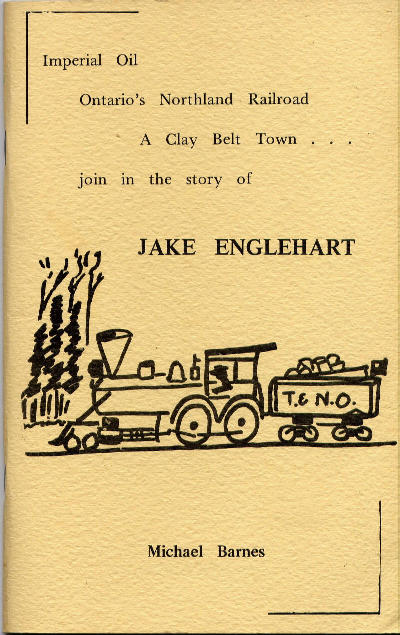
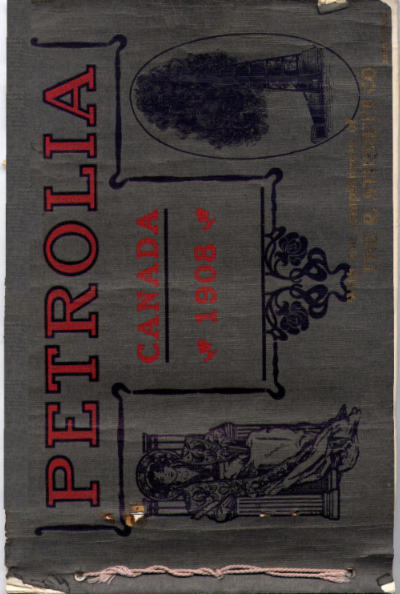
This is a document that was written some time around ca.1908. It captures our history in a very interesting way.There have been many requests for the details of the Petrolia's history and I have chosen JH Fairbank's eyewitness account because it really sums it up very well. For more on Petrolia books go to the bottom of the page.and this link to the 1908 Petrolia book. 1908 Petrolia Book
by J. H. Fairbank
Sketch of Petrolia's Early Days
In the beginning the Township of Enniskillen contained eighty-six thousand eight hundred acres. By assessment Roll, of 1847, it had three hundred and ninety-six and a half acres under cultivation by 37 settlers, who owned thirty-four cows and sixteen dogs.
Very near the centre of this once grand hunting ground, where, sheltered by the towering walnuts, oaks and elms, the wild deer roamed in freedom, and the wilder turkey reared its brood, Petrolia was born. A spring sowing oil was its father. It was named in 1861 by the first postmaster, Patrick Barclay, and three others.
At the time oil had caught the attention of George L. Thayer and other Boston gentlemen, who acquired lands, sand curbed wells (40 feet from the surface) to the rock where they found oil. They built a refinery. The oil found was heavy, an excellent lubricator but not adapted to make lamp oil.
Among those early in the fight were, S. J. Lancaster, Joseph Barrett, John Wattie, Oliver Chamberlin, Hugh Smiley, and Henry Canneff. A mile up stream, Bear Creek, ran a mill, where John Woodley ground food for the hungry.
During the years 1862-63-64, the infant Petrolia slept, while Oil Springs budded, blossomed, bloomed and faded. Its "rock poured forth rivers of oil," and the oil rand down the "river."
In those days there was no railway, no highway, no pipe line. From Wyoming, by Petrolia, to Oil Springs was only one mud hole. It was twelve miles long, and of uncertain depth.
Oil men met -- met frequently -- and passed resolutions. Andrew Elliot built a plank road.
The last half of the year 1865 arrived. Lee and Johnson had surrendered. The
American civil war was ended. Crude oil had touched $10.00, gold. The thing was inviting. Americans, ballasted with greenbacks, invaded Petrolia. Hotels were quickly built, and quickly filled: William Boyce, at the Great Western; Lombard & Simpson, at the United States; Fletcher & Boswell, at the American; also the Saginaw and New York, all in action. The "Boom" was on.
Amongst the arrivals were Col. Thompson, Dow Elwood, Col. Shoemaker, Frank SMith, Col. Parsons, Dr. Underwood, Horace Blackmore, Major VanTuyl, H.W. Lancey, Judge Avery.
There also came John D. Noble, John McMillan, J.H. Fairbank, Edwin D. Kerby, John Brake, and many others.
Amongst the early builders were Walter Oliver, Robert Paul, John Sinclair, Malcolm Scott. A little later came John Crosbie (the hunter), J. & J. Kerr, Robert Jackson, and others.
Of the early storekeepers were Thompson, McQuien, Bennett, McGarvey, McKenzie & Cary, Chris. McKenzie, and Father Bishop, a little later.
In those days the anvil of Goerge Sanson, "Petrolia's Blacksmith," rand to the forging of drilling tools that, with Petrolia men who learned to use them, have carried the name of Petrolia to the ends of the earth. Tronson Draper's, and Hector McKenzie's machine shops finished up these tools, Later the mantle of these modern Tubal Cain's fell upon James Joyce, the sons of Hector McKenzie, McKee & Marwick, Mike Gorman, and others.
Peter Taylor was captain of transportation. With is 56 horses he moved anything that had two ends to it.
In those days Petrolia "took its medicine" from Dr. Buckham, supplied by Druggist W. H. Dale.
In the spring of 1866 there were four frame dwellings west of the bridge, Wheelwright, Col Thompson, Bennett, Fairbank.
June first, 1866, the fool Fenian raid occurred. It was a cooling bath to Petrolia. Late in the year the "King" well was struck, and Petrolia had "oil to burn," and a year later burned it. On the 17th of December, 1866, the Great Western Railway branch, Wyoming to Petrolia, was opened. Eleven years later came the Canadian Southern Railway.
In September, 1866, came the first newspaper, "The Valuator and Petrolia Reporter," T. Galbraith, editor., It demised young. "The Weekly News-Letter and Petrolia Advertiser," came 30th of September, 1870, J. B. Dale, proprietor and editor. July 5th, 1872, R. Herring became proprietor and editor of "Petrolia Advertiser and Sentinel." March 20th, 1879, came the "Petrolia Topic," Lowery Bros., proprietors and editors.
In 1867 came the first election for Legislative Assembly. T. B. Pardee and Robert Rae, candidates for Lambton. There was something to an election in those days -- one polling place in all Enniskillen -- two days polling. Booths convenient to poll -- "lashins" of refreshments perfectly free to all. Here the "Free and Independent" openly recorded their choice.
John McDonald built stills for John McMillan. A year or so later William Stevenson and Arthur Kavanaugh built Parson & Co.'s 2,000-bbl. still.
By 1868, oil refineries were numerous here and elsewhere. At times they worked together, at times they did not. There was a surplus of crude. To aid export, A crude Oil Association was formed, Dow Elwood, president; J. H. Fairbank, manager; John Brake, Alex. Craise, directors. Heavy sales for export only, at 60 cents, moved the surplus.
Among the many, who in these days pitched their tents in Petrolia, were, James Lawson, Joseph McDougall, R. A. Townsend, Samuel and William Stokes, Melville Parker, Henry Fish, Henry Rosenburg, J. C. Hyde, Robert Egan, Joseph Ward, D. M. Kennedy, William Lindsay, James Perkins (and here the Perkins boys grew), Hiram Cooley, W. H. Hammond, Patrick Gleeson, J. J. Woodward, Harry Kittridge, James Peat, A. T. Gurd, John Walker, James McCort, W. G. Fraser, John Fraser, J. W. Ford, "Mon" Crysler (another hunter), John Tracey, King Houston, Ai Moss, Adam Isbister, W. E. Reynolds, Lewis Lambert, Charles H. Errington, C. A. Farr, John Carmichael, Wallace Bell, H. H. Gore, George Denham, John Watson, Henry Prince, James Joyce, James Harley, E. A. Archer, George Moncrieff, W. K. Gibson, O. Simmons, Fred Reid, George Primmer, Charles Ribighini, John Shields, Duncan Sinclair, Neil Sinclair, J. S. Lougheed, Thomas Cochrane, R. S. Dunlop, John Rispin, Thomas Rutter, Donald Cameron, Marshall, and Goodrich, and many others. If not here just then, they were coming. The churches kept step with the procession. Three of them build on England Avenue, East End:
Methodist -- Rev. G. W. Frazee, first minister.
Presbyterian -- Rev. J. W. Chestnut, first minister.
Catholic -- Rev. Henry Japes, first priest.
In the "trek" westward the Methodists and Presbyterians camped for a time on the Flats. Here, too, the Baptists (Rev. T.S. Johnston, first minister), first built. Rev. John McRobie came in 1874 -- Here is here yet.
The Church of England first held service in Fletcher & Boswell's barroom. Congregation seated with back to the curtained bar, listened to Rev. Wm. Brookman, the sailor preacher.
In the spring of 1869 came Charles Jenkins. Some years later, he with John D. Noble, R. D. Noble and others organized, built and operated the P. C. O & T. Co., with its tanks, pipe lines and warehouse receipts.
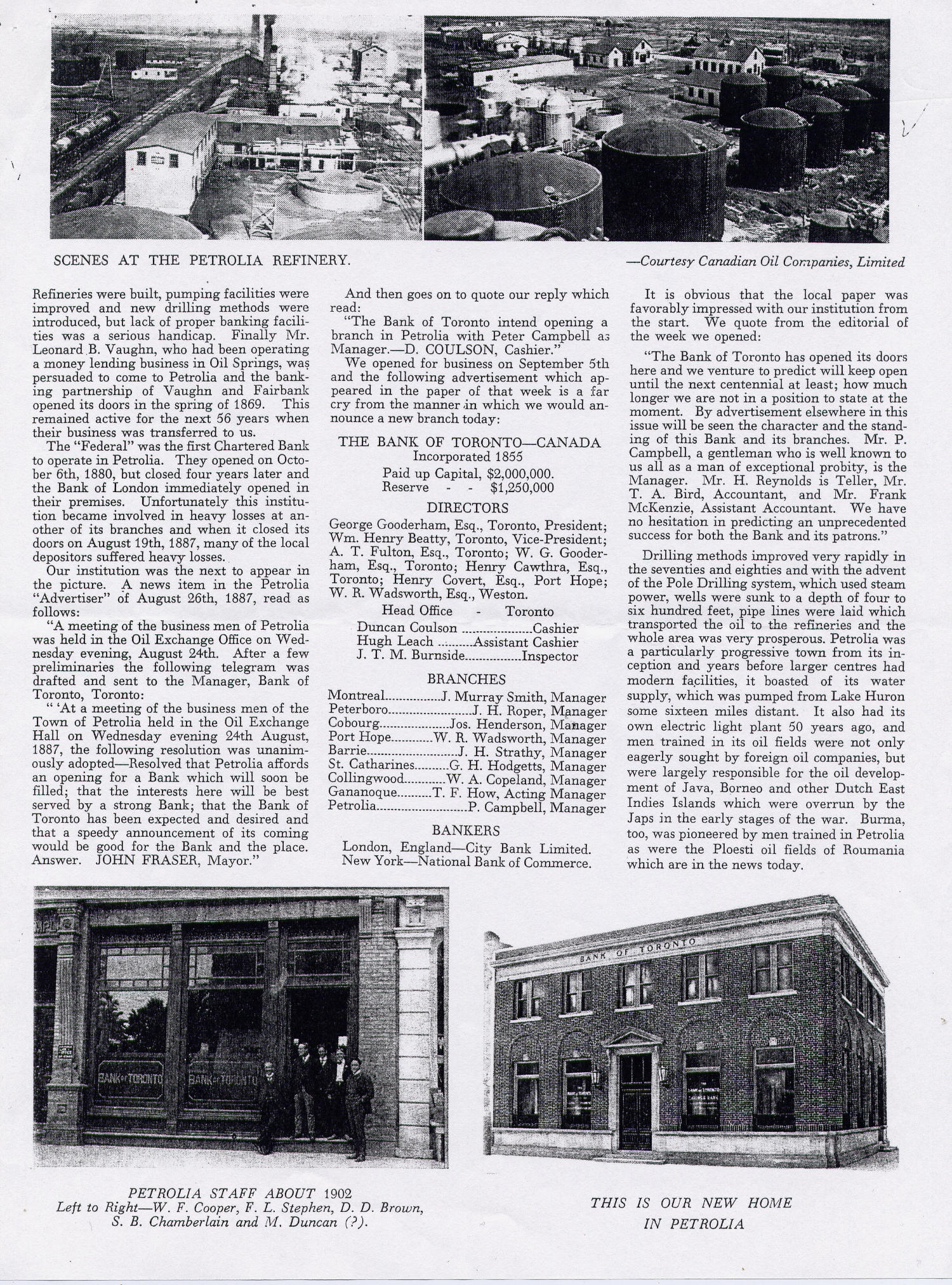
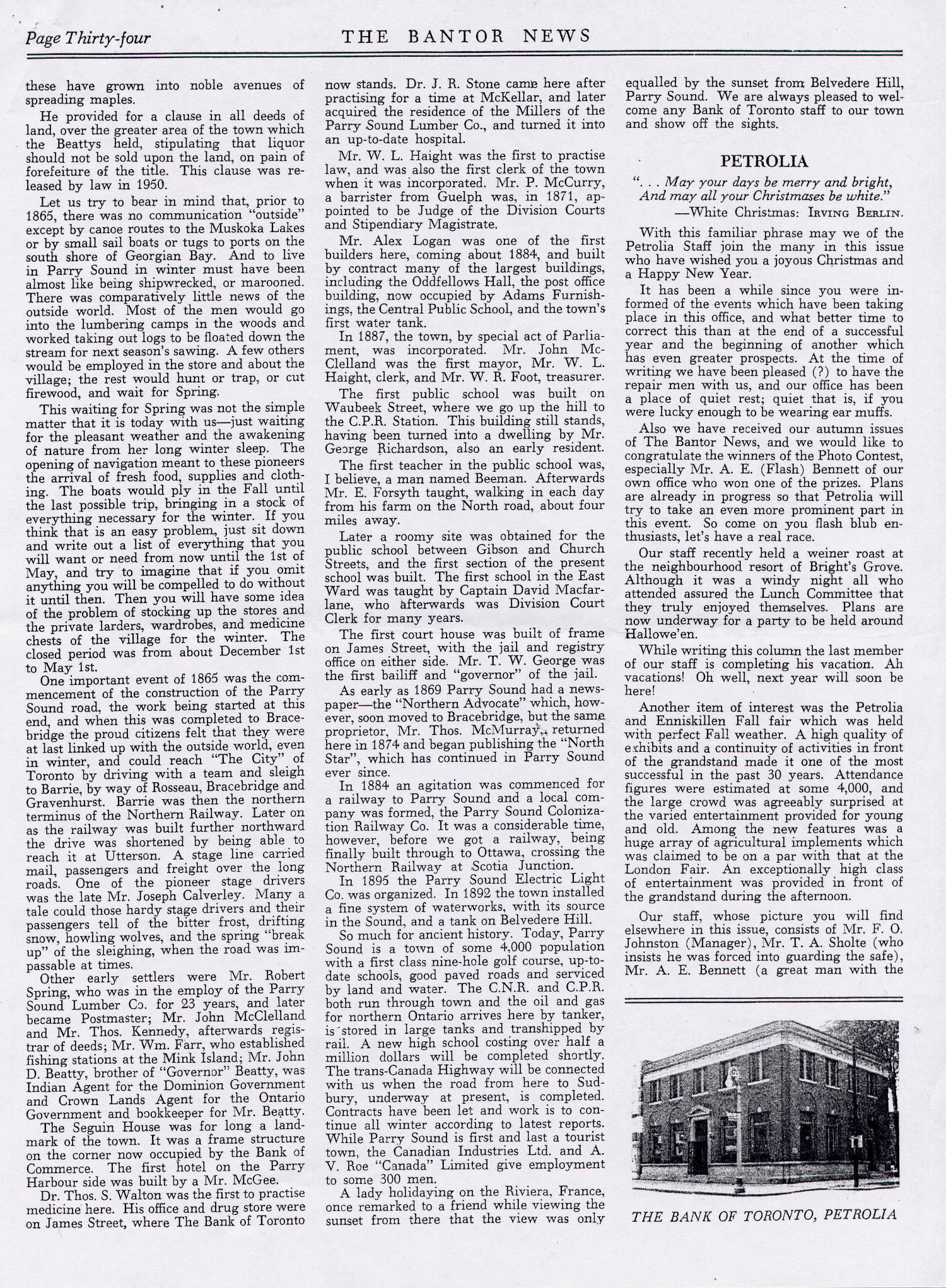
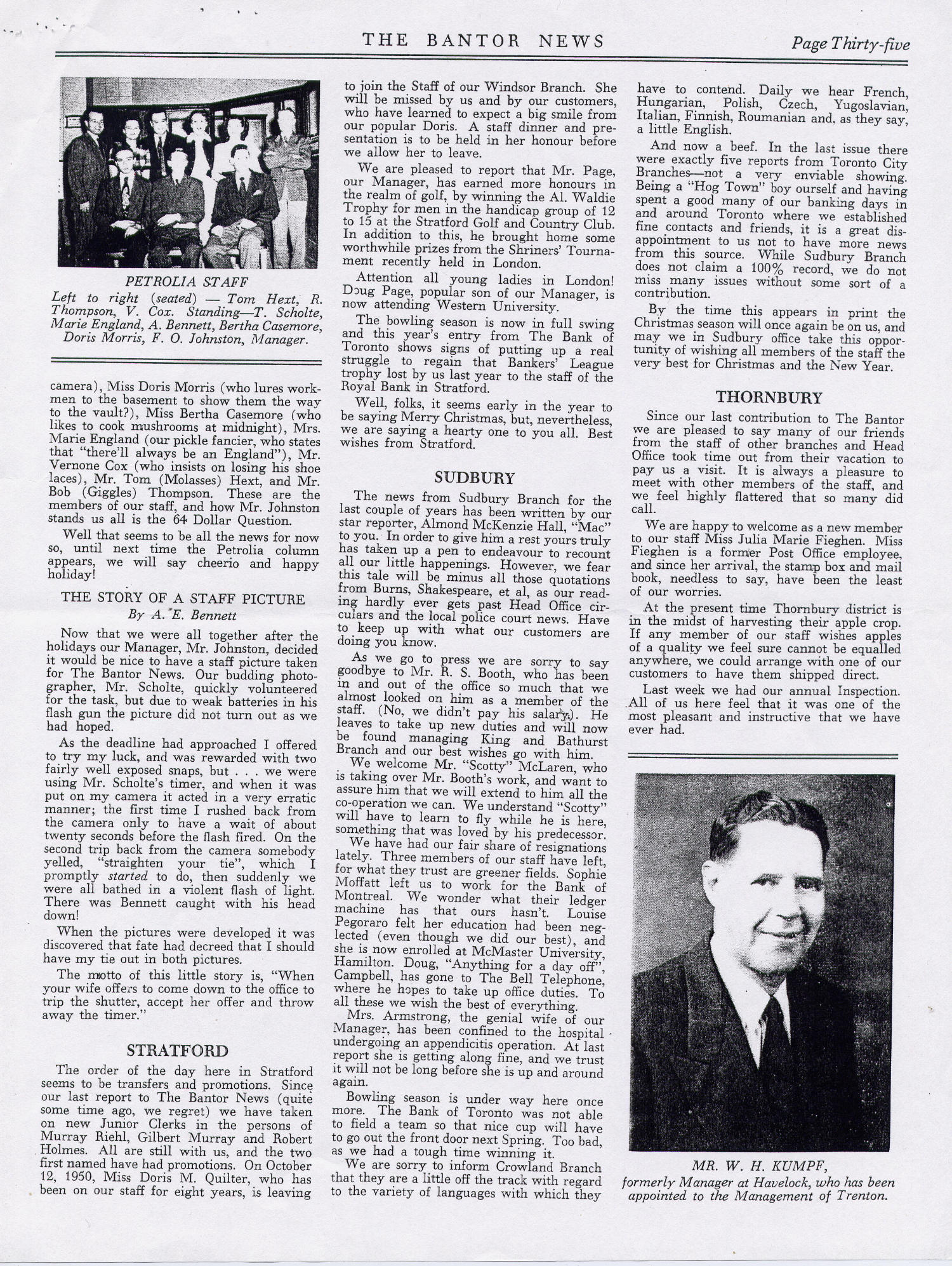
Also later in the year 1869 came L. B. Vaughn and opened a banking office -- it is open yet. Shot bags of silver was the currency in these days. Some years later came A. C. Edward; George Denham came, when he got ready, and sold drugs; also as newspaper correspondent gave spicy items from "Quality Hill." George also built a brass band. Hardly on schedule time arrived J. L. Englehart and Harrison Corey, but after they came they "stuck to their job."
On the 30th of November, 1871, the bagpipes announced the birth of Petrolia's St. Andrew. As a child it was healthy, as a youth it was strong, in its manhood irresistible.
The last Crude Oil Association, "The Financial," was formed in 1886. Its prime object was to improve quality of Canadian burning oil. It did it. Fairbank, Smith, McMillan (James), Woodward & Bradley, directors. Woodward, Kittridge, Kerr (James), and The Imperial Oil Company did good work in this regard.
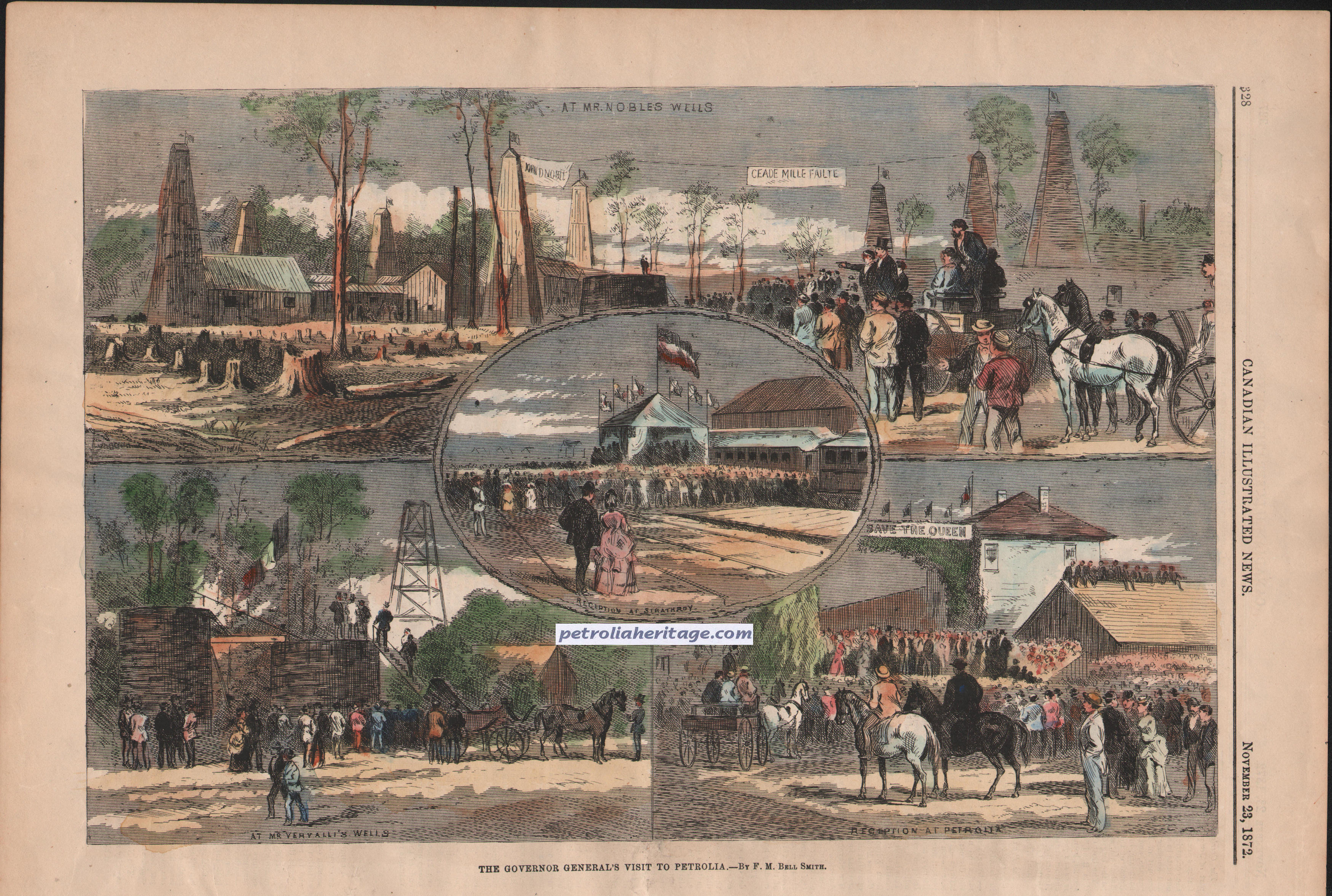
Among the prominent public men, who have visited Petrolia, are -- Prince Arthur. Governors General, Earl Dufferin and Lord Stanley. Dominion Premiers, Hon. Sir John A. Macdonald, Hon. Alexander MacKenzie, Hon. Sir John Thompson, Hon. Sir Mackenzie Bowell, Hon. Sir Charles Tupper, and Hon. Sir Wilfrid Laurier. HonSir Henri and Lady Joly also spent several days here, guests of John and Mrs. Fraser.
On the 8th of December, 1896, came Finance Minster Feilding, and Minister of Customs Paterson, two members of the Tariff Commission. They fully inspected the oil wells, how they were built and worked. When they left they understood the oil question as they could not have done without a personal inspection. This was good day's work for Petrolia. Not a word was said concerning tariff. That was done later on at Ottawa.
The early Municipal record of Petrolia, is --
Incorporated as a Village, December 21st, 1866.
1867, first Reeve and Council -- Moncreiff, Hunt, Barclay, Chamberlain; J. G. Bold, clerk and H. Smiley, treasurer.
1868-69-70, Reeve and Council -- Fairbank, Barclay, Taylor and Woodley.
1869, first Hook and Ladder Co. -- Chamberlin, chief; Smiley, captain.
First Police -- James Ryan.
1871-72--Joseph McDougall, reeve; P. Barclay, treasurer; Dr. Mearns, physician; William Lindsay, tax collector.
Incorporated as a Town, January 1st, 1874.
First Mayor -- George Moncrieff. Council -- Perkins, Dunlop, Cooley, Garner, Coryell, Chamberlin, Draper, Brake, McDonald, Mearns, Noble.
1874 to 1887 -- J. H. Fairbank, fire warden;; W. G. Fraser, assisting during the last years, and succeeded him. T. G. Jackson, chief engineer steam fire engine.
1875 -- W. H. McGarvey, mayor. T. G. Jackson, chief of police.
1879 -- G. S. McPherson, for years reeve of Enniskillen, appointed town clerk.
The Fire Brigade has always been a marked feature of Petrolia -- it has had much experience.
Greenwood Driving Park, Petrolia's play ground, was opened in 1882.
Lest we forget--a few dates: Great fire at King Wells, 3rd August, 1867; burning 2,000-bbl. still, 30th July, 1872. (The writer is indebted to Mrs. J. D. Noble for these two dates.)
The first really permanent business building was The Vaughn Block, 1879. Lancey Block was built in 1881; Town Hall was built in 1887; Masonic Temple was built in 1887; Iroquois Hotel was built by John Kerr in 1896; big fire at Imperial, 22nd of April, 1896; Petrolia Waterworks was built in 1896; Methodist Church was built in 1898.
Petrolia has always been and orderly, law-abiding, Sunday-observing, church-going place. It has representatives in every land who look back with pride and pleasure to the "Old Town."
At home and abroad, its men have been manly men, its women, womenly women, and it babies, perfectly lovely and numerous -- at times, two on a stem. The baby carriage always has the right-of-way in Petrolia.
The "Old Town" looks with glad expectation to August, 1908, to the coming of the Old Boys and Girls.
editor's note : special thanx to Carol Graham for typing this for me
-----------------------------------------------------------------------------------------------------------------------------------------------------------
Here is an item that the good John Rochon of Sarnia brought over for me to copy. It is a page from the ca.1872 Canadian Illustrated News. It is entitled "The Governor General's Visit To Petrolia"
Thanks to John this amazing item is here for your enjoyment.
-------------------------------------------------------------------------------------------------------------------------------------------------------------------------------------------------

Email Martin of Petrolia Ontario Canada at martyd@ebtech.net